

Guides
How United States Businesses Can Ensure Compliance with Contractor Data Security and SOC 2 Requirements
Ensuring contractor data security and SOC 2 compliance in the United States means applying strong controls and policies to protect sensitive.
By The surhires.com team · · 7 min read
Ensuring contractor data security and SOC 2 compliance in the United States means applying strong controls and policies to protect sensitive information handled by contractors. US businesses must verify that contractors meet SOC 2 criteria for security, availability, processing integrity, confidentiality, and privacy to satisfy customer and regulatory expectations.
Key takeaways
- SOC 2 compliance centers on five trust service criteria crucial for contractor data security.
- Managing ai contractor data requires specialized controls to prevent misuse or leaks.
- Businesses should verify contractor SOC 2 compliance through audits and contractual terms.
- Continuous monitoring and documentation maintain up-to-date contractor compliance.
- Platforms like surhires.com help US businesses efficiently manage contractor security.
- Contractor security lapses risk fines, breaches, and damage to brand reputation.
What is SOC 2 Compliance and Why Does it Matter for Contractors?
SOC 2 is a US auditing framework by the AICPA focused on how organizations secure customer data across five trust service principles. It matters for contractors because they often access sensitive information, and verifying their security practices mitigates risks like data breaches and regulatory penalties.
SOC 2 compliance ensures contractors implement controls to protect your business data. For example, a Chicago fintech company relies on Houston-based developers who must follow SOC 2 standards to avoid exposing customer financial data. Without such compliance, US businesses face potential fines under laws like HIPAA, lose customer trust, and suffer reputational harm.
How Does SOC 2 Apply to Contractor Data Security in the United States?
SOC 2 standards apply not only internally but also to contractors handling your data. US regulations hold businesses responsible for safeguarding customer information, even when processed by third parties. Ensuring contractors meet SOC 2 controls prevents unauthorized access, data loss, or downtime.
For instance, if a Detroit ERP consultant mishandles employee or supplier data, the manufacturer may face state breach notification penalties. US businesses embed SOC 2 clauses into contracts, review audit reports, and monitor contractor security to maintain compliance. This creates a vendor risk management program aligning with SOC 2 trust principles and protecting sensitive ai contractor data.
What are the Five Trust Service Criteria of SOC 2 and How Should Contractors Address Them?
SOC 2 compliance rests on these five criteria contractors must address to keep data secure and reliable:
1. Security
Contractors protect systems and data from unauthorized access using firewalls, MFA, and constant monitoring. A Houston cloud support vendor uses network segmentation and regular vulnerability scans to maintain secure access.
2. Availability
Contractors ensure their services remain accessible via backups and disaster recovery. Detroit ERP consultants run redundant servers and perform quarterly recovery drills to reduce downtime risks.
3. Processing Integrity
Contractors guarantee data is processed accurately and timely without unauthorized changes. Automated scripts used in financial systems require testing and audit trails to avoid errors.
4. Confidentiality
Contractors safeguard business secrets by encrypting data and signing confidentiality agreements. Chicago marketing firms lock down data transmissions and monitor who accesses client files.
5. Privacy
Contractors protect personal information under US laws like HIPAA with limited access and breach notifications. Healthcare contractors restrict sensitive data usage on a strict need-to-know basis.
Contractors provide SOC 2 Type 1 or 2 reports to prove controls exist and work effectively across these principles.
How Can US Businesses Evaluate Contractor Data Security SOC 2 Compliance?
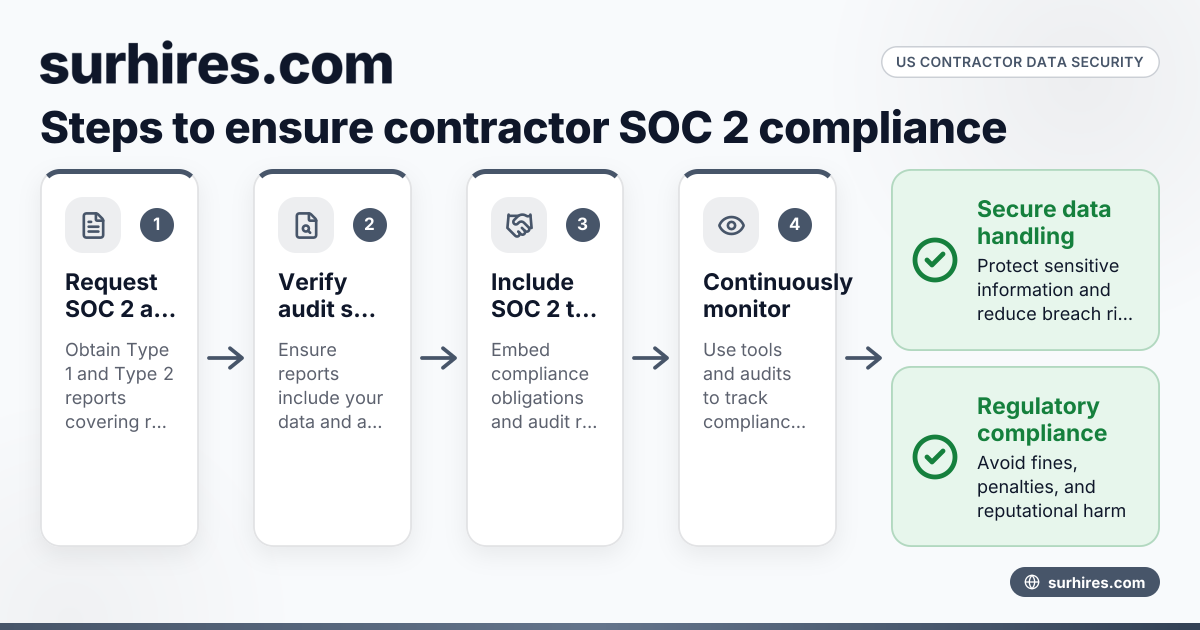
Evaluating contractor SOC 2 compliance involves these steps:
- Request recent SOC 2 audit reports—Type 1 for control design, Type 2 for operating effectiveness.
- Verify report scope covers systems related to your data.
- Analyze any exceptions and remediation actions.
- Assess risks based on contractors’ data access—payment processors in QuickBooks/Stripe require stricter review.
- Include SOC 2 obligations in contracts with audit rights.
- Monitor contractor security continuously using tools and periodic audits.
This ensures contractors handling ai contractor data comply with your data security standards and US regulations.
How Can AI Contractor Data Usage Impact SOC 2 Compliance Requirements?
AI use by contractors introduces new risks to data security and SOC 2 compliance. AI systems process large volumes of sensitive data, risking leaks or unauthorized access if not properly controlled.
AI can obscure data flows, complicating processing integrity and privacy compliance. US businesses must enforce role-based access, multi-factor authentication, and audit AI training data to prevent exposing ai contractor data.
For example, a Chicago chatbot contractor employing AI must document how algorithms handle personal information and prevent unauthorized access to meet SOC 2 privacy and integrity criteria.
Proper AI data management helps maintain trust and regulatory compliance when using AI-driven contractor services.
How Can US Businesses Implement a Contractor Data Security Program Aligned with SOC 2?
Follow these steps tailored for US businesses:
- Create clear policies specifying contractor data handling, access limits, and incident reporting.
- Provide SOC 2 and US privacy law training during contractor onboarding.
- Use IAM, encryption, and network segmentation to secure systems contractors access.
- Set incident reporting protocols compliant with state notification rules.
- Regularly audit contractor SOC 2 compliance with reports and onsite checks.
- Document all controls, training, incidents, and audits for accountability.
For Detroit manufacturers using ERP integrated with Stripe, limiting contractor accounts and encrypting data transfers exemplifies strong compliance measures.
How Can Surhires.com Assist in Managing Contractor SOC 2 Compliance?
Surhires.com helps US businesses streamline complex contractor compliance processes. It offers:
- Automated onboarding workflows with embedded security acknowledgments.
- Contract management featuring SOC 2 compliance clauses.
- Training modules tracking contractor completion of privacy and security courses.
- Centralized document storage for SOC 2 audit reports and incident logs.
- Dashboards monitoring contractor compliance and highlighting gaps.
These tools reduce manual work and provide clear visibility into contractor security postures. Learn more about enhancing compliance in How United States Businesses Can Use surhires.com to Manage Contractor Worker Classification Risks.
Keeping contractor data security aligned with SOC 2 in the US protects your business from risks of data breaches and penalties. By enforcing robust policies, vetting contractors, monitoring compliance, and using platforms like surhires.com, you can confidently manage contractor-related data risks.
Frequently asked questions
What is SOC 2 Type 1 vs. Type 2 compliance?
Type 1 reports assess if controls are well designed at a specific date. Type 2 reports show how effectively those controls operated over time (usually 6-12 months), offering stronger assurance of consistent security performance.
Do all contractors need SOC 2 certification?
SOC 2 is essential for contractors handling sensitive data or key systems (payment processing, health info). Other contractors without data access may not require SOC 2 but should meet baseline security standards.
How often should contractors provide updated SOC 2 reports?
Most US businesses request SOC 2 reports annually. High-risk contractors may need more frequent updates, including penetration testing and self-assessments to confirm ongoing compliance.
What risks arise if contractors lack SOC 2 compliance?
Without SOC 2 controls, contractors increase exposure to data breaches, regulatory fines, and service interruptions. Such failures can heavily damage reputation and customer trust, especially in finance and healthcare sectors.
Can AI-related contractor data handling create new compliance challenges?
Yes. AI processing of sensitive data risks leaking confidential info or automated errors. Specific security controls and comprehensive documentation of AI data flows are vital for SOC 2 compliance involving AI contractor data.
How can I start improving contractor data security today?
Begin by reviewing contractor contracts for SOC 2 clauses and obtaining recent SOC reports. Set clear security expectations upfront and consider platforms like surhires.com to centralize compliance tracking, documentation, and monitoring efforts.
For US businesses depending on contractors, SOC 2 compliance is a cornerstone of securing sensitive data and regulatory trust. Practical policies, thorough reviews, and modern tools make managing these challenges feasible. Discover more guidance in the surhires.com blog.
Published 24 October 2026
See Surhires on a live requisitionMore from the blog
How to Manage State-Specific Sales Tax Obligations When Paying Independent Contractors in the United States
Managing state sales tax obligations for independent contractors in the United States requires understanding varied state rules, identifying taxable.
27 October 2026 · 6 min read
How United States Businesses Can Use surhires.com to Automate Contractor Time Tracking and Payroll Integration
Automating contractor time tracking and payroll integration helps U.S. businesses capture accurate work hours and simplify payments. surhires.com uses
26 October 2026 · 5 min read
How United States Businesses Can Simplify Contractor I-9 Employment Eligibility Verification with surhires.com
Contractor I-9 verification in the United States requires businesses to confirm contractors’ legal work authorization using Form I-9. surhires.com.
26 October 2026 · 6 min read