




Comparisons
PEO vs Employer of Record in the United States: Which Should Small Businesses Choose?
A PEO and an Employer of Record both help small businesses handle HR and compliance, but they solve different problems in the United States. A PEO.
By The surhires.com team · · 12 min read
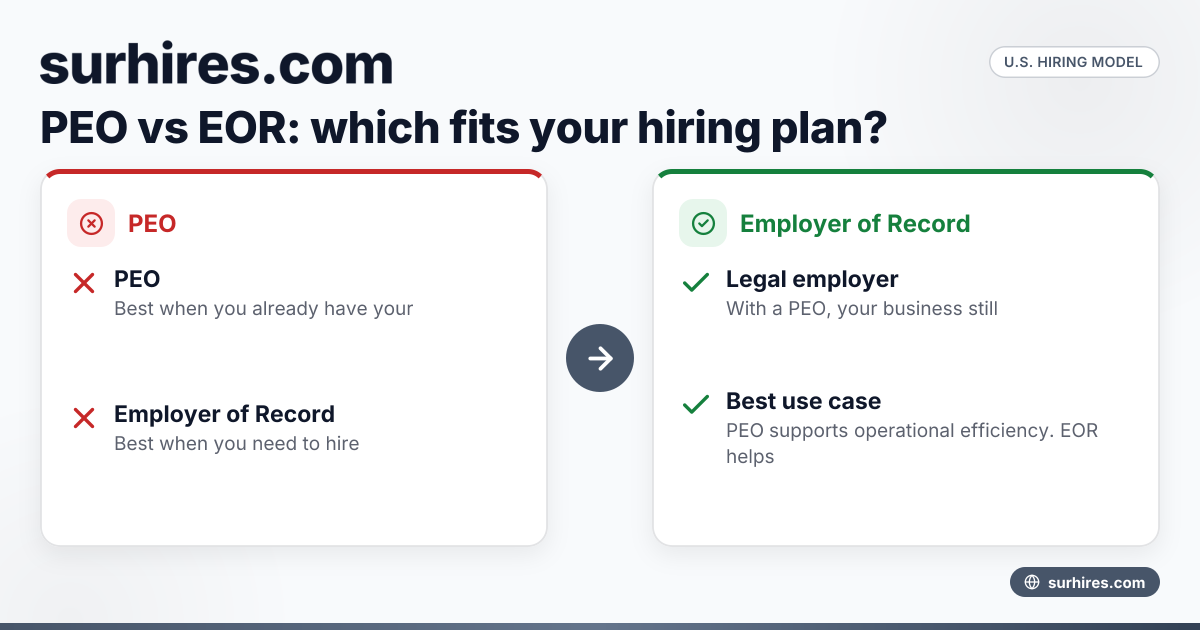
A PEO and an Employer of Record both help small businesses handle HR and compliance, but they solve different problems in the United States. A PEO supports your existing U.S. employees through a co-employment model, while an Employer of Record becomes the legal employer on paper so you can hire workers without setting up your own payroll entity in that state.
Key takeaways
- A PEO works best when your business already has a U.S. entity and wants help with payroll, benefits, and HR administration.
- An Employer of Record works best when you need to hire employees in a U.S. state where you are not set up to run payroll.
- The biggest difference is legal employment. With an EOR, the provider is the employer of record. With a PEO, your business still employs the worker.
- Small businesses often choose an EOR for speed and state-by-state expansion, and a PEO for operational support after they have infrastructure in place.
- Worker classification, payroll tax registration, onboarding, and state compliance should all factor into the decision.
- If you also use contractors, review Independent Contractor Compliance Guide in the United States alongside your hiring plan.
What is the difference between a PEO and an Employer of Record in the United States?
A PEO shares HR responsibilities with your company through co-employment. An Employer of Record legally employs the worker for payroll, tax, and compliance purposes. In the United States, that distinction matters because state payroll registration, unemployment insurance, benefits setup, and onboarding obligations can differ based on who the legal employer is.
A Professional Employer Organization, or PEO, usually helps with payroll processing, benefits administration, HR support, onboarding workflows, and some compliance tasks. Your business still directs the employee’s day-to-day work. Your business also remains the actual employer for many practical purposes.
An Employer of Record, or EOR, takes on the formal employer role for the worker. The employee performs work for your business, but the EOR handles payroll, tax withholding, employment paperwork, and certain compliance obligations tied to employment.
For a small business, this changes the implementation path.
If you are a Chicago software company hiring your first sales employee in Texas, a PEO may not be enough if you are not registered to employ workers there. An EOR can often bridge that gap because the EOR is the legal employer.
If you already have a legal entity, state registrations, payroll accounts, and benefits strategy in place, a PEO may be the more natural fit. It helps you run the employee relationship more efficiently without replacing your status as employer.
When should a small business choose an EOR?
Choose an EOR when you need to hire fast in a U.S. state where you do not have payroll and HR infrastructure. It is often the better option for first hires, multi-state expansion, and reducing setup work. It can also lower compliance friction when your team is spread across several states.
Small businesses often reach for an EOR in three situations.
1. You are entering a new state
State employment setup is not just a payroll switch. You may need state payroll tax registration, unemployment insurance accounts, workers’ compensation coverage, and state-specific onboarding forms. If you want to hire in Houston next month but your company only operates in Illinois today, an EOR may be the fastest route.
2. You need a compliant employee setup quickly
Many founders do not want to wait through every internal step needed to build a new-state employment stack. An EOR can simplify onboarding, employment documents, and payroll administration so your team can focus on operating the business.
3. You want one model for distributed hiring
If your company has employees in Michigan, Illinois, and Texas, managing every state rule internally can become burdensome. An EOR can centralize the employer-side administration while you manage the employee’s work and performance.
If your question is really about staffing models, not just payroll setup, this comparison can also help: Employer of Record vs Staffing Agency in the United States: What’s the Difference?.
When should a small business choose a PEO?
Choose a PEO when you already employ people through your own business and want better HR support, payroll administration, and access to benefits infrastructure. A PEO is usually a better fit when your legal setup is already established and you want operational efficiency, not a substitute employer.
A PEO can make sense for small businesses with growing internal complexity.
You already have your own entity and payroll accounts
If you already employ staff in Detroit and Chicago under your own company, a PEO can support payroll, benefits, handbooks, onboarding, and HR processes. That can be useful when your internal admin team is small.
You want stronger HR systems
A PEO may help standardize HR workflows such as employee onboarding, benefits enrollment, time-off tracking, payroll cycles, and policy administration. That matters when your company is moving from founder-led operations to a more structured team model.
You plan to keep employment in-house
Some businesses prefer to remain the direct employer because they want complete control over payroll setup, benefit choices, and long-term HR architecture. In that case, a PEO may be more aligned with your operating model.
How do legal responsibility and compliance differ?
With a PEO, your company remains the employer and carries more direct responsibility for employment setup. With an EOR, the provider is the legal employer for payroll and many compliance tasks. The practical impact is largest when hiring across state lines or entering a new state for the first time.
That short answer drives most of the buying decision.
With a PEO
A PEO relationship is usually based on co-employment. The PEO may process payroll, support benefits, and help with HR administration. But your business still employs the worker. That means you typically need your own business presence and employment infrastructure in the relevant state.
You still need to think carefully about:
- state registrations
- employee classification
- wage and hour rules
- onboarding forms
- leave rules
- workers’ compensation
- termination practices
- recordkeeping
A PEO can support these processes. It does not usually erase the need for your own legal readiness.
With an EOR
An EOR becomes the legal employer of the worker. That means the EOR handles payroll under its employment structure and takes on employer-facing paperwork and administration. Your company still manages the role, performance expectations, schedules, and work output.
This structure is often useful when a small business wants to avoid building state-by-state employment operations too early.
If you are comparing adjacent models, Contractor of Record vs Employer of Record in the United States: Which One Does Your Business Need? can help clarify where contractor engagement fits.
What does a PEO or EOR actually handle day to day?
Both can help with payroll, onboarding, and HR paperwork. The difference is not the task list alone. The difference is who employs the worker and whose legal structure supports the employment relationship. That determines whether the service is administrative support or a true employment solution.
In day-to-day terms, there is often overlap.
Tasks a PEO may support
A PEO may help with:
- payroll processing
- benefits administration
- onboarding workflows
- HR guidance
- handbook support
- employee records
- leave administration
- workers’ compensation coordination
But the employee is still your employee.
Tasks an EOR may support
An EOR may handle:
- employment agreements
- payroll and tax withholding
- onboarding documentation
- employee classification support
- benefits administration
- state-specific employment compliance
- offboarding paperwork
But the worker performs services for your company.
For many buyers, the practical question is not “which has more features?” It is “which model fits our hiring plan?” That is why searches like ai peo vs often miss the real issue. The answer depends less on software language and more on who needs to be the legal employer in the United States.
PEO vs employer of record United States: which is better for multi-state hiring?
An EOR is often better for early multi-state hiring because it can reduce the setup burden in each new state. A PEO is often better after your company is already registered and operating as an employer where you hire. The right choice depends on whether you need market entry or HR support.
Small businesses often underestimate how quickly multi-state hiring becomes an operations issue.
One employee in another state may require:
- State payroll tax registration
- State unemployment setup
- Workers’ compensation coverage
- State labor notices
- Payroll withholding setup
- New-hire reporting
- State-specific onboarding documents
If your company is not ready for that, an EOR can be the more practical path.
If your company is already established in those states, a PEO may give you better support without changing the employer relationship.
How should small businesses compare costs?
Do not compare only monthly fees. Compare total operating cost, internal admin time, state setup work, legal risk, payroll complexity, and the cost of delay. A lower apparent fee can become more expensive if your team still needs to handle registrations, compliance gaps, or manual onboarding.
Cost conversations should stay grounded in business context.
Cost factors that matter with a PEO
A PEO may be cost-effective when you already have:
- a U.S. entity set up for employment
- payroll registrations in the right states
- internal ownership for HR and people operations
- enough employees to benefit from process standardization
In that case, the PEO can reduce admin load without changing your legal employment model.
Cost factors that matter with an EOR
An EOR may be cost-effective when you want to avoid:
- opening employment infrastructure in a new state too soon
- delays in making a critical hire
- fragmented payroll across states
- internal time spent on new compliance workflows
For a small business, time matters. If a delayed sales hire in Houston costs you pipeline, the cheapest administrative model may not be the cheapest business decision.
Ask these cost questions during evaluation
- Do we already have the ability to employ workers legally in this state?
- Who will manage payroll issues and onboarding internally?
- How many states do we expect to hire in over the next 12 months?
- Do we want to remain the direct employer right now?
- What is the cost of waiting to hire?
What should small businesses ask before choosing?
Start with your hiring plan, not product labels. Clarify where you are hiring, who will be an employee versus a contractor, whether you have state payroll infrastructure, and how much HR administration your team can absorb. The best model is the one that fits your current operating reality.
Here is a simple buying framework.
1. Map your next 12 months of hiring
List each planned hire by state, role type, and start date. Separate employees from contractors. If you are hiring contractors too, collect tax information correctly. This guide on How to Collect Form W-9 From Contractors in the United States is a useful companion.
2. Confirm where you can already employ workers
Ask your finance or legal team whether you are already set up to run payroll in each relevant state. If the answer is no, an EOR may be a cleaner solution for those hires.
3. Define how much control you want over the employer relationship
If you want to remain the direct employer everywhere, a PEO may align better. If you need flexible market entry and faster setup, an EOR may fit better.
4. Review compliance exposure
Missteps in employment setup can create avoidable issues. Review onboarding, payroll, classification, leave administration, and documentation. You can also use this Remote Hiring Compliance Checklist in the United States to structure your review.
5. Plan for the future state
Some businesses start with an EOR for speed, then later move to their own entity and use a PEO for scale. Others stay with one model longer because it matches their team size and expansion pace.
Common scenarios for small businesses
The best choice becomes clearer when you match the model to a real business situation.
Scenario 1: First out-of-state employee
A small SaaS company in Chicago wants to hire an account executive in Texas. It has no payroll registration there. An EOR is usually the simpler choice because the company can hire without building state employment infrastructure first.
Scenario 2: Existing in-state team, growing admin load
A manufacturer in Detroit already employs 20 people and uses QuickBooks for accounting and a standard payroll stack. The business wants stronger HR support and benefit administration. A PEO may be the better fit because the company already employs the team directly.
Scenario 3: Distributed remote growth
A services firm wants to hire in Illinois, Michigan, and Texas over six months. It has no internal HR department. An EOR may reduce complexity during early expansion.
Scenario 4: Mature small business tightening operations
A business with employees already on its own payroll wants better HR process, cleaner onboarding, and consolidated administration. A PEO may support that goal without changing who employs the workers.
Final decision: which should small businesses choose?
If your small business needs to hire employees in new U.S. states quickly and does not want to build payroll infrastructure first, choose an Employer of Record. If your business already employs workers through its own entity and wants HR, payroll, and benefits support, choose a PEO.
That is the clearest way to think about the PEO vs employer of record United States decision.
The right choice is less about buzzwords and more about readiness. Ask whether you need an administrative partner for employees you already employ, or a legal employment solution that lets you hire where you are not yet set up.
If you are exploring Employer of Record options, you can learn more through the surhires.com blog and review broader market context in Best Employer of Record Services in the United States for Small Businesses.
If you want a simpler way to understand hiring models and compliance choices in the United States, learn more about surhires.com.
Frequently asked questions
Is a PEO the same as an Employer of Record?
No. A PEO supports your business through a co-employment arrangement, while an EOR is the legal employer of the worker. That difference affects payroll setup, tax handling, and state hiring logistics.
Can a small business use a PEO to hire in a new state?
Sometimes, but not always in the way founders expect. If your company is not set up to employ workers in that state, a PEO may not solve the core issue. An EOR is often more practical for first hires in a new state.
Published 11 October 2026
See Surhires on a live requisitionMore from the blog
How to Manage State-Specific Sales Tax Obligations When Paying Independent Contractors in the United States
Managing state sales tax obligations for independent contractors in the United States requires understanding varied state rules, identifying taxable.
27 October 2026 · 6 min read
How United States Businesses Can Use surhires.com to Automate Contractor Time Tracking and Payroll Integration
Automating contractor time tracking and payroll integration helps U.S. businesses capture accurate work hours and simplify payments. surhires.com uses
26 October 2026 · 5 min read
How United States Businesses Can Simplify Contractor I-9 Employment Eligibility Verification with surhires.com
Contractor I-9 verification in the United States requires businesses to confirm contractors’ legal work authorization using Form I-9. surhires.com.
26 October 2026 · 6 min read