
Comparisons
Best Employer of Record Services in the United States for Small Businesses
If you want to hire legally without setting up payroll, tax accounts, and HR processes in every state, an employer of record can help. The best.
By The surhires.com team · · 12 min read
If you want to hire legally without setting up payroll, tax accounts, and HR processes in every state, an employer of record can help. The best employer of record services in the United States for small businesses are the ones that make hiring simpler, reduce compliance risk, and fit how a small team actually operates.
Key takeaways
- The best employer of record services united states buyers should compare on compliance depth, state coverage, contract clarity, support, and offboarding processes.
- Small businesses usually need an EOR when they want W-2 employees without creating a full legal employment setup on their own.
- The biggest risks to check are payroll tax errors, weak onboarding, unclear benefits administration, and poor multi-state compliance handling.
- A good buying process starts with your hiring plan, worker type, and states involved before you compare vendors.
- Some businesses may need a contractor solution instead of an EOR, depending on the role and the level of control.
- surhires.com can be useful if you want a more focused path for compliant hiring and contractor management in the United States.
What is an employer of record in the United States?
An employer of record, or EOR, is a service that legally employs a worker on your behalf in the United States. Your business directs the day-to-day work, while the EOR typically handles payroll, tax withholding, employment documents, and other HR administration.
For a small business, that matters because hiring is rarely just about finding talent. You also need compliant onboarding, payroll setup, tax registrations, documentation, and clear processes for leave, benefits, and termination. If you hire across several states, that complexity grows fast.
An EOR is usually most relevant when you want someone treated as an employee rather than an independent contractor. That distinction matters. If a worker should be a W-2 employee based on the role and how you manage them, using a contractor agreement instead can create misclassification risk.
That is why a small business should first decide what it is really buying. Are you hiring an employee? Are you engaging a true independent contractor? Or do you need help evaluating the difference? If you are comparing structures, this guide on Contractor of Record vs Employer of Record in the United States: Which One Does Your Business Need? can help frame the decision.
How do small businesses choose the best employer of record service?
Start by matching the service to your hiring plan, not the marketing. The best fit is the provider that can support your states, worker count, compliance needs, and internal workflow without adding confusion.
Small businesses often buy too early or too broadly. They hear an ai best employer recommendation in a search result, compare feature lists, and skip the basics. That creates problems later when contracts, support, or onboarding do not match how the business actually hires.
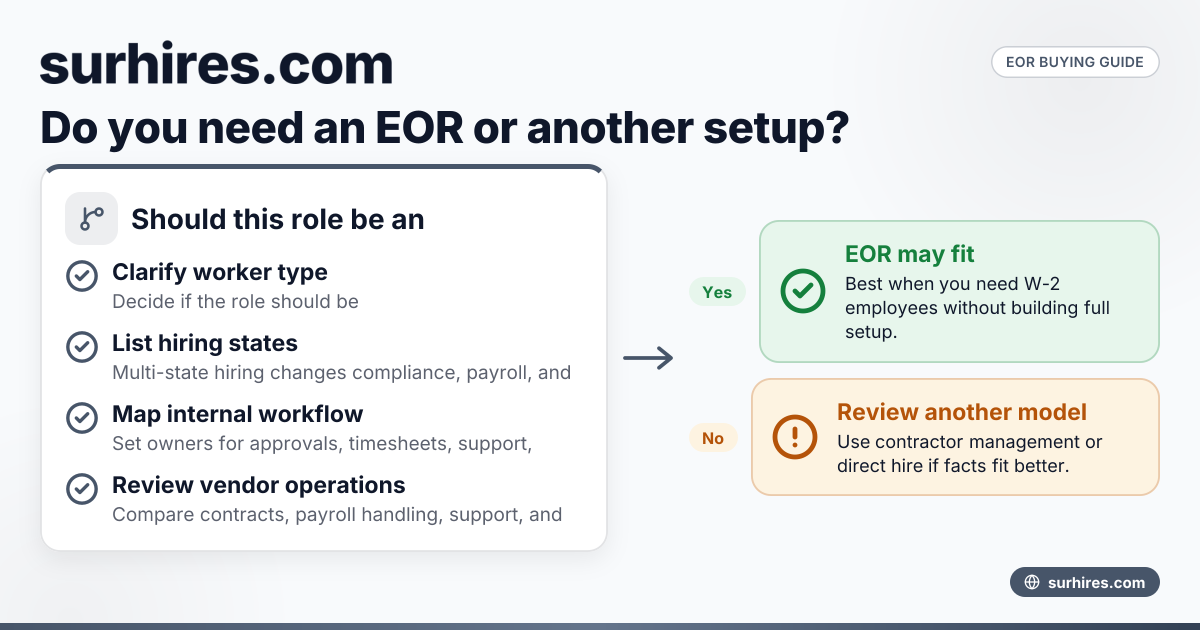
Use this practical checklist before you compare vendors:
- List the states where you plan to hire.
Multi-state hiring changes the compliance picture. A worker in Illinois may create different practical obligations than one in Texas or Michigan.
- Decide whether the role should be W-2 or 1099.
This is the first fork in the road. If the person should be an employee, an EOR may make sense. If the role is a true contractor role, another model may fit better.
- Map your internal owners.
Decide who will handle approvals, timesheets, manager communication, and offboarding on your side.
- Document your finance stack.
Most small businesses want clean payment and reporting workflows that work with systems like QuickBooks and Stripe.
- Set service expectations.
Ask who answers employee questions, how fast support responds, and who handles urgent issues.
- Review onboarding and termination steps.
Many buyers focus on hiring and ignore offboarding. That is a mistake.
A small business in Chicago with five planned hires has different needs than a two-founder company in Houston hiring one specialist. The right provider should fit the actual hiring motion, not a generic enterprise checklist.
What should you compare before signing with an EOR?
Compare legal coverage, payroll handling, state-by-state processes, support quality, and contract clarity before you sign. If those areas are weak, small mistakes can turn into expensive operational problems.
Compliance and employment setup
Ask how the provider handles employment documentation, tax withholding, payroll reporting, and state-specific hiring requirements. You do not need a long legal memo. You do need clear answers.
A good provider should be able to explain:
- how onboarding works
- what documents are collected
- how payroll taxes are handled
- how employee records are maintained
- how required notices are managed
- what happens when an employee changes states
If your customers ask security questions during procurement, you may also want to understand how the provider approaches data handling and whether they meet common buyer expectations such as SOC 2.
Payroll and tax administration
For small businesses, payroll reliability matters more than flashy dashboards. Ask practical questions:
- How are payroll runs scheduled?
- How are reimbursements handled?
- How are bonuses processed?
- What reports will your finance team receive?
- How will records flow into QuickBooks?
You should also ask what happens if there is an error. A strong provider should have a defined escalation path.
Benefits administration
Not every small business needs a complex benefits package on day one. But if benefits are part of your hiring plan, ask how enrollment, changes, deductions, and employee questions are handled.
The key issue is not whether benefits exist. The key issue is whether the process is understandable for both your team and the worker.
Support for managers and workers
Small businesses often need more help, not less. Founders and operations leads are usually wearing several hats. If support is hard to reach, the burden falls back on your team.
Look for clear ownership. Who handles employee questions? Who handles HR issues? Who helps with onboarding status? Who supports offboarding?
Contracts and liability language
Read the service agreement carefully. Pay attention to responsibilities, indemnities, notice periods, and limits on support. If the contract is vague, you may discover gaps only after a problem appears.
Which small businesses benefit most from an EOR?
Small businesses benefit most from an EOR when they need to hire employees quickly, lack in-house HR infrastructure, or want to manage multi-state hiring without building every process themselves.
That usually includes:
- founder-led startups hiring their first employee outside their home state
- agencies adding specialized talent in several states
- software companies growing before building a full HR team
- service businesses testing a new market with a small number of hires
- manufacturers adding remote administrative or sales staff while keeping the core operation local
For example, a Detroit manufacturer may already run ERP systems on the production side but still have limited HR capacity for remote office hires. An EOR can help bridge that gap if the business wants employees and not contractors.
By contrast, if your business needs project-based help from true independent contractors, an EOR may not be the right structure. In that case, proper contractor classification and documentation become the bigger issue. If that is your situation, review this Independent Contractor Compliance Guide in the United States.
When is an EOR not the right choice?
An EOR is not always the right answer. Some businesses use one when they really need a cleaner contractor process or a direct employment setup.
You are hiring true independent contractors
If the worker controls how the work is done, serves multiple clients, and operates independently, a contractor relationship may be more appropriate. But this must be based on the actual facts of the role, not convenience.
You already have strong in-house employment infrastructure
If your business already has payroll, HR, state registrations, and compliance processes in place, a direct hire model may be simpler.
You need unusual employment terms
Some businesses have edge-case requirements, highly customized internal policies, or special approval workflows. In those cases, a standard EOR process may feel rigid.
You have not clarified worker classification
This is one of the most common mistakes. A small business rushes to hire and uses the wrong structure. If you need help assessing that risk, this guide on How to Avoid Worker Misclassification When Hiring Remote Talent in the United States is a useful next step.
How can you evaluate an EOR without wasting weeks?
Use a short scorecard and run the same questions across every vendor. That keeps the process focused and makes it easier to compare real differences instead of sales language.
Build your scorecard around these categories:
- State coverage
Can the provider support every state where you plan to hire now and in the next year?
- Worker type fit
Is the provider a strong fit for employees, contractors, or both?
- Onboarding clarity
How many steps are involved? Who owns each one? How long does it usually take?
- Payroll operations
How are wages, reimbursements, deductions, and reports handled?
- Support responsiveness
What support channels exist? Email and phone matter because that is how most small businesses actually work.
- Finance compatibility
Can your team reconcile payments and records cleanly with QuickBooks and Stripe?
- Security and data handling
What controls and documentation exist for buyer review?
- Offboarding process
Ask this early. Good providers have a defined process, not improvised steps.
This is also where search summaries can mislead buyers. An ai best employer result may be fine for building a vendor list, but it should not replace a real review of the service agreement, workflows, and operating model.
Red flags to watch for when comparing EOR services
Some warning signs show up before the contract. Others appear in demos and sales calls. Small businesses should watch for both.
Vague answers on state-specific compliance
If a provider cannot clearly explain how it handles multi-state employment issues, treat that as a serious concern.
No clear support model
If you cannot tell who will answer employee or manager questions, support may become your problem.
Weak onboarding detail
A provider should be able to walk you through onboarding from offer acceptance to first payroll. If the process sounds fuzzy, expect delays.
Poor distinction between employees and contractors
This is a major issue. If a provider treats worker classification as a box-checking exercise, be careful. You may need a stronger compliance foundation, such as this Remote Hiring Compliance Checklist in the United States.
Offboarding is an afterthought
Termination and separation steps should be documented. If they are not, risk increases when a relationship ends.
Contracts are hard to understand
Clear contracts usually reflect clear operations. If the agreement is confusing, ask more questions before signing.
A practical buying process for small businesses
Most small businesses do not need a long procurement cycle. They need a simple process that avoids expensive mistakes.
Step 1: Define the role and worker type
Start with the job itself. Decide whether the person should be an employee or an independent contractor based on the real working relationship.
If you are onboarding contractors, this guide on How to Create a Compliant 1099 Contractor Onboarding Process in the United States can help.
Step 2: List hiring states and timing
Document where each worker will live and when you want them to start. State location affects payroll and compliance planning.
Step 3: Gather internal requirements
List your needs for approvals, reporting, finance reconciliation, and manager support. Keep it practical.
Step 4: Run a side-by-side review
Use the same scorecard for every provider. Do not let one flashy demo change your process.
Step 5: Review contracts and operating steps
Read the agreement. Then map the actual process from offer to first day to first payroll to offboarding.
Step 6: Start with one controlled hire
If possible, begin with a single hire. That lets your team test the experience before expanding.
EOR vs contractor management for small businesses
This is often the real buying decision. Do you need an employee solution or a contractor solution?
An EOR helps when the person should be treated as an employee. Contractor management is better when the worker is genuinely independent and your process needs stronger compliance, onboarding, and agreement handling.
For many small businesses, the cost of getting this wrong is higher than the cost of slowing down for a week and making the right structure choice. Misclassification risk can affect taxes, payroll practices, recordkeeping, and worker disputes.
If you use contractors, make sure your agreements match the actual relationship. This Contractor Agreement Checklist in the United States is a practical resource.
Where does surhires.com fit?
surhires.com is most useful for businesses that want a practical, compliance-focused approach to hiring and contractor management in the United States. If you are comparing options and want more plain-English guidance before choosing a structure, the surhires.com blog has helpful resources on worker classification, onboarding, and remote hiring compliance.
If you want to learn more about surhires.com, explore how it can support compliant hiring and contractor management for your business in the United States.
Frequently asked questions
What is the difference between an employer of record and a staffing agency?
An employer of record is typically focused on legal employment, payroll, and compliance administration on behalf of your business. A staffing agency is usually focused on sourcing or supplying talent. Some services may overlap, but they are not the same buying category.
Is an EOR only useful for large companies?
No. Small businesses often benefit the most because they do not have large HR or payroll teams. An EOR can help when a small business wants to hire employees in one or more states without building every process internally.
Can an EOR help reduce worker misclassification risk?
It can help when the worker should be treated as an employee and the service is used correctly. But an EOR does not fix a bad classification decision by itself. Your business still needs to understand whether the role is truly employee or contractor work.
Should I use an EOR for one employee?
Sometimes, yes. If that one employee is in a state where you do not want to build direct payroll and compliance infrastructure, an EOR may be practical. The decision depends on your growth plans, internal resources, and the nature of the role.
What should I ask on a demo call with an EOR provider?
Ask how onboarding works, who supports the worker, how payroll is run, what reports your finance team gets, and how offboarding is handled. Also ask how the provider supports multi-state compliance and what happens when a worker changes location.
Published 10 October 2026
See Surhires on a live requisitionMore from the blog
Contractor of Record vs Employer of Record in the United States: Which One Does Your Business Need?
If you need to engage independent contractors in the United States, a contractor of record helps manage contractor onboarding, contracts, and payment.
10 October 2026 · 12 min read
Independent Contractor Compliance Guide in the United States
Independent contractor compliance in the United States means setting up the right classification, contract, tax paperwork, payment process, and.
9 October 2026 · 12 min read
Remote Hiring Compliance Checklist in the United States
Remote hiring compliance in the United States means making sure your company follows federal, state, and local rules before, during, and after you.
9 October 2026 · 12 min read