




Guides
1099 or LLC for Freelancers in the United States: What Businesses Need to Check Before Hiring
If you are deciding between a 1099 independent contractor and an LLC freelancer, the main point is simple: an LLC does not automatically change worker
By The surhires.com team · · 12 min read
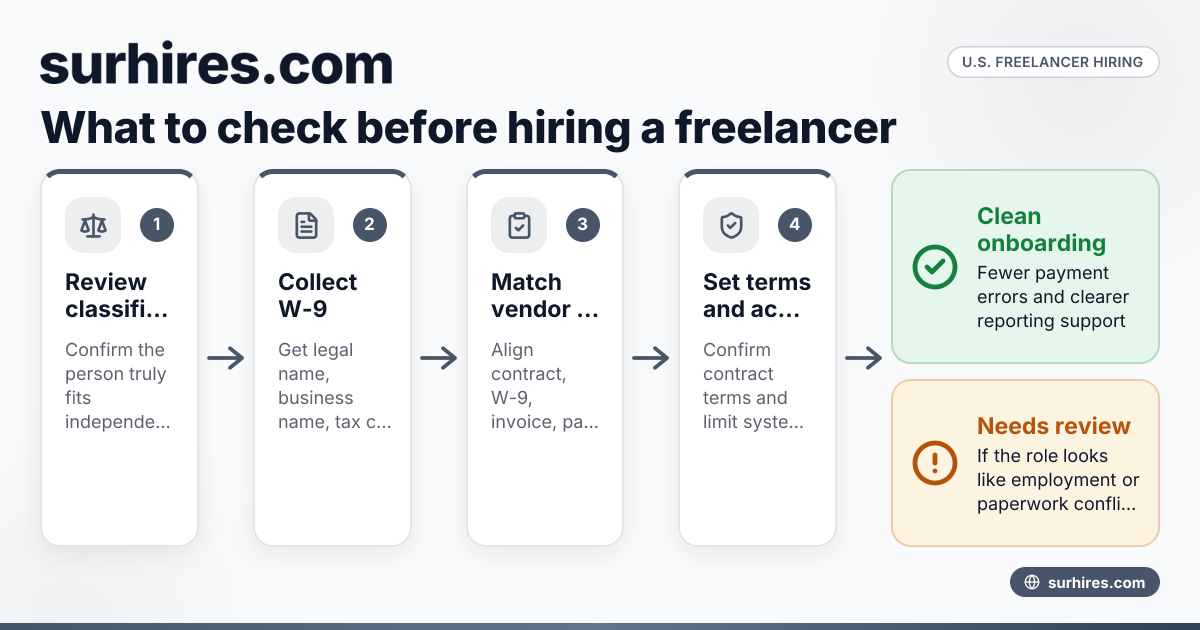
If you are deciding between a 1099 independent contractor and an LLC freelancer, the main point is simple: an LLC does not automatically change worker classification. For a U.S. business, the real question is whether the person qualifies as an independent contractor under the facts of the relationship, and then what tax forms, onboarding documents, and compliance checks you need before work starts.
Key takeaways
- “1099 or LLC for freelancers” is not an either-or legal test. A freelancer can be paid as an independent contractor and still operate through an LLC.
- An LLC is a business structure, not a worker classification. It does not by itself prevent misclassification risk.
- Before hiring, check classification, business name, tax documentation, payment setup, insurance, and contract terms.
- Many businesses should collect a Form W-9 before the first payment and keep clear records for year-end 1099 reporting when required.
- Your finance and hiring teams should align early, especially if you use QuickBooks, Stripe, or a procurement workflow.
- If your contractor is working across state lines, payroll and tax rules can get more complex; the surhires.com blog covers related hiring topics.
What does “1099 or LLC for freelancers” really mean?
For U.S. businesses, “1099 or LLC for freelancers” usually means this: should you hire the worker as an independent contractor, or do they need to invoice you through an LLC? The short answer is that these are different issues. “1099” points to tax reporting tied to contractor payments. “LLC” refers to the legal structure the freelancer may use for their business.
A freelancer can be:
- A sole proprietor using their own name
- A sole proprietor using a DBA
- A single-member LLC
- A multi-member LLC
- An LLC taxed in different ways under federal tax rules
From your business’s side, none of that replaces the need to determine whether the person is truly an independent contractor. If the relationship looks like employment, calling them an LLC vendor does not solve the problem.
That is why smart hiring teams do not ask only, “Do they have an LLC?” They ask:
- Who controls the work?
- Is the contractor running an independent business?
- What documents do we need before paying them?
- Will we need to issue a 1099 form?
- Are there state-specific risks based on where the work happens?
This is where a lot of confusion starts. Some managers assume an LLC is safer because it sounds more formal. In practice, the legal entity may help the freelancer organize their business, but it does not erase your classification obligations.
Is an LLC better than a 1099 for freelancers?
An LLC is a business entity. A 1099 is part of tax reporting. Your business should classify the worker based on the working relationship, not on whether they formed an LLC.
That short answer matters because it frames the whole hiring process. If a freelance designer in Chicago has an LLC, but you set their hours, require daily check-ins, control their methods, and treat them like staff, you still may have misclassification risk. If a software consultant in Houston works independently for multiple clients and uses their own tools, they may fit contractor status whether or not they formed an LLC.
Why businesses confuse these terms
Teams often use “1099” as shorthand for “contractor.” They also use “LLC” as shorthand for “real business.” Both shortcuts can create mistakes.
Here is the cleaner way to think about it:
- Worker classification asks whether the person is an employee or an independent contractor.
- Entity type asks how the freelancer has organized their business.
- Tax reporting asks what information return you may need to file after payments are made.
These are linked, but they are not the same decision.
Why the distinction matters
If you skip this distinction, several problems can follow:
- Your AP team may pay the wrong legal name
- Your tax team may collect an incomplete Form W-9
- Your managers may onboard a contractor like an employee
- Your company may miss year-end 1099 reporting requirements
- Your compliance team may lack documentation if classification is questioned later
That is why the phrase ai 1099 or LLC can be misleading when reduced to a simple binary choice. In real business operations, you need a classification review and a vendor setup review.
What should a business check before hiring a freelancer?
Check worker classification first, then confirm tax documents, legal name, payment details, contract terms, and operational controls before any work begins.
After that first review, build a repeatable process. A one-person marketing agency in Detroit and a freelance developer in Austin may both be contractors, but your internal file should still show why you reached that conclusion and how you verified their business details.
1. Confirm independent contractor status
Start with the working relationship, not the invoice header. Ask practical questions:
- Does the person control how the work is done?
- Do they use their own tools and systems?
- Can they work for other clients?
- Are they hired for a project or defined scope?
- Are they integrated into core employee workflows?
- Will a manager supervise them closely day to day?
Your legal or HR team should review any gray-area roles. This is especially important if the freelancer will work long term, represent your brand externally, or perform work similar to employees.
2. Collect a completed Form W-9
Before the first payment, collect a Form W-9 so you have:
- Legal name
- Business name, if different
- Federal tax classification
- Taxpayer Identification Number
- Address
This helps your AP and tax teams avoid year-end cleanup. If you need a practical walkthrough, see How to Collect Form W-9 From Contractors in the United States.
3. Verify the payee name and tax treatment
If the contractor says, “Pay my LLC,” make sure that matches the W-9 and the contract. Your invoice, vendor profile, and payment record should all align.
This matters because businesses often receive invoices under a brand name, while the W-9 shows a different legal entity or individual owner. That mismatch creates avoidable reporting issues.
4. Review the contract terms
Your independent contractor agreement should cover:
- Scope of work
- Deliverables
- Payment terms
- Intellectual property terms
- Confidentiality
- Data security expectations
- Term and termination rights
- Independent contractor status language
Do not rely on labels alone. A contract can say “independent contractor,” but if the real relationship looks like employment, the label will not carry the whole analysis.
5. Check data access and security
If the freelancer will access customer data, internal systems, or financial records, define security requirements early. Many U.S. buyers expect basic vendor diligence, and larger customers may ask about internal controls or SOC 2-related practices.
A freelance RevOps consultant working inside your CRM should not get the same access model as a full-time employee by default. Limit access to what the project needs.
6. Align payment operations
Decide how the contractor will be paid and documented. Many U.S. businesses use QuickBooks, Stripe, or an AP tool tied to their general ledger. Make sure your process supports:
- Proper vendor setup
- Clear invoice matching
- Approval workflows
- Year-end reporting support
This is often where classification errors become finance errors.
Does hiring an LLC avoid issuing a 1099?
No. An LLC does not automatically remove 1099 reporting duties. Your business still needs the contractor’s Form W-9 and should determine reporting based on the payee’s tax classification shown there.
That is why AP teams should not guess. Some businesses assume “LLC means no 1099,” but that is too broad. The W-9 is the starting point for your reporting decision, along with the nature of the payment and your tax process.
Why businesses get this wrong
The problem usually starts with incomplete vendor onboarding. A department head hires a freelancer quickly. AP gets an invoice from “Blue Lake Studio LLC.” Someone assumes the entity type answers the reporting question. It does not.
Your process should require:
- A signed contract
- A completed W-9
- A validated vendor profile
- Internal approval before payment
- Year-end review of reportable payments
What your team should do instead
Use a simple checklist:
- Never decide based only on “LLC” in the invoice name
- Use the W-9 to capture the payee’s tax classification
- Keep records in one system
- Review exceptions before year-end
- Involve finance early for high-volume contractor programs
If your company works with remote contractors in several states, related tax and operations issues can expand quickly. For teams managing distributed hiring, Multi-State Payroll Compliance for Remote Teams in the United States is a useful next read.
Common red flags when hiring freelancers
Some freelancer relationships are low risk and clearly project based. Others sit in a gray area. The following red flags deserve extra attention.
The contractor works like a regular employee
Watch for patterns such as:
- Fixed daily schedules
- Required attendance at all team meetings
- Close manager supervision
- Ongoing open-ended duties
- Company-issued email and phone as standard practice
- Performance management similar to employees
One factor alone may not decide the issue, but several together should prompt review.
The role is core to daily operations
If the person is not just delivering a project but handling a core function under your direct control, reassess. This is common with operations, support, and sales development work.
For example, if your company hires a “freelance” outbound rep to call prospects every day using your scripts, CRM, manager oversight, and phone system, you may also need to think about TCPA and CAN-SPAM compliance in addition to classification.
The contractor cannot work independently
A real independent business usually has some operational independence. If the freelancer cannot make decisions about methods, timing, tools, or staffing, the relationship may not be truly independent.
The paperwork is inconsistent
Inconsistencies often signal weak controls:
- Contract signed by one name
- W-9 under another name
- Invoice from a third name
- Payments sent to a personal account without explanation
This may be harmless, but your team should reconcile it before payment.
A practical hiring checklist for U.S. businesses
Here is a simple process your team can use before hiring any freelancer.
Step 1: Define the scope
Write down the deliverables, timeline, and success criteria. If the role sounds like an open-ended job, pause and reassess classification.
Step 2: Review classification
Use your internal legal, HR, or compliance process to assess whether the worker should be an employee or an independent contractor.
Step 3: Collect onboarding documents
At minimum, gather:
- Signed contract
- Form W-9
- Contact details
- Payment instructions
- Insurance details, if required for the project
Step 4: Set up the vendor correctly
Make sure the vendor name in your system matches the legal or tax reporting information you collected.
Step 5: Limit access
Give only the systems access needed for the work. Remove access at project end.
Step 6: Track payments and reporting
Use one workflow for invoices, approvals, and year-end review. This reduces missed 1099 reporting and duplicate records.
When should you consider another hiring model?
Not every freelance engagement should stay a pure contractor relationship. If the worker will be long term, tightly managed, or central to operations, another structure may fit better.
For some small businesses, the real question is not only 1099 or LLC for freelancers. It is whether the role should be hired through payroll or with outside employer support. If you are weighing those options, PEO vs Employer of Record in the United States: Which Should Small Businesses Choose? explains the difference.
You may also compare service models when flexible talent is involved. Employer of Record vs Staffing Agency in the United States: What’s the Difference? and Contractor of Record vs Employer of Record in the United States: Which One Does Your Business Need? can help frame that decision.
How finance, HR, and operations should work together
Many freelancer issues are not legal theory problems. They are process problems between teams.
Finance owns payment accuracy
Finance should ensure:
- W-9 collection happens before payment
- Vendor records stay clean
- Payment trails are complete
- Year-end reporting workflows are in place
If you use QuickBooks, build a required field process for legal name and tax classification so AP is not chasing details in January.
HR or legal supports classification
HR and legal should help managers spot risk. This is especially useful when departments want to convert a former employee into a “freelancer” immediately after separation.
Managers own day-to-day behavior
Even if finance and legal do everything right, a manager can create risk by treating a contractor like staff. Give managers simple rules on meetings, schedules, supervision, and system access.
Final thoughts on 1099 or LLC for freelancers
For U.S. businesses, the safest approach is to separate three questions: is the person properly classified, what business entity are they using, and what tax reporting steps does your company need to follow? If you build that into onboarding, you reduce confusion, payment errors, and misclassification risk.
If you want more practical hiring guidance for U.S. teams, learn more through surhires.com and explore the resources built for business buyers managing modern workforce decisions.
Frequently asked questions
Is a freelancer with an LLC automatically an independent contractor?
No. An LLC does not automatically decide worker classification. Your business still needs to evaluate the actual relationship and level of control.
Do I always need a Form W-9 before paying a freelancer?
It is a strong best practice to collect it before the first payment. It helps your business set up the vendor correctly and supports year-end tax reporting when required.
Can I pay a freelancer’s business name instead of their personal name?
Yes, if that business name matches the contractor’s tax and payment documentation. Your contract, W-9, invoice, and vendor record should all align.
Does hiring a freelancer through an LLC remove misclassification risk?
No. Misclassification risk depends on the facts of the relationship. If you control the work like an employer, the LLC label will not fix that issue.
What if my freelancer works in another state?
That can add complexity to tax, labor, and operational compliance. Review the arrangement carefully, especially if the relationship is ongoing or resembles employment.
When should I look beyond a contractor setup?
Consider other models when the role is long term, tightly supervised, or essential to daily operations. In those cases, payroll-based hiring or structured workforce solutions may be more appropriate.
Published 11 October 2026
See Surhires on a live requisitionMore from the blog
How to Manage State-Specific Sales Tax Obligations When Paying Independent Contractors in the United States
Managing state sales tax obligations for independent contractors in the United States requires understanding varied state rules, identifying taxable.
27 October 2026 · 6 min read
How United States Businesses Can Use surhires.com to Automate Contractor Time Tracking and Payroll Integration
Automating contractor time tracking and payroll integration helps U.S. businesses capture accurate work hours and simplify payments. surhires.com uses
26 October 2026 · 5 min read
How United States Businesses Can Simplify Contractor I-9 Employment Eligibility Verification with surhires.com
Contractor I-9 verification in the United States requires businesses to confirm contractors’ legal work authorization using Form I-9. surhires.com.
26 October 2026 · 6 min read