
How-to
How to Collect Form W-9 From Contractors in the United States
Collecting Form W-9 from contractors in the United States means asking each contractor to provide their legal name, business name if any, tax.
By The surhires.com team · · 12 min read
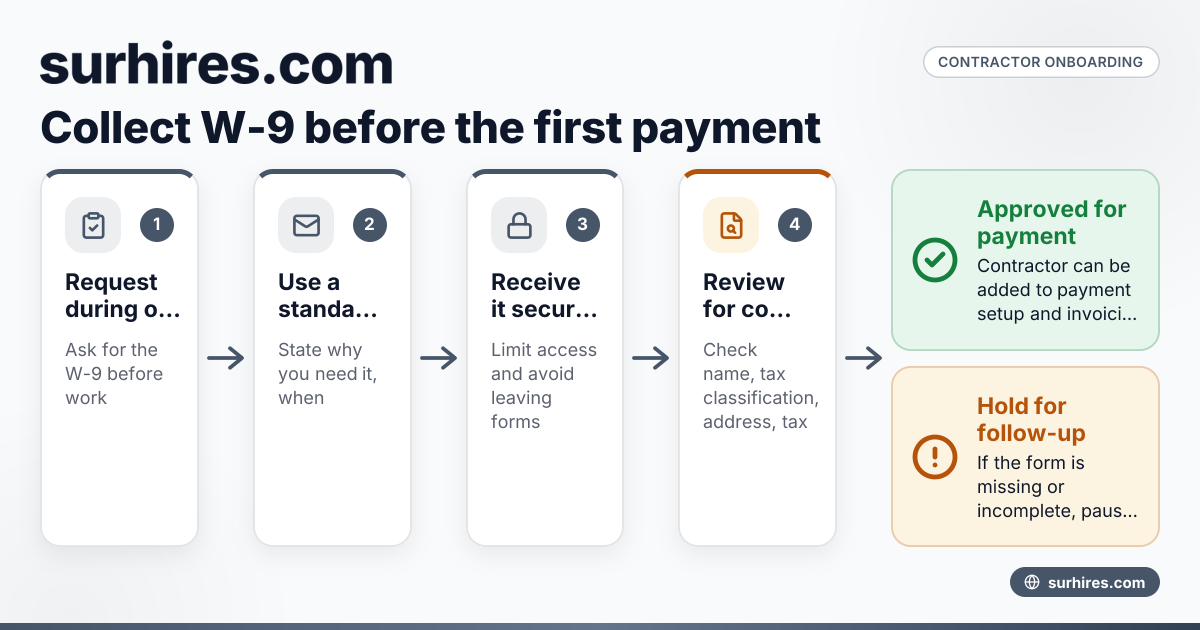
Collecting Form W-9 from contractors in the United States means asking each contractor to provide their legal name, business name if any, tax classification, address, and taxpayer identification number before you pay them. The safest approach is to request the form during onboarding, review it for completeness, store it securely, and use it later when preparing Form 1099-NEC if required.
Key takeaways
- The best time to collect a W-9 is before the first payment goes out.
- A complete W-9 helps your business prepare accurate 1099 forms and reduce tax reporting errors.
- You should use a consistent process for requests, reminders, review, storage, and access control.
- Contractors do not file Form W-9 with the IRS. They give it to your business.
- Sensitive data on a W-9 should be handled carefully because it includes a Social Security number or EIN.
- A written onboarding workflow makes contractor compliance easier as your team grows.
What is Form W-9 and why do businesses collect it?
Form W-9 is a request for a contractor’s taxpayer identification number and certification. Businesses in the United States collect it from independent contractors and certain vendors so they can report payments correctly when a 1099 is required.
The form usually includes the contractor’s legal name, federal tax classification, address, and tax ID. For a sole proprietor, that may be a Social Security number. For a business entity, it may be an employer identification number.
Your business usually keeps the W-9 in its records. The contractor gives it to you directly. You generally do not send it to the IRS unless the IRS asks for it.
For most businesses, the practical reason to collect a W-9 is simple. It gives your finance or operations team the information needed to set up the contractor in QuickBooks, prepare year-end 1099s, and reduce avoidable mismatches.
If you work with freelancers, consultants, designers, recruiters, or project-based specialists, this is part of a basic contractor onboarding process. It also helps create a clean audit trail if your business later reviews vendor records.
When should you collect a W-9 from contractors?
You should collect a W-9 before the contractor starts work or, at the latest, before you send the first payment. Waiting until year-end creates risk because people change addresses, stop responding, or submit incomplete tax details under pressure.
A better process is to make the W-9 part of onboarding. That way, no one is approved for payment until the form is received and reviewed.
This matters even more if your team is spread across functions. In many companies, a hiring manager brings in the contractor, operations approves the work, and accounting pays the invoice. Without a defined step, everyone assumes someone else requested the form.
A simple policy can fix that. For example:
- Contractor is approved by the hiring manager.
- Contractor receives onboarding documents.
- W-9 is completed and returned.
- Finance reviews the form.
- Contractor is added to your payment system.
- First invoice is approved for payment.
This sequence is easy to follow in a small business in Chicago or a larger services firm in Houston. It also scales better than chasing tax forms in January.
How to collect W-9 from contractors?
Ask for the W-9 during onboarding, before payment, using a secure and repeatable process. Review the form for missing fields, store it safely, and make sure accounting can access the final version for 1099 reporting.
Here is a practical workflow most United States businesses can use.
1. Add the W-9 request to your onboarding checklist
The easiest way to collect W-9 forms consistently is to stop treating them as a separate tax task. Make the request part of the same package as the contractor agreement, scope of work, payment instructions, and onboarding steps.
If you already use a checklist, add a line item that says no payment will be released until required tax documentation is received. This helps avoid last-minute confusion with AP.
If you are building a stronger process, these resources can help: Independent Contractor Compliance Guide in the United States and How to Create a Compliant 1099 Contractor Onboarding Process in the United States.
2. Use a standard request message
Your team should not reinvent the email every time. A standard request improves completion rates and reduces confusion.
A simple message can say:
- why you need the form
- when you need it
- how to submit it
- who to contact with questions
For example, you might ask the contractor to return a completed W-9 before invoicing begins. Keep the note short and direct. Most delays happen because the request is vague or buried in a long welcome email.
3. Give contractors a secure way to return it
Because Form W-9 includes sensitive tax information, you should not rely on casual handling. Email is common in business, but your process should still limit exposure and control who can access the document.
A practical approach is to use a secure document collection workflow with restricted access. If your team uses a shared drive, limit permissions to the people who truly need the form, usually finance, legal, and selected operations staff.
You should also avoid unnecessary duplication. Do not leave W-9s attached in long email threads or saved in open folders. A clean file naming method helps too. Use something like:
Contractor Name - W-9 - MM/DD/YYYY received
That makes later retrieval much easier during 1099 season.
4. Review the form before approving the contractor
Do not just collect the W-9 and move on. Someone should review it for completeness. A missing tax classification, unsigned certification, or incomplete taxpayer identification number can create a problem later.
Check for these basics:
- legal name is present
- business name is included if applicable
- federal tax classification is selected
- address is listed
- taxpayer identification number is present
- form is signed and dated when required on the version used
If something is unclear, ask the contractor to fix it right away. It is much easier to solve this before payments begin.
5. Match the W-9 to your payment and vendor records
Once reviewed, the information on the W-9 should match what your accounting team uses in QuickBooks or your vendor management process. If the contractor’s invoice name does not match the name on the W-9, flag it early.
This is a common source of year-end cleanup work. A contractor may brand themselves one way but have a different legal name for tax reporting. Your records should clearly connect the two.
If your business pays through Stripe or another payment workflow, make sure the tax identity in your records is still accurate. Payment setup and tax reporting should not live in separate worlds.
6. Store the form securely and set retention rules
W-9 forms contain sensitive data. That means storage matters just as much as collection. Save the final version in a secure system and define who can access it.
You should also document where W-9s live. A lot of businesses struggle because tax forms sit across inboxes, laptops, shared folders, and onboarding tools. One source of truth is better.
If customers or enterprise buyers review your controls, they may expect reasonable data handling practices. Even if no buyer asks directly, secure storage is part of basic operational discipline.
7. Track who has and has not submitted a W-9
A simple tracker can save a lot of time. This can be a spreadsheet, onboarding board, or internal system with fields for:
- contractor name
- start date
- W-9 requested date
- W-9 received date
- reviewer
- status
- notes
This matters if you work with many short-term contractors. In a Detroit manufacturing support project or a fast-moving marketing team, contractor volume can rise quickly. Without tracking, forms get missed.
8. Follow up before the first invoice is paid
If a contractor has not returned the W-9, send a reminder before payment is processed. This should be a firm but professional step in your policy.
Your finance team should know the rule. No approved tax documentation, no payment release unless a documented exception exists and leadership approves it.
That sounds strict, but it is much easier than trying to collect missing tax forms from unresponsive contractors months later.
What should you include in your W-9 collection process?
Include a standard request, a secure submission method, a review checklist, controlled storage, and a rule that the contractor cannot be paid until the form is received. Keep ownership clear so hiring managers, finance, and operations know exactly who does each step.
A strong process is not complicated. It just needs to be consistent.
Core parts of a workable process
At minimum, your internal process should define:
- Who requests the W-9
Usually operations, finance, or the hiring manager.
- When the request goes out
Ideally at contractor onboarding.
- How the contractor submits it
Through a secure workflow with limited access.
- Who reviews it
Someone trained to check for completeness.
- Where it is stored
In a secure, organized record system.
- How exceptions are handled
For example, who decides whether payment can proceed without a completed form.
This is where many businesses benefit from documenting the full contractor process, not just the tax piece. A related guide that may help is Contractor Agreement Checklist in the United States.
Can you collect a W-9 by email?
Yes, many businesses request and receive W-9 forms by email, but they should still limit access and store the final document securely. The main risk is not email itself. The bigger risk is poor handling after receipt.
If email is your current method, tighten the process around it.
First, use a dedicated finance or onboarding inbox when possible. That reduces the chance that forms sit in personal mailboxes. Second, move the file quickly into your approved storage location. Third, restrict access so only authorized staff can view it.
Also remind your team not to forward W-9s casually. Sensitive tax data should not circulate just because several people are involved in onboarding.
If you want a cleaner approach, consider whether your contractor onboarding workflow can centralize document collection. That can reduce confusion, especially as volume increases.
What if a contractor refuses or delays sending a W-9?
If a contractor refuses or delays sending a W-9, pause payment and follow your written policy. Chasing the form after work is complete is much harder and can create tax reporting problems at year-end.
You do not need a long debate with the contractor. You need a clear business rule.
How to handle delays without creating friction
Use a short sequence:
- Send the initial request with a due date.
- Send one reminder before the start date or invoice approval.
- Explain that payment setup cannot be completed without required tax documentation.
- Escalate internally if the work is urgent.
- Hold payment until the form is received, unless leadership approves an exception.
This approach keeps the issue operational, not personal. It also helps your AP team stay consistent.
Contractors who work with many businesses usually expect this request. Problems often come from unclear instructions, not resistance. That is why simple language matters.
How can ai how help your team collect W-9 forms more consistently?
AI can help by organizing reminders, flagging missing fields, and routing forms to the right reviewer, but your team still needs a human-approved process. The goal is not to automate judgment. It is to reduce missed steps and manual follow-up.
Used well, internal automation can make a big difference. For example, you can build triggers that notify finance when a contractor agreement is signed but the W-9 is still missing. You can also create a checklist that blocks payment setup until required documents are complete.
That said, do not let automation create overconfidence. Someone still needs to confirm the form is complete, the contractor is set up correctly, and sensitive information is stored appropriately.
If your buyer asks about controls, they usually care less about flashy tools and more about whether your process is repeatable. A simple workflow that works every time is better than a complicated system no one follows.
Build a repeatable contractor onboarding workflow
The best way to collect W-9 forms consistently is to treat them as one part of contractor compliance, not a standalone finance chore. That means connecting legal, onboarding, tax, and payment steps into one process.
A practical workflow often includes:
- Contractor classification review.
- Written contractor agreement.
- W-9 request and receipt.
- Payment system setup.
- Access controls if systems or customer data are involved.
- Invoice approval rules.
- Year-end 1099 preparation.
If your company hires remote contractors across states, a broader compliance checklist can help. See Remote Hiring Compliance Checklist in the United States. You can also browse the surhires.com blog for related how-to articles on contractor compliance.
If your business is evaluating ways to make contractor onboarding cleaner and more controlled, surhires.com is a good place to learn more about building a compliant, practical process for United States hiring.
Frequently asked questions
Do all contractors need to send a W-9?
Not every vendor relationship works the same way, but many independent contractors are asked for a W-9 so the paying business can maintain accurate tax records. The safest approach is to collect it during onboarding whenever your business may need tax identification details for reporting.
Is a W-9 the same as a 1099?
No. A W-9 is collected by your business from the contractor. A 1099-NEC is a year-end tax form your business may issue to report certain payments to nonemployees.
Can I pay a contractor before receiving a W-9?
You can set your own internal policy, but it is usually better to collect the W-9 before the first payment. That reduces the chance of missing tax details when year-end reporting begins.
How should we store W-9 forms?
Store them in a secure location with limited access. Avoid leaving them in open shared folders or scattered across email inboxes because they contain sensitive tax information.
Who in the company should collect W-9 forms?
That depends on your workflow, but ownership should be clear. In many businesses, operations requests the form, finance reviews it, and accounting uses it for vendor setup and 1099 reporting.
What else should contractor onboarding include besides the W-9?
Most businesses should also cover classification review, a written contractor agreement, payment setup, and recordkeeping.
That helps your business confirm the worker relationship, set payment rules, and maintain a clear file for operations and tax reporting. If you are comparing service options for broader hiring support, Best Employer of Record Services in the United States for Small Businesses provides additional context.
Published 10 October 2026
See Surhires on a live requisitionMore from the blog
Best Employer of Record Services in the United States for Small Businesses
If you want to hire legally without setting up payroll, tax accounts, and HR processes in every state, an employer of record can help. The best.
10 October 2026 · 12 min read
Contractor of Record vs Employer of Record in the United States: Which One Does Your Business Need?
If you need to engage independent contractors in the United States, a contractor of record helps manage contractor onboarding, contracts, and payment.
10 October 2026 · 12 min read
Independent Contractor Compliance Guide in the United States
Independent contractor compliance in the United States means setting up the right classification, contract, tax paperwork, payment process, and.
9 October 2026 · 12 min read