
Comparisons
Contractor of Record vs Employer of Record in the United States: Which One Does Your Business Need?
If you need to engage independent contractors in the United States, a contractor of record helps manage contractor onboarding, contracts, and payment.
By The surhires.com team · · 12 min read
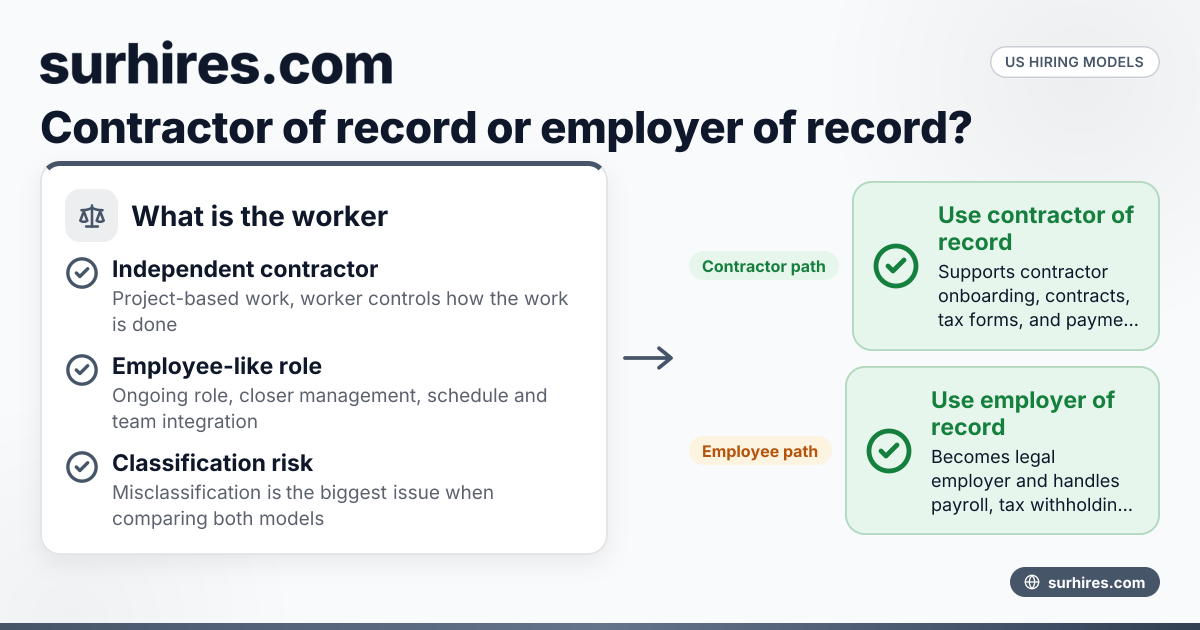
If you need to engage independent contractors in the United States, a contractor of record helps manage contractor onboarding, contracts, and payment workflows. If you need to hire workers as employees, an employer of record becomes the legal employer and handles payroll, tax withholding, and employment compliance.
Key takeaways
- A contractor of record supports compliant contractor engagement in the United States, while an employer of record hires employees on your behalf.
- The right model depends on the worker’s legal classification, not just your budget or hiring speed.
- Misclassification risk is the biggest issue when comparing contractor of record vs employer of record united states options.
- A contractor of record can help with 1099 contractor processes, but it does not turn a true employee into a contractor.
- An employer of record is usually used when you want employee control, employee benefits, and W-2 payroll handling.
- Your finance, legal, and hiring teams should align before choosing either model.
What is the difference between a contractor of record and an employer of record in the United States?
A contractor of record supports the engagement of independent contractors. An employer of record hires workers as employees through its own legal entity. The main difference is worker status: 1099 contractor versus W-2 employee.
That short answer matters because many businesses compare these models as if they are interchangeable. In the United States, they are not. The first question is not which provider is cheaper or faster. The first question is whether the worker should legally be a contractor or an employee.
A contractor of record is built for independent contractor relationships. It can help with contractor onboarding, collecting tax forms, handling agreements, and creating a cleaner payment process. It may also help your team document why a worker is being engaged as an independent contractor. That is useful when your business works with specialized project talent, such as a freelance designer in Chicago or a marketing consultant in Houston.
An employer of record is built for employment. The employer of record hires the worker as its employee and places that worker with your business. It typically handles payroll, tax withholding, employment documents, and other employer-side obligations tied to the employment relationship.
This difference affects almost everything else:
- who signs the work arrangement
- who runs payroll
- who withholds taxes
- whether benefits apply
- what level of control you can exercise
- what compliance risks you carry
If your team is reviewing options for an ai contractor, this distinction still applies. The work may be technical, remote, or project-based, but the legal question stays the same. You still need to decide whether the person is truly operating as an independent business or should be treated as an employee.
Why does worker classification matter so much?
Because classification drives tax handling, contracts, control, and legal risk. If you classify a worker wrong, you can face back taxes, penalties, wage claims, and expensive cleanup work.
In the United States, worker classification is not a branding decision. A contract alone does not decide it. Calling someone a contractor does not make them one. Regulators and agencies look at the real relationship, including control over the work, the worker’s independence, and how the work fits into your business.
That is why a contractor of record should be seen as a compliance support model, not a loophole. It can help structure and document a contractor relationship. It cannot erase the risk if the facts point to employment.
An employer of record is often the safer route when:
- The worker will be closely managed day to day.
- The worker has a fixed schedule set by your company.
- The worker uses your systems and works like part of your internal team.
- The role is ongoing and central to your operations.
- You want to provide an employee-style experience.
A contractor of record may fit better when:
- The worker controls how the work is done.
- The engagement is project-based or outcome-based.
- The worker serves multiple clients.
- The worker operates an independent business.
- Your company needs streamlined 1099 contractor administration.
For a deeper look at classification risk, see How to Avoid Worker Misclassification When Hiring Remote Talent in the United States.
When should you use a contractor of record in the United States?
Use a contractor of record when the worker is properly classified as an independent contractor and you want help managing compliance, contracts, onboarding, and payments.
That answer is simple, but the practical details matter. A contractor of record can be helpful when your business needs flexibility without building a large internal contractor operations process. This is common for startups, agencies, software companies, and manufacturers that need niche expertise for a limited scope of work.
For example, imagine a Detroit manufacturer needs a supply chain systems consultant for a four-month ERP cleanup project. The consultant works through their own business, uses their own methods, and delivers a defined project outcome. In that case, a contractor model may make sense. A contractor of record can help standardize the paperwork and reduce administrative gaps.
Common reasons businesses choose a contractor of record
1. Cleaner contractor onboarding
Many businesses do not have a consistent process for collecting tax forms, contracts, and classification documentation. That creates risk later. A contractor of record can make onboarding more uniform and easier to audit.
If your team needs a stronger starting point, review How to Create a Compliant 1099 Contractor Onboarding Process in the United States.
2. Better documentation
Independent contractor relationships should be documented clearly. That includes scope, payment terms, confidentiality terms, and ownership of work product where relevant. Good records will not solve every issue, but poor records almost always make problems worse.
A useful companion resource is Contractor Agreement Checklist in the United States.
3. Simpler finance operations
Contractor payments often become messy across teams. Finance may need clean vendor records, approved invoices, and year-end reporting support. Businesses using QuickBooks or Stripe often want contractor processes that fit into their existing stack without manual rework.
4. Support for scaling contractor programs
If your business uses many contractors across departments, standardization becomes more important. A contractor of record can help centralize process controls as volume grows.
When should you use an employer of record in the United States?
Use an employer of record when the worker should be an employee and you want a third party to employ them legally and handle payroll and related compliance.
An employer of record is often chosen when a company wants to add talent quickly without building full internal employment infrastructure for every hiring case. The provider becomes the legal employer of the worker, while your company manages the worker’s day-to-day business priorities.
This route often makes more sense for long-term roles. It is also common when your business wants tighter control over schedules, duties, and performance management. If the person looks and works like part of your internal team, an employee model is often the better fit.
Common reasons businesses choose an employer of record
1. W-2 payroll handling
Employees require payroll tax withholding and wage reporting. An employer of record handles these obligations as the legal employer.
2. Reduced employment administration
Employment requires more ongoing administration than contractor engagement. A provider can take on much of that burden.
3. Better fit for integrated team roles
If the worker joins recurring meetings, reports to your managers, follows company hours, and supports core business operations, employee status is often more defensible.
4. Lower misclassification risk
When a role sits near the line between contractor and employee, an employer of record may reduce the chance of misclassification disputes.
Which option is cheaper?
A contractor of record may cost less than an employer of record, but lower cost should never drive classification. If the role should be employment, choosing a contractor model to save money can create much bigger costs later.
Cost comparison gets tricky because the services are not identical. A contractor of record supports an independent business relationship. An employer of record supports a formal employment relationship. The cost structures reflect those differences.
When comparing total cost, look beyond provider fees. Include:
- internal legal review time
- HR administration time
- payroll operations
- tax handling
- benefits expectations
- misclassification exposure
- audit readiness
- contract management effort
For example, paying a lower service fee on paper means little if your company later has to unwind a misclassified arrangement, correct tax treatment, and defend wage claims. A more expensive model upfront can be cheaper in total risk-adjusted terms.
You should also think about internal process maturity. A business with strong legal and finance systems may manage more in-house. A smaller company may value outside structure because it lowers operational strain.
What are the compliance risks of choosing the wrong model?
The biggest risk is treating an employee like a contractor. That can lead to tax issues, wage and hour claims, benefit disputes, and broader legal exposure.
This is the core issue behind most contractor of record vs employer of record united states evaluations. The wrong model creates a mismatch between the legal facts and the paper structure.
Risks tied to a misused contractor model
If you use a contractor setup for a worker who functions like an employee, your business may face:
- back taxes and withholding issues
- wage and hour claims
- disputes over overtime eligibility
- problems with unemployment or workers’ compensation treatment
- contract enforceability issues
- higher legal costs during disputes
A contractor of record can improve process quality, but it does not guarantee the classification is correct. Your business still needs a real classification review.
Risks tied to a poor employer of record setup
An employer of record can reduce some risks, but it also needs careful review. You should understand:
- which party controls which obligations
- what employment policies apply
- how data is handled
- how terminations are managed
- how payroll errors are corrected
- what service levels your teams need
Business buyers should also ask about security expectations. If a provider will handle sensitive worker and payment data, many buyers will want a clear understanding of controls and whether the provider aligns with common buyer expectations such as SOC 2 readiness.
For broader compliance planning, see Remote Hiring Compliance Checklist in the United States.
How should your business decide between the two?
Start with classification, then map the operating model, then compare providers. Do not start with a sales demo or pricing sheet.
A practical way to decide is to follow a short internal review process.
Step 1: Define the actual work relationship
Write down how the worker will operate in practice. Focus on:
- who controls the schedule
- who controls the method of work
- whether the worker serves other clients
- whether the role is project-based or ongoing
- whether the worker is part of your core operations
Avoid idealized descriptions. Use the reality your managers expect.
Step 2: Review classification risk
Have legal, HR, or a qualified internal stakeholder review whether the person should be a contractor or an employee. If the answer is not clearly contractor, pause before moving forward.
You can also use Independent Contractor Compliance Guide in the United States to structure your internal review.
Step 3: List your operational needs
Once classification is clearer, define what support you need:
- contract generation
- onboarding workflows
- tax form collection
- invoice processing
- payment support
- payroll administration
- termination support
- audit trails
This will help you compare service models with less confusion.
Step 4: Review your finance and data workflows
Think about how the solution fits your systems. Many US businesses want smooth handoffs into QuickBooks, Stripe, or existing approval workflows. Finance leaders should be involved early, not after contracts are signed.
Step 5: Check legal documents carefully
Do not treat provider documents as routine paperwork. Review the allocation of responsibility, indemnity language, data terms, and service scope.
Step 6: Train your managers
A compliant structure can fail if managers treat a contractor like an employee after onboarding. Managers need simple rules about control, communication, and scope changes.
What questions should you ask a contractor of record or employer of record provider?
Ask how the provider supports the model you actually need, not the model you hope will be easiest. Good vendor review starts with direct operational questions.
Questions to ask if you are considering a contractor of record
- How do you support contractor classification review?
- What contractor onboarding documents are included?
- How are tax forms collected and stored?
- How are payment approvals handled?
- What records are available for audits or disputes?
- How do you help maintain contractor-specific boundaries?
If your business is new to this category, What Is a Contractor of Record in the United States? gives a useful foundation.
Questions to ask if you are considering an employer of record
- Who is the legal employer?
- Who handles payroll tax withholding and reporting?
- How are benefits handled, if offered?
- What happens during termination or offboarding?
- How do you support wage and hour compliance?
- What data security controls do you maintain?
Questions to ask either type of provider
- What responsibilities stay with our business?
- How does your service fit our approval workflows?
- What support do you provide during disputes?
- How do you handle document retention?
- What implementation work is required from our team?
Common buying mistakes to avoid
Many business buyers make the same mistakes when evaluating these models. Avoiding them can save time and reduce risk.
Choosing based on speed alone
Fast onboarding feels attractive. But speed can hide classification problems. A rushed contractor setup is risky if the role really functions like employment.
Letting department managers decide alone
A hiring manager may focus on filling a role quickly. Finance may focus on payment ease. Legal may focus on risk. These views all matter. One team should not make the decision in isolation.
Assuming contracts solve classification
They do not. A strong contract helps. It does not override the facts of the relationship.
Ignoring downstream finance work
If invoices, approvals, or payment records are messy, the process will create friction later. Finance operations should be part of the buying decision from the start.
Forgetting ongoing governance
A worker may begin as a valid contractor, then drift into employee-like work over time. Periodic review matters, especially for long engagements.
If you want more practical guidance on hiring and compliance topics, you can browse the surhires.com blog.
Published 10 October 2026
See Surhires on a live requisitionMore from the blog
How to Collect Form W-9 From Contractors in the United States
Collecting Form W-9 from contractors in the United States means asking each contractor to provide their legal name, business name if any, tax.
10 October 2026 · 12 min read
Best Employer of Record Services in the United States for Small Businesses
If you want to hire legally without setting up payroll, tax accounts, and HR processes in every state, an employer of record can help. The best.
10 October 2026 · 12 min read
Independent Contractor Compliance Guide in the United States
Independent contractor compliance in the United States means setting up the right classification, contract, tax paperwork, payment process, and.
9 October 2026 · 12 min read