




Guides
How to Manage State-Specific Sales Tax Obligations When Paying Independent Contractors in the United States
Managing state sales tax obligations for independent contractors in the United States requires understanding varied state rules, identifying taxable.
By The surhires.com team · · 6 min read
Managing state sales tax obligations for independent contractors in the United States requires understanding varied state rules, identifying taxable services, and maintaining compliance across jurisdictions. Businesses must carefully assess where their contractors work, which services are taxable, and how to manage sales tax filings.
Key takeaways
- Sales tax rules on contractor services differ significantly across US states.
- Most states do not tax payments to independent contractors for services, but some states do tax specific service types.
- Proper classification and contracts clarify who bears sales tax responsibilities.
- AI-powered "ai state sales" compliance tools can simplify multi-state tax rule tracking.
- Businesses must register for sales tax permits and file returns where required.
- Platforms like surhires.com help manage contractor payments and support sales tax compliance.
What are state sales tax obligations for payments to independent contractors in the United States?
State sales tax typically applies to tangible goods and some services. When paying independent contractors, your business must determine whether the contractor’s services are taxable in the state where the work occurs or where the service benefits are delivered.
Most states do not require businesses to remit sales tax on contractor services, but some—such as Hawaii, New Mexico, and South Dakota—tax services like cleaning or repairs. To comply, you must identify:
- Your states of nexus (where your business has taxable presence or contacts),
- Which contractor services are taxable in each state,
- Whether your business or the contractor must collect and remit sales tax.
How do I know if my contractor’s services are taxable in my state?
Rules for sales tax on services vary widely across states. Consult your state’s Department of Revenue or taxation agency guidance to determine if the service type your contractor provides is taxable.
What’s a quick way to check if sales tax applies in a specific state?
Check your state’s official tax authority website or use a qualified tax professional for the latest. AI-enabled compliance platforms can also flag taxable services by examining invoices, which helps avoid errors.
For example, Illinois taxes some services like repair and installation but exempts many others. Texas taxes select services like data processing but not general labor. With complex state rules, AI tools using "ai state sales" data make tracking and compliance more manageable.
Do I have to collect and remit sales tax on payments to independent contractors?
Typically, businesses paying contractors are not required to collect sales tax on those payments. The contractor may have the obligation to collect and remit sales tax from the business or the end-user if applicable.
However, in cases where the contractor lacks a sales tax permit, your business might owe use tax on the payment. Clear contract terms and verifying your contractors’ sales tax registration status help avoid unexpected tax liabilities. Surhires.com can automate tracking these details to minimize risks.
What is nexus, and how does it affect my state sales tax obligations for contractors?
Nexus is the legal link between your business and a state that establishes tax collection duties. Nexus arises from physical presence—offices, employees, or contractors—or economic activity thresholds.
If your contractors work in states where your business has nexus, you must register for sales tax permits and comply with that state's tax laws. Nexus affects your sales tax responsibilities for contractor payments and use tax.
How does nexus impact paying contractors across states?
If contractors work in states without your nexus, you generally have no sales tax obligations there. But if contractors work in nexus states, confirm registration and tax obligations. For example, a Detroit manufacturer hiring an Illinois electrician must understand Illinois nexus and tax rules for repair services performed there.
How can AI help manage complex sales tax issues with contractors?
AI-powered "ai state sales" automation platforms analyze contractor data and invoices in real-time, applying state taxability rules by service type and nexus. This reduces manual compliance efforts, keeps up with changing regulations, and manages filing deadlines.
Integrating such AI tools with contractor management platforms, like surhires.com, streamlines compliance for businesses operating in multiple states.
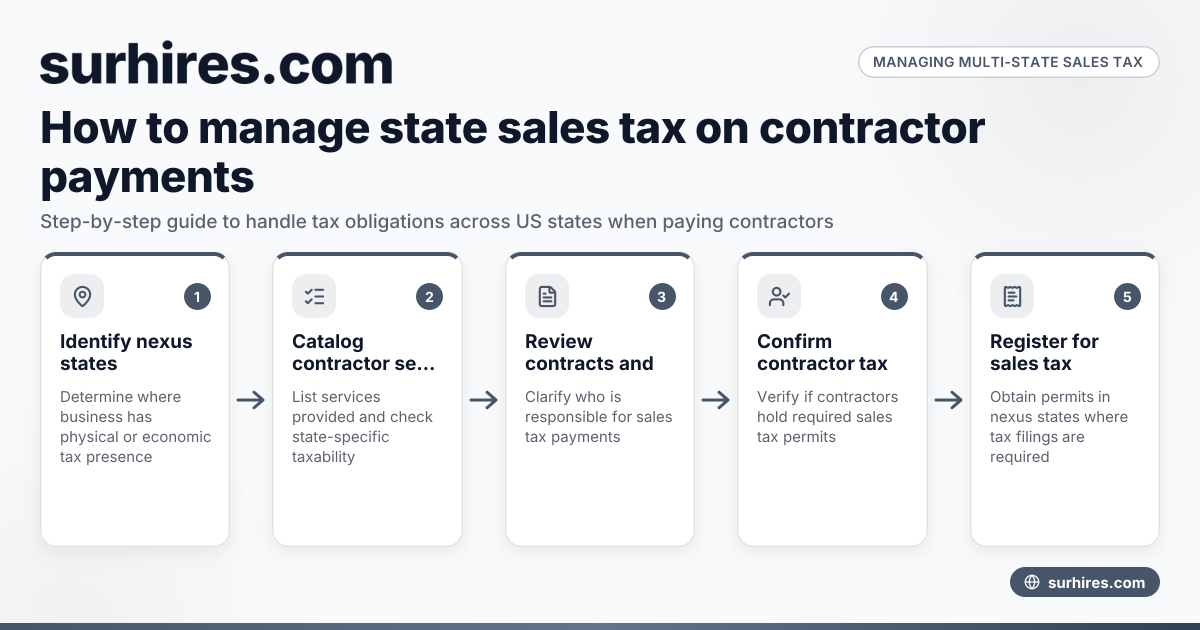
Step-by-step guide: Managing state sales tax with independent contractors
- Identify your states of nexus based on physical presence or economic thresholds.
- Catalog the services your contractors provide and determine their taxability per state.
- Review contracts and invoice terms to clarify sales tax responsibilities.
- Confirm contractors’ sales tax registration where required.
- Obtain sales/use tax permits where your business must remit tax.
- Leverage AI-driven compliance tools and platforms like surhires.com to automate tracking.
- File timely and accurate state sales and use tax returns.
- Maintain thorough documentation—contracts, invoices, correspondence—for audits.
Why is proper contractor classification important for sales tax?
Incorrect classification can create sales tax and payroll tax liabilities. Employees require payroll tax withholding, while contractor payments may trigger sales or use tax issues differently.
Accurate classification helps define who is responsible for collecting and remitting sales tax. surhires.com offers tools to assist businesses in correctly classifying contractors and managing compliance seamlessly.
How can surhires.com help with state sales tax and contractor payments?
Surhires.com centralizes contractor management by combining digital contracts, tax form collection, and payment processing. Its integration with accounting software and sales tax automation simplifies determining sales tax on payments and ensures accurate filings.
Businesses in Houston, Chicago, Detroit, and beyond can streamline contractor time tracking, payroll, and compliance. This reduces administrative overhead and mitigates risks tied to errors or missed state sales tax obligations.
Learn more about staying compliant and efficient by visiting the surhires.com blog.
Frequently asked questions
Do all states impose sales tax on payments to independent contractors?
No. Most states exempt service payments to contractors from sales tax, but some tax certain service categories. Check each state’s rules based on where your business has nexus before proceeding.
How can I tell if my business has nexus in a specific state?
Nexus exists through physical presence or by surpassing economic thresholds (sales or transactions). State revenue websites and compliance software help monitor ongoing nexus status across states.
What happens if my contractor does not collect sales tax but the state requires it?
You may owe use tax in that state if the contractor is unregistered. Confirm your contractors’ tax status and specify tax responsibilities clearly in contracts to prevent liability.
Can AI tools handle multi-state sales tax obligations for contractors?
Yes. Advanced AI platforms leverage "ai state sales" rules and contractor data to quickly identify tax obligations across multiple states, saving time and avoiding mistakes.
How do I handle sales tax on reimbursed contractor expenses?
Reimbursed expenses that are taxable may also require sales tax. Maintain detailed records and consult state laws. Using surhires.com can help track these expenses properly.
Is surhires.com suitable for businesses managing contractors nationwide?
Yes. Surhires.com supports managing contractors across multiple states and integrates with popular accounting and sales tax systems. For more detail, see How United States Businesses Can Use surhires.com to Automate Contractor Time Tracking and Payroll Integration.
Published 27 October 2026
See Surhires on a live requisitionMore from the blog
How United States Businesses Can Use surhires.com to Automate Contractor Time Tracking and Payroll Integration
Automating contractor time tracking and payroll integration helps U.S. businesses capture accurate work hours and simplify payments. surhires.com uses
26 October 2026 · 5 min read
How United States Businesses Can Simplify Contractor I-9 Employment Eligibility Verification with surhires.com
Contractor I-9 verification in the United States requires businesses to confirm contractors’ legal work authorization using Form I-9. surhires.com.
26 October 2026 · 6 min read
How United States Businesses Can Ensure Compliance with Contractor Data Security and SOC 2 Requirements
Ensuring contractor data security and SOC 2 compliance in the United States means applying strong controls and policies to protect sensitive.
24 October 2026 · 7 min read