




Guides
How United States Businesses Can Manage Multi-State Contractor Workers' Compensation Requirements
Multi-state workers compensation for contractors involves managing insurance requirements for contractor employees who work across multiple states.
By The surhires.com team · · 7 min read
Multi-state workers compensation for contractors involves managing insurance requirements for contractor employees who work across multiple states. U.S. businesses must comply with the workers’ compensation laws of every state where contractors perform work to avoid penalties and protect workers.
Key takeaways
- Workers’ compensation requirements vary by state, so multi-state contractors need tailored coverage.
- Determining the contractor’s work locations and classification is crucial for compliance.
- Businesses should obtain workers’ compensation policies that cover all states where contractors work.
- Failing to comply with multi-state workers compensation laws risks fines, lawsuits, and uninsured losses.
- Using platforms like surhires.com can simplify managing multi-state compliance and documentation.
Understanding Multi-State Workers Compensation for Contractors
Businesses that engage contractors working in multiple states face unique challenges. Each state in the U.S. has its own workers compensation laws, regulations, and coverage requirements. This means the contractor’s workers compensation coverage must comply not only with the state where the business is based, but also where the contractor actually performs work.
Workers compensation covers medical treatment and lost wages for employees or contractors injured on the job. Without proper multi-state coverage, a business could be liable for injury costs, legal penalties, or face claims denied due to insufficient insurance.
Contractors are sometimes misclassified as independent contractors to avoid workers compensation costs, but this can be legally risky. Correct classification based on work circumstances and state law is essential to ensure coverage and compliance.
How do I determine which states’ workers compensation rules apply?
The relevant states typically include every state where the contractor physically performs work. Occasional travel to a state may not always require coverage if work is minimal, but substantive job duties in a state almost always trigger that state’s workers compensation laws.
Businesses should review job sites, service locations, and contractor reporting to map out a comprehensive list of applicable states. Knowing where the contractor spends time and performs duties forms the basis for compliance.
Can I have one policy for all states or do I need separate policies?
You can often obtain a single workers compensation policy that includes coverage for multiple states. These multi-state or “voluntary compensation” policies extend coverage beyond the business’s home state and list all other states where coverage is needed.
However, some states require policy endorsements or separate state-specific filings. An insurance broker familiar with multi-state workers compensation can help select and set up correct policies that meet each state’s regulations.
The Risks of Non-Compliance with Multi-State Workers Compensation
Non-compliance can have costly consequences. If a contractor suffers a workplace injury where coverage is deficient or missing:
- The business may become liable for medical payments and lost wages out-of-pocket.
- State regulators can impose fines or sanctions for failure to maintain proper workers compensation coverage.
- Lawsuits for workplace injuries can proceed without the shield of workers compensation immunity.
- Compliance audits can trigger remediation costs and operational disruptions.
For example, a manufacturing business in Detroit with contractors performing on-site installations in Chicago and Houston needs workers compensation coverage valid in Michigan, Illinois, and Texas. Lacking coverage in any one of those states puts the company at risk.
How does AI multi-state workers compensation management help?
AI multi-state workers compensation solutions leverage automation and data analysis to track contractor work locations, classification, and state-specific regulations. They generate alerts for coverage gaps, help gather necessary documentation, and optimize insurance policy configurations.
Using AI tools can improve accuracy and reduce the administrative burden of managing complex multi-state compliance. They also enhance reporting and audit readiness by maintaining organized, up-to-date records of all contractor workers compensation details.
How does a U.S. business obtain workers compensation coverage for contractors working in multiple states?
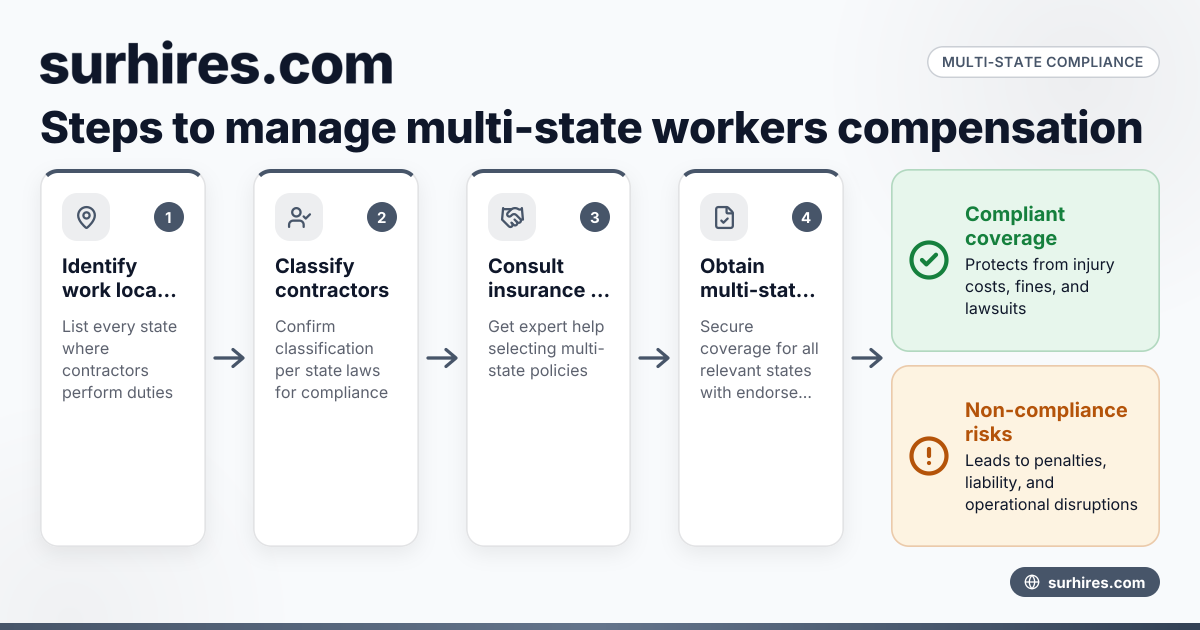
Getting compliant coverage requires a clear process:
- Identify Work Locations – List all states where contractors will perform any work duties.
- Classify Workers Properly – Confirm if contractors are classified consistent with state regulations regarding workers compensation.
- Consult Insurance Brokers – Work with brokers who specialize in multi-state workers compensation policies for contractors.
- Obtain Multi-State Policies – Purchase or endorse policies covering all relevant states, ensuring exceptions or state-specific rules are addressed.
- Maintain Records – Keep documentation on contractors, coverage certificates, and work assignments to demonstrate compliance.
- Review and Update Regularly – Refresh the list of work states and coverage requirements quarterly or upon changes in the contractor pool.
Using digital platforms and AI-driven compliance systems like surhires.com adds efficiency to these steps with automated alerts and documentation tracking.
What are some state-specific considerations for multi-state workers compensation?
Some states, like Texas, have unique rules that allow companies to opt out of the state workers compensation system but require alternative proof of coverage. California typically has stricter rules on contractor classification and requires specific coverage notices.
States have differing rules on coverage for out-of-state contractors temporarily working within their borders, with thresholds for duration and type of work. Knowing these nuances is essential for comprehensive multi-state workers compensation management.
How can surhires.com help with multi-state workers compensation compliance?
surhires.com offers tools to manage contractor documentation and compliance obligations effectively. The platform helps U.S. businesses:
- Track contractor work locations and classification status.
- Store and manage workers compensation insurance certificates across states.
- Automate reminders for policy renewals and updates.
- Ensure adherence to state-specific compliance rules, reducing risk.
By integrating with your existing HR and finance systems, surhires.com streamlines the complex process of multi-state contractor compliance management and reduces manual errors.
Tips for Managing Multi-State Workers Compensation for Contractors
- Keep detailed logs of where each contractor works and for how long.
- Regularly consult legal and insurance experts to stay current on evolving state laws.
- Use centralized digital systems rather than spreadsheets or manual files.
- Educate contractors about your coverage and compliance process to encourage transparency.
- Audit compliance annually to uncover gaps early and adjust policies accordingly.
Conclusion
Navigating multi-state workers compensation for contractors requires clear knowledge of applicable laws, proper classification, comprehensive insurance coverage, and ongoing compliance management. U.S. businesses that succeed in this area protect themselves from financial risk and legal exposure. Tools like surhires.com can ease multi-state compliance by automating key processes, organizing documentation, and providing proactive alerts.
For U.S. businesses hiring contractors across state lines, mastering multi-state workers compensation compliance is critical to sound operations and worker safety.
To learn more about how surhires.com can help manage contractor compliance across your business operations, visit the surhires.com blog.
Frequently asked questions
What defines “multi-state” workers compensation for contractors?
Multi-state workers compensation refers to insurance coverage meeting the requirements of all U.S. states where contractors physically perform work. Since each state has different rules, having appropriate policies that cover each applicable state is essential.
Are contractors always required to have workers compensation coverage?
Requirements depend on state laws and worker classification. Many states require businesses to provide or verify workers compensation coverage for contractors performing work physically in their jurisdiction. Correct classification influences coverage obligations.
Can I use surhires.com to verify contractor insurance in multiple states?
Yes, surhires.com helps you store, track, and verify workers compensation certificates from contractors across all states, ensuring you have valid and current proof of multi-state insurance compliance.
How often should I review contractors’ workers compensation coverage?
It’s best practice to review coverage whenever contractors start or change work locations. Quarterly reviews can help catch potential coverage gaps as your contractor pool or work sites evolve.
What happens if a contractor works in a state without proper coverage?
The business risks paying injury claims directly, fines from state insurance regulators, and legal expenses from lawsuits without workers compensation immunity, making compliance critical.
How expensive is multi-state workers compensation insurance for contractors?
Costs vary widely depending on the states involved, the contractor’s class code, and the nature of work. Engaging brokers familiar with multi-state policies can help optimize coverage and cost-effectiveness.
For additional practical guides and insights, check out the surhires.com blog.
Published 22 October 2026
See Surhires on a live requisitionMore from the blog
How to Manage State-Specific Sales Tax Obligations When Paying Independent Contractors in the United States
Managing state sales tax obligations for independent contractors in the United States requires understanding varied state rules, identifying taxable.
27 October 2026 · 6 min read
How United States Businesses Can Use surhires.com to Automate Contractor Time Tracking and Payroll Integration
Automating contractor time tracking and payroll integration helps U.S. businesses capture accurate work hours and simplify payments. surhires.com uses
26 October 2026 · 5 min read
How United States Businesses Can Simplify Contractor I-9 Employment Eligibility Verification with surhires.com
Contractor I-9 verification in the United States requires businesses to confirm contractors’ legal work authorization using Form I-9. surhires.com.
26 October 2026 · 6 min read