




Guides
How United States Businesses Can Use surhires.com to Manage Contractor Worker Classification Risks
How United States Businesses Can Use surhires.com to Manage Contractor Worker Classification Risks Properly classifying contractor workers in the.
By The surhires.com team · · 9 min read
How United States Businesses Can Use surhires.com to Manage Contractor Worker Classification Risks
Properly classifying contractor workers in the United States is essential to avoid costly legal and tax penalties. surhires.com simplifies this process by centralizing contractor data, automating risk assessments, and tracking compliance with federal and state classification laws in a secure, integrated platform.
Key takeaways
- Misclassifying contractor workers can lead to IRS fines, back taxes, and costly lawsuits in the United States.
- surhires.com consolidates contractor information and classification documentation to ensure audit-ready compliance.
- AI-powered tools automatically assess classification risks using current IRS and Department of Labor criteria.
- The platform supports multi-state compliance, tackling diverse state laws such as California’s AB5 or Illinois’ SAFE-T Act.
- surhires.com integrates with common payroll and finance systems like QuickBooks and Stripe for seamless tax reporting.
- Data analytics and reporting features help optimize contractor classifications and prevent risks before they arise.
What is contractor worker classification in the United States?
Contractor worker classification in the United States determines whether a worker is treated as an independent contractor or an employee for tax and legal purposes. The IRS and the Department of Labor have established specific tests focusing on factors such as:
- Behavioral Control: Does the company control or direct how the worker performs tasks?
- Financial Control: Does the worker have significant investment in their work or the ability to make a profit or loss?
- Type of Relationship: Are there contracts, benefits, or permanency that indicate employment?
Classification impacts tax withholding, payroll tax obligations, eligibility for benefits like unemployment insurance, and labor law protections. Misclassifying employees as contractors to save on taxes or benefits is illegal and can trigger audits, back taxes, interest, and penalties.
Worked example: Misclassification impact in Chicago
Consider a Chicago-based manufacturing business that classifies assembly line workers as independent contractors. If audited, the IRS may find that behavioral control (work hours, supervision) points to employee status. This triggers back payment of payroll taxes, penalties, and Illinois state unemployment insurance obligations. The company risks thousands in unexpected expenses and possible legal claims.
Why do United States businesses face worker classification risks?
The risk of misclassification arises because classification rules are complex and vary across jurisdictions.
- Multi-layered regulations: The IRS provides federal criteria, but states have their own additional rules. California’s AB5 law, for example, imposes stricter guidelines on independent contractor status compared to Texas or Illinois.
- Evolving laws: States regularly update classification laws to address gig work and contractor trends.
- Operational complexity: Businesses often work with contractors across multiple states, each with differing rules.
- Manual management pitfalls: Companies relying on spreadsheets or disconnected systems can miss compliance updates or misfile documents.
- Growing contractor workforce: With more firms using contract labor to stay agile, the risk of non-compliance and audits increases.
Pitfall: Inconsistent practices
A business may classify all remote IT consultants as contractors without verifying each state's laws where they reside. This inconsistency can lead to reclassification demands, owing back taxes in multiple states, and legal exposure.
How does an AI contractor worker analysis help reduce misclassification?
AI contractor worker analysis uses machine learning algorithms to review relevant data such as contracts, work patterns, payment records, and business interactions. It compares this data against federal and state classification criteria and generates risk scores.
- Early detection: Flags contractors whose work arrangements resemble employees more than contractors.
- Actionable insights: Recommends reviewing agreements or adjusting payroll classifications.
- Continuous monitoring: Alerts when new data or regulation changes affect classification status.
- Reduced manual errors: Replaces guesswork and manual assessments with data-driven accuracy.
Step-by-step AI analysis process
- Upload or link contractor agreements and payment data.
- AI examines clauses related to control, work scope, expenses, and relationship terms.
- The system analyzes work schedules, supervision intensity, and financial arrangements.
- It scores each contractor’s classification risk and provides detailed reports.
- Businesses review flagged contractors and make compliance updates accordingly.
This approach helps businesses avoid costly misclassification penalties and stay audit-ready.
How can I use surhires.com to manage contractor worker classification United States requirements?
surhires.com offers a comprehensive solution tailored to U.S. businesses:
- Centralize Contractor Data: Upload contracts, IRS Form W-9s, classification questionnaires, insurance certificates, and compliance documents all in one secure place.
- AI-Powered Risk Evaluation: Automatically assess classification risk using IRS and Department of Labor guidelines incorporated into the platform. Quickly identify contractors at risk of misclassification.
- Multi-State Compliance Management: The platform maintains a database of state-specific classification laws. It automatically monitors contractors operating in states like California, Illinois, Texas, Detroit, and Chicago, providing alerts if classification risks emerge due to local laws.
- Secure Digital Signatures: Obtain legally binding e-signatures for classification agreements, NDAs, and other contracts to streamline onboarding and renewals.
- Audit-Ready Reporting: Generate reports summarizing classification status, risk assessments, and compliance history to support IRS or state agency audits efficiently.
- Integration with Payroll Systems: Sync contractor payment information with QuickBooks and Stripe, ensuring accurate 1099-K and 1099-NEC form preparation and filing.
Worked example: Using surhires.com for a Houston construction company
A Houston construction firm manages dozens of subcontractors. By uploading all contracts into surhires.com and running AI risk evaluations, they find several subcontractors showing employee-like control patterns. They update contracts to clarify the independent nature of work and adjust payroll classification accordingly. Syncing with QuickBooks ensures proper 1099-NEC filings at year-end, avoiding IRS scrutiny.
Can surhires.com help with contractor classification when working with multiple states?
Yes. surhires.com is especially valuable for businesses with contractors spread across different states. It addresses key challenges:
- State Law Tracking: Constantly updated repository of classification laws and labor standards per state.
- Automated Compliance Alerts: Flags contractors that may violate specific state laws, such as New York’s strict guidelines or Michigan’s unique contractor definitions.
- Custom Document Templates: Provides compliant contract and agreement templates tailored for each state’s requirements.
- Centralized Contractor Profiles: Enables businesses to see each contractor’s classification status across all states in one dashboard.
By automating compliance monitoring and documentation, surhires.com helps companies in urban hubs like Detroit, Chicago, and Houston reduce regulatory risks and the administrative burden associated with multi-state labor laws.
Pitfall to avoid
Ignoring differing state classification laws can lead to reclassification in some states but not others, resulting in fragmented risk exposure and complex audits. surhires.com helps avoid this by ensuring consistent compliance status across jurisdictions.
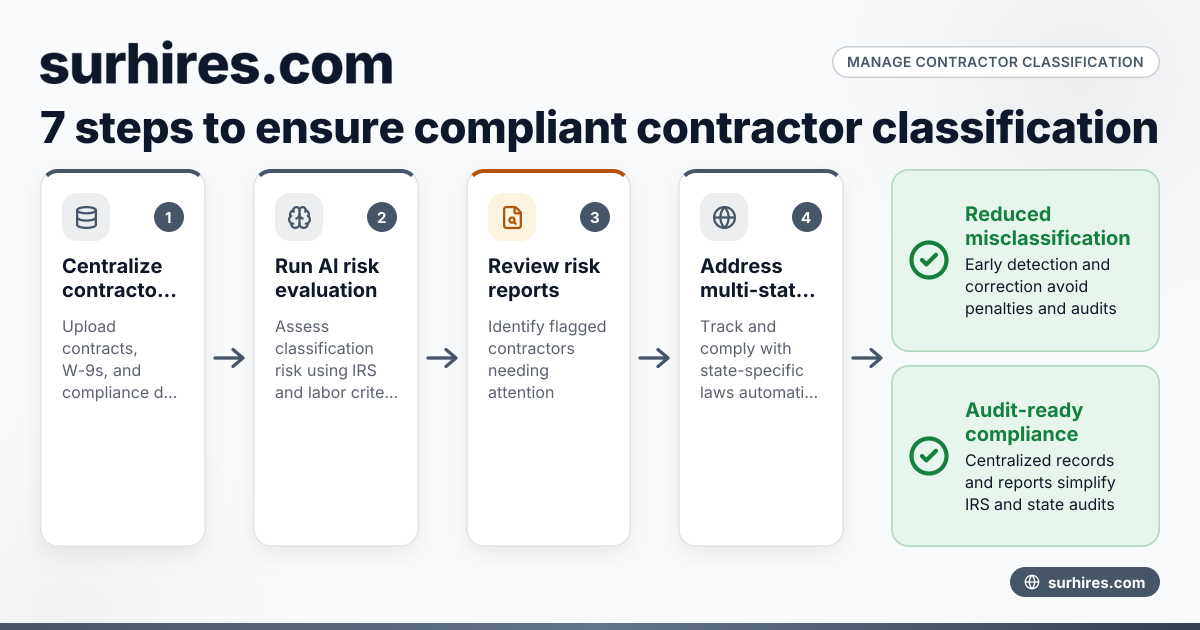
What steps should I take to ensure compliance with contractor classification using surhires.com?
Follow these practical steps to manage classification risk effectively:
- Gather Contractor Documentation: Collect all contracts, W-9s, work statements, and prior classification decisions. Upload these to surhires.com.
- Run Classification AI Analysis: Use surhires.com’s AI tools to assign risk scores for each contractor based on legal criteria.
- Evaluate Risk Reports: Review flagged contractors and high-risk cases for needed changes in contracts, work arrangements, or payroll classifications.
- Address Multi-State Rules: Let the platform track state-specific requirements and update contractor profiles accordingly.
- Securely Execute Updated Documents: Use surhires.com’s e-signature feature to confirm updated classification agreements with contractors promptly.
- Integrate with Payroll and Finances: Connect your QuickBooks or Stripe accounts to keep 1099 filings and payments synchronized and compliant.
- Maintain Ongoing Monitoring: Reassess contractor classification risk when contracts renew, business operations change, or regulations update.
Consistent adherence to this process minimizes misclassification exposure and prepares businesses for IRS or state audits.
How do I handle contractor non-disclosure agreements (NDAs) and classification documents simultaneously?
Contractor NDAs and classification agreements often must be managed together to ensure clear expectations and compliance.
- surhires.com allows you to upload and organize NDAs alongside classification documents within each contractor’s profile.
- Digital signatures for both document types can be obtained simultaneously, with audit trails for legal proof.
- Centralized document management reduces onboarding delays and prevents conflicting terms that might blur the line between contractor and employee.
- Automates reminders to renew or update NDAs and classification agreements as needed.
Learn more about managing NDAs with contractor classification on How United States Businesses Can Manage Independent Contractor Non-Disclosure Agreements (NDAs) Efficiently.
What about tax filings related to contractor workers?
Classifying contractors correctly directly affects IRS tax reporting requirements such as Forms 1099-NEC and 1099-K.
- surhires.com tracks contractor payments linked to classification status.
- The platform validates that contractor income reported on 1099 forms aligns with payment data submitted by QuickBooks, Stripe, or other finance tools.
- Automated deadline alerts prevent late or missed filings.
- Consolidated reporting facilitates IRS audits, reducing business risk.
For deeper insights on using surhires.com for tax filing compliance, see How United States Businesses Can Use surhires.com to Manage Contractor IRS Form 1099-NEC Filing Deadlines.
Conclusion
Correctly classifying contractor workers in the United States requires understanding nuanced federal and state laws, maintaining organized documentation, and staying updated on regulatory changes. surhires.com empowers businesses to meet these challenges by centralizing contractor data, applying AI-driven risk analysis, monitoring multi-state compliance, enabling secure digital workflows, and integrating with common payroll and payment systems.
Adopting surhires.com helps U.S. businesses reduce expensive misclassification mistakes, simplify compliance, and maintain audit readiness. To learn more about optimizing contractor management and worker classification, visit the surhires.com blog for practical guidance and expert advice.
Frequently asked questions
What are the key criteria that define a contractor worker classification in the United States?
The IRS considers behavioral control (how work is done), financial control (how workers are paid and their expenses), and the type of relationship (contracts, benefits) to distinguish employees from independent contractors. Workers who have autonomy and business-like control over their work usually qualify as contractors.
Can surhires.com handle updates in state laws that affect contractor classification?
Yes. surhires.com actively updates classification rules and contract templates to reflect recent federal and state law changes. Users automatically benefit from these updates, aiding continuous compliance without extra legal research.
How does surhires.com ensure data privacy for contractor information?
surhires.com employs strong encryption, secure cloud storage, and meets SOC 2 compliance standards. This protects sensitive contractor financial and personal data, meeting the security expectations of business users in the United States.
Can surhires.com integrate with existing payroll or expense management tools?
Absolutely. surhires.com integrates with popular U.S. finance systems such as QuickBooks and Stripe. This synchronizes payment data, supports accurate 1099 filings, and streamlines expense reimbursements.
What happens if a misclassification is detected through surhires.com?
The platform flags at-risk contractors and suggests corrective steps like revising contracts or reclassifying pay status. Early detection allows businesses to resolve issues proactively before triggering audits or penalties.
How do AI features improve contractor classification decisions on surhires.com?
AI processes contract details, work behavior, and payment patterns comprehensively, revealing risks that manual reviews might miss. This ensures precise compliance assessments and reduces human error in classification decisions.
Published 23 October 2026
See Surhires on a live requisitionMore from the blog
How to Manage State-Specific Sales Tax Obligations When Paying Independent Contractors in the United States
Managing state sales tax obligations for independent contractors in the United States requires understanding varied state rules, identifying taxable.
27 October 2026 · 6 min read
How United States Businesses Can Use surhires.com to Automate Contractor Time Tracking and Payroll Integration
Automating contractor time tracking and payroll integration helps U.S. businesses capture accurate work hours and simplify payments. surhires.com uses
26 October 2026 · 5 min read
How United States Businesses Can Simplify Contractor I-9 Employment Eligibility Verification with surhires.com
Contractor I-9 verification in the United States requires businesses to confirm contractors’ legal work authorization using Form I-9. surhires.com.
26 October 2026 · 6 min read