




Comparisons
Employer of Record vs Staffing Agency in the United States: What’s the Difference?
If you are comparing an employer of record vs staffing agency in the United States, the main difference is simple. An employer of record legally.
By The surhires.com team · · 12 min read
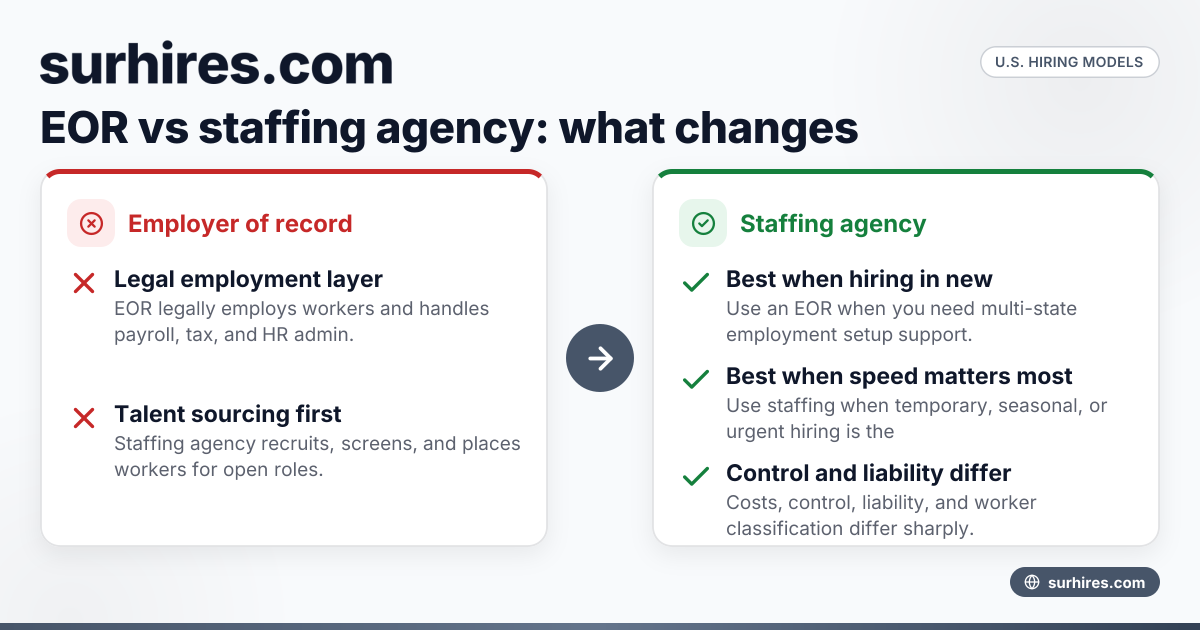
If you are comparing an employer of record vs staffing agency in the United States, the main difference is simple. An employer of record legally employs workers on your behalf, while a staffing agency mainly recruits and supplies talent. Both can help you hire faster, but they solve different problems.
Key takeaways
- An employer of record handles legal employment, payroll, tax withholding, and HR administration for workers it employs for your business.
- A staffing agency focuses on finding and placing workers, often for temporary, contract, or hard-to-fill roles.
- In the United States, the right option depends on whether you need compliant employment infrastructure or recruiting help.
- An EOR is often useful when hiring in new states, while a staffing agency is often useful when speed and candidate sourcing matter most.
- Costs, control, liability, and worker classification differ sharply between the two models.
- Some businesses use both together: a staffing agency sources talent, and an EOR becomes the legal employer.
Employer of Record vs Staffing Agency in the United States: the basic difference
An employer of record, or EOR, is a company that becomes the legal employer of a worker for your business. The EOR typically handles payroll, tax withholding, employment documents, benefits administration, and parts of HR compliance. Your company directs the worker’s day-to-day tasks, but the EOR is the employer on paper.
A staffing agency is different. Its main job is to find workers and place them with client companies. In many cases, the staffing agency recruits, screens, and supplies temporary workers. Depending on the arrangement, the agency may also run payroll for temps it employs. But staffing is still centered on talent supply, not broad employment infrastructure.
That distinction matters for U.S. businesses. If you are opening up hiring in states where you do not already have payroll, registrations, or HR systems, an EOR can help you employ workers without building everything internally. If you simply need five warehouse associates in Houston next week, or a contract customer service rep in Chicago, a staffing agency may be the more natural fit.
What is an employer of record in the United States?
An employer of record is a third party that legally employs a worker on behalf of your business in the United States. The worker performs services for your company, but the EOR manages core employment administration. That usually includes payroll processing, tax withholding, Form W-2 reporting for employees, onboarding documents, and certain HR records.
For many buyers, the core value is compliance support. Hiring across state lines can create real complexity. State payroll registrations, unemployment insurance setup, labor notices, paid leave rules, final paycheck rules, and workers’ compensation expectations can differ by state. A business in Detroit that wants to hire an employee in Texas or Illinois may not want to build a full multi-state employment setup from scratch.
An EOR can reduce that burden. It does not remove the need for good internal management, but it can centralize the legal employment layer. That is why EORs are often discussed alongside remote hiring and distributed teams. If that is your use case, Remote Hiring Compliance Checklist in the United States can help you think through the basics.
What does an employer of record usually handle?
In a typical U.S. arrangement, an EOR may help with:
- Employment agreements and onboarding
- Payroll and tax withholding
- Wage and hour administration
- Benefits administration
- Time-off tracking
- Employment recordkeeping
- Offboarding and final pay coordination
- Multi-state employment setup support
The exact scope depends on the provider and contract. Buyers should never assume every EOR handles every HR or legal issue.
What is a staffing agency in the United States?
A staffing agency helps businesses find workers. It usually recruits candidates, screens them, and places them into roles. Staffing agencies are common for temporary work, seasonal hiring, contract roles, administrative jobs, warehouse labor, healthcare support, and urgent backfills.
In the United States, many staffing agencies work best when speed matters. A manufacturer in Ohio with a sudden production spike may call a staffing agency for machine operators. A retail business in Chicago may use one during holiday demand. A customer support team may use one to fill a short-term call center need fast.
Some staffing agencies also employ temporary workers and assign them to clients. In those cases, the agency may process payroll for those temps. But the business model is still staffing-first. The agency’s main promise is talent supply and placement, not full employment infrastructure for your broader workforce.
What does a staffing agency usually handle?
A staffing agency often helps with:
- Job advertising and sourcing
- Resume screening
- Candidate interviews
- Skills testing
- Reference checks
- Temporary or contract placement
- Some payroll for agency-employed temps
- Rapid backfill for open roles
This model is useful when recruiting is the bottleneck. It is less useful when your real challenge is setting up compliant employment in a new state.
Which one is the legal employer?
An employer of record is generally the legal employer of the worker it hires for your company. A staffing agency may be the employer for temporary workers it places, but that depends on the staffing arrangement. In both cases, your business still directs the work, which means risk and responsibility do not disappear just because a third party is involved.
This is where many buyers get confused. The phrase “we do not employ them directly” can create a false sense of distance. In reality, U.S. businesses still need to manage workplace conduct, supervision, schedules, performance expectations, and job-related decisions carefully. Co-employment and shared responsibility concepts may matter depending on the arrangement.
Why legal employer status matters
Legal employer status affects:
- Payroll reporting
- Tax withholding
- Eligibility for benefits
- Employment documentation
- Workers’ compensation coverage
- Unemployment insurance handling
- Termination process
- Recordkeeping responsibilities
This also affects procurement and security reviews. Larger buyers often ask who employs the worker, who stores employee data, and what controls are in place. If your company sells to enterprise customers, questions about SOC 2, HR processes, and access controls can come up during vendor review.
When should you use an employer of record?
Use an EOR when your main problem is legal employment setup, not candidate sourcing. This often happens when a business wants to hire employees in a state where it has no current employment infrastructure.
For example, imagine a software company in Chicago hiring its first sales employee in Florida and its first account manager in Colorado. The company may not want to register payroll accounts, learn each state’s rules, and build a compliant onboarding process internally right away. An EOR can help bridge that gap.
An EOR can also help when speed matters but the worker should be an employee, not an independent contractor. Misclassification is a serious U.S. issue. If you are weighing contractor relationships as an alternative, read Independent Contractor Compliance Guide in the United States.
Signs an EOR may be the better fit
You may want an EOR if:
- You are hiring in new states.
- You need W-2 employees, not just short-term placements.
- You want centralized payroll and HR administration.
- You need support for multi-state compliance.
- You do not want to build internal employment setup yet.
- You want a cleaner path for remote employee hiring.
Some buyers also look for an ai employer solution when they want faster onboarding workflows and simpler workforce administration. That can be a useful starting point, but buyers should still verify the legal and operational details behind the software layer.
When should you use a staffing agency?
Use a staffing agency when your biggest problem is finding people quickly. This is especially true for temporary, seasonal, project-based, or high-turnover roles.
A distribution business in Houston may need 20 temporary workers for eight weeks. A healthcare office may need a fast front-desk replacement during leave coverage. A manufacturer may need contract quality inspectors for a plant launch. In these situations, a staffing agency’s recruiting network and speed may matter more than EOR-style employment infrastructure.
Staffing agencies can also be useful for hard-to-fill roles where you need market reach, recruiter relationships, and active candidate pipelines. The agency can save internal time by sourcing and screening candidates before they reach your hiring manager.
Signs a staffing agency may be the better fit
You may want a staffing agency if:
- You need workers fast.
- The role is temporary or seasonal.
- Recruiting bandwidth is your main issue.
- You need specialized sourcing support.
- You expect frequent volume hiring.
- You want help filling urgent gaps in operations.
What does it cost?
An EOR usually charges for employment administration, while a staffing agency usually charges for recruiting or labor supply. The total cost depends on role type, hiring volume, assignment length, benefits, and the contract terms. The cheaper option on paper is not always the lower-risk option in practice.
When comparing cost, do not stop at the headline fee. Look at the full operating picture. A staffing agency may quote a markup on hourly labor. An EOR may charge for employment administration and payroll support. Your internal team may still carry management, equipment, software access, and training costs either way.
Cost factors to compare
For an EOR, common cost drivers may include:
- Number of employees
- States involved
- Payroll complexity
- Benefits administration
- Onboarding and offboarding volume
- HR support level
For a staffing agency, common cost drivers may include:
- Role urgency
- Local labor market conditions
- Shift coverage
- Assignment duration
- Skill level
- Conversion terms if you later hire the worker directly
A practical buying approach is to compare total cost of hiring, not just vendor invoices. For example, if an EOR helps you hire a long-term employee compliantly in a new state without creating internal payroll setup work, that may be more efficient than a short-term staffing fix followed by a later rebuild.
How do control and management differ?
With either model, your business usually manages the worker’s day-to-day duties. But the scope of administrative control differs. An EOR handles employment administration for workers it legally employs. A staffing agency mainly handles recruiting and placement, though it may also administer payroll for agency-employed temps.
This difference affects internal workflows. With an EOR, your HR, finance, and legal teams may coordinate on onboarding, wage details, time off, and offboarding through the EOR process. With a staffing agency, your team may spend more time defining assignments, reviewing candidates, and managing shift needs.
Questions to ask internally
Before choosing either option, answer these:
- Is our problem hiring speed or employment setup?
- Is this worker temporary, project-based, or long term?
- Do we need a W-2 employee?
- Are we hiring in a new state?
- Who will manage onboarding and performance?
- What level of compliance support do we need?
These answers usually make the decision much clearer.
Is an EOR the same as a temp agency?
No. An EOR is built around legal employment and HR administration, while a temp agency is built around sourcing and placing workers, often for short-term needs. They can overlap in some practical ways, but they are not the same service.
A temp agency is one type of staffing agency. Temp agencies are especially common in warehousing, clerical work, manufacturing, and seasonal operations. They shine when the work is short term and labor demand changes quickly.
An EOR is usually a better fit for a business that already knows who it wants to hire, or expects a more stable employee relationship, but does not want to build internal multi-state employment infrastructure yet. If you are comparing adjacent models, Contractor of Record vs Employer of Record in the United States: Which One Does Your Business Need? is also worth reviewing.
How should U.S. businesses evaluate providers?
Start with your risk, not the sales pitch. Buyers often focus on speed first. That matters, but compliance, data handling, and operational fit matter just as much.
A simple evaluation checklist
Use these steps:
- Define the worker type.
Decide whether you need a temporary worker, contractor, or employee.
- Map the states involved.
Multi-state hiring creates payroll and labor rule complexity fast.
- Confirm legal responsibilities.
Ask who employs the worker, who runs payroll, and who keeps records.
- Review onboarding and offboarding workflows.
Check how documents, tax forms, and final pay are handled.
- Ask about systems integration.
Many U.S. businesses need workflows that fit QuickBooks, Stripe, or existing HR tools.
- Check security expectations.
Ask about access controls, audit trails, and whether the provider can support enterprise buyer expectations such as SOC 2 reviews.
- Validate classification logic.
Do not let a vendor push workers into the wrong category for convenience.
- Review the contract carefully.
Pay attention to indemnity, service scope, termination terms, and data responsibilities.
If you are building contractor workflows at the same time, How to Create a Compliant 1099 Contractor Onboarding Process in the United States and How to Collect Form W-9 From Contractors in the United States can help.
Common mistakes when comparing an employer of record vs staffing agency United States
Many buyers use the phrase “employer of record vs staffing agency United States” because the services can look similar at first glance. The mistakes usually happen when teams compare only speed or only cost.
Mistake 1: Assuming both solve the same problem
They do not. EORs solve legal employment administration. Staffing agencies solve talent sourcing and placement.
Mistake 2: Ignoring the worker’s expected duration
A short seasonal assignment and a long-term remote employee need different support models.
Mistake 3: Overlooking state-by-state employment complexity
A business may manage one-state hiring well, then struggle when it adds workers in several states.
Mistake 4: Treating compliance as an afterthought
Payroll taxes, wage rules, onboarding documents, and worker classification can become expensive issues later.
Mistake 5: Failing to involve finance and legal early
Procurement, HR, finance, and legal should all weigh in before you sign.
A good comparison process saves time later. You can also browse the surhires.com blog for more practical guides on workforce models and compliance in the United States.
Final decision: which one should you choose?
Choose an employer of record if you need a third party to legally employ workers for your business and handle the employment administration layer. Choose a staffing agency if you need help sourcing and supplying workers quickly, especially for temporary or urgent roles.
Published 10 October 2026
See Surhires on a live requisitionMore from the blog
How to Manage State-Specific Sales Tax Obligations When Paying Independent Contractors in the United States
Managing state sales tax obligations for independent contractors in the United States requires understanding varied state rules, identifying taxable.
27 October 2026 · 6 min read
How United States Businesses Can Use surhires.com to Automate Contractor Time Tracking and Payroll Integration
Automating contractor time tracking and payroll integration helps U.S. businesses capture accurate work hours and simplify payments. surhires.com uses
26 October 2026 · 5 min read
How United States Businesses Can Simplify Contractor I-9 Employment Eligibility Verification with surhires.com
Contractor I-9 verification in the United States requires businesses to confirm contractors’ legal work authorization using Form I-9. surhires.com.
26 October 2026 · 6 min read