How-to
How to Create a Compliant 1099 Contractor Onboarding Process in the United States
A compliant 1099 contractor onboarding process in the United States helps you start work quickly without creating tax, labor, or security problems.
By The surhires.com team · · 12 min read
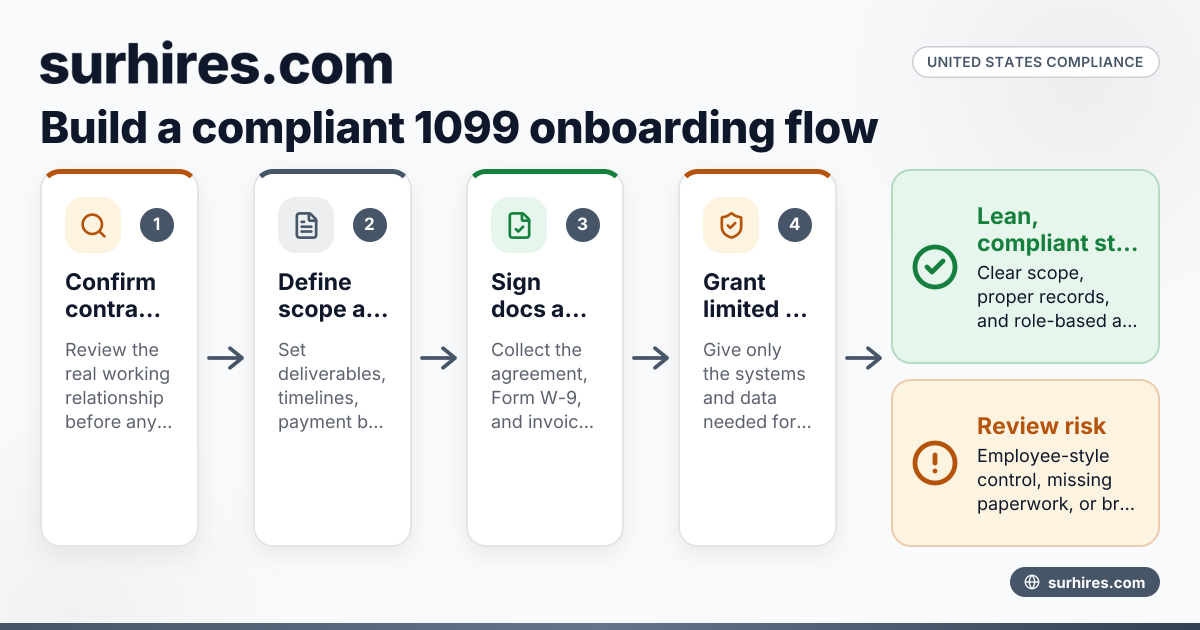
A compliant 1099 contractor onboarding process in the United States helps you start work quickly without creating tax, labor, or security problems later. The goal is simple: verify the relationship, collect the right documents, define the work clearly, and onboard the contractor without treating them like a W-2 employee.
Key takeaways
- A strong 1099 contractor onboarding process in the United States starts before the first task is assigned.
- Classification comes first. If the worker should be an employee, onboarding documents will not fix the problem.
- Your process should cover contracts, tax forms, payment setup, system access, and security expectations.
- Keep onboarding lean. Give contractors what they need to do the work, not employee-style controls and perks.
- Review state-specific rules, client requirements, and data access before work begins.
- Standardizing the process reduces delays, protects your business, and improves the contractor experience.
What is a compliant 1099 contractor onboarding process in the United States?
A compliant 1099 contractor onboarding process in the United States is the set of steps a business uses to bring in an independent contractor while keeping the relationship properly structured. It covers classification review, written agreements, tax paperwork, payment details, scope, security, and access controls.
This matters because contractor compliance is not just about getting a signed contract. It is also about how the relationship works in practice. If you control the contractor like an employee, require rigid schedules, or fold them into employee policies without a good reason, you may increase misclassification risk.
For most US businesses, the onboarding process should create clarity in five areas:
- Who the contractor is and what business they operate.
- What services they will provide.
- How and when they will be paid.
- What systems or data they can access.
- What rules apply without turning them into employees.
If you are building your process from scratch, it helps to review How to Hire 1099 Contractors in the United States before you document the workflow.
Why does onboarding matter so much for 1099 compliance?
Good onboarding sets the legal and operational tone from day one. It helps you avoid sloppy practices that create risk later, such as missing W-9 forms, unclear deliverables, poor access controls, and payment disputes.
A weak process usually causes problems in three places. First, finance may not have the right tax information to issue required forms. Second, managers may treat contractors like employees because no one gave them clear guardrails. Third, IT may grant broad access without confirming what the contractor actually needs.
That is why onboarding should be owned across teams, not just by hiring managers. In many companies, legal, finance, HR, procurement, IT, and the department using the contractor all play a role. Even small businesses in Chicago or Houston benefit from a simple checklist that covers each function.
A compliant process also makes the contractor relationship easier to manage. Contractors can start faster when they know the scope, invoice requirements, points of contact, and system access rules upfront. Your business then spends less time fixing preventable issues.
What documents do you need to onboard a 1099 contractor?
At minimum, collect a signed contractor agreement, a completed Form W-9, payment details, and any confidentiality or security terms tied to the work. Add project-specific documents only when they are necessary.
The exact document set depends on the work. A graphic designer doing one short project needs less than a software developer accessing production systems or customer data.
Core documents to collect before work starts
Most businesses should gather these items before any work begins:
- Independent contractor agreement
This should define the services, payment terms, ownership of work product, confidentiality, term, termination rights, and contractor status.
- Form W-9
Finance uses this to capture the contractor's taxpayer information for reporting purposes.
- Statement of work or scope document
This should describe deliverables, deadlines, milestones, and acceptance criteria.
- Payment setup information
Collect the details needed to pay invoices through your accounts payable workflow, often using QuickBooks or a similar finance process.
- Non-disclosure or confidentiality terms if needed
Some businesses include these in the contractor agreement. Others use a separate document.
- Security or data handling requirements
These matter when the contractor will access sensitive business, buyer, or customer information.
For a practical starting point, see Contractor Agreement Checklist in the United States.
Documents you may need based on the work
Some roles require extra documentation. Examples include:
- Background check authorization, if your process allows it and the work justifies it
- Insurance requirements, if the contractor must carry coverage
- Access request forms for software, file storage, or equipment
- Client-required compliance acknowledgments
- Intellectual property assignment language for custom creative or technical work
Be careful not to overload the file with employee-style forms that do not fit contractor status. A long employee handbook acknowledgment, mandatory attendance policy, or broad performance management form can blur the line between contractor and employee.
Step-by-step: 1099 contractor onboarding process United States
Here is a practical 1099 contractor onboarding process United States businesses can use and adapt.
1. Confirm the worker should be a contractor
Before anything else, review the relationship itself. Ask whether the worker operates independently, controls how the work is done, uses their own methods, and is being engaged for specific services instead of an open-ended employee role.
This is the most important step. If the role should be a W-2 position, no contract language will make it compliant. The day-to-day working relationship matters.
Watch for common red flags:
- You plan to set fixed daily hours
- The worker will report like a manager-supervised employee
- The role is ongoing with no clear project or service scope
- The worker will be trained like new staff
- You expect exclusivity without a strong business reason
If you need a deeper review, read How to Avoid Worker Misclassification When Hiring Remote Talent in the United States.
2. Define the scope and business terms
Write down exactly what the contractor is being hired to do. Keep this focused on outcomes, deliverables, and timelines. Avoid language that describes employee-like duties unless that wording is truly necessary.
A strong scope should answer:
- What work will be delivered?
- When is it due?
- How will success be measured?
- Is payment hourly, per project, per milestone, or on another basis?
- Who approves completed work?
This step reduces disputes and makes invoicing easier. It also helps managers avoid over-directing the contractor later.
3. Sign the contractor agreement before the first day
Do not let work start on a verbal understanding. The agreement should be signed first. It should clearly state that the worker is an independent contractor and responsible for their own taxes and business obligations, to the extent allowed by law.
The agreement should also cover:
- Services
- Fees and payment timing
- Invoice requirements
- Confidentiality
- Work product ownership
- Term and termination
- Compliance with your security requirements
- Limits on authority to bind your business
This is also a good point to think about whether your business needs a structured service to support contractor engagement. If that is relevant, What Is a Contractor of Record in the United States? explains the model.
4. Collect Form W-9 and payment details
Finance should not chase missing forms after work has started. Collect Form W-9 and confirm how the contractor will submit invoices, where they should send them, and what information each invoice must include.
A simple invoice policy often includes:
- Legal name or business name
- Invoice date
- Service period
- Description of work
- Amount due
- Purchase order or project code if required
For businesses using Stripe for certain workflows or QuickBooks for payables, this is the point where internal setup matters. The goal is simple: make sure the contractor can get paid accurately and on time.
5. Give only the access needed for the job
Contractors often need email, shared documents, software tools, or buyer-facing systems. But access should be narrow and role-based. Do not grant broad permissions by default.
For example:
- A freelance marketer may need access to campaign assets, not payroll data.
- A developer may need a test environment, not unrestricted production access.
- A sales contractor may need CRM access, not your full finance system.
This step matters even more if buyers ask about your controls during security reviews. Many US businesses now face basic SOC 2 expectations from enterprise customers, especially when contractors can access sensitive systems.
6. Set communication rules without managing like an employee
Contractors need clarity, but they should not be onboarded as if they joined your employee org chart. Define points of contact, preferred channels, deadlines, and approval steps. Then avoid unnecessary day-to-day control over how they perform the work.
Good contractor communication rules often include:
- Who assigns work
- Who approves deliverables
- How often status updates are shared
- Which channel to use for urgent issues
- How invoices and change requests are handled
Email and phone remain the most common business channels in the United States. Keep the process practical and documented.
7. Train managers on the difference between onboarding and employment
This step is often skipped. It should not be. Managers create risk when they treat contractors exactly like employees after onboarding is complete.
Give managers a short list of do's and don'ts. For example:
Do:
- Focus on outcomes and deadlines
- Use written scopes and change orders
- Limit access to needed systems
Do not:
- Require attendance at employee-only events unless necessary
- Fold contractors into employee performance reviews
- Assign open-ended responsibilities outside the agreed scope
- Control every detail of the workday without a valid reason
8. Document completion and review periodically
Once onboarding is complete, keep a record of what was collected, approved, and granted. Then review active contractors at set intervals.
Your review can check:
- Is the scope still accurate?
- Has access expanded beyond need?
- Has the relationship become ongoing and employee-like?
- Are invoices matching the agreed terms?
- Does the contractor still fit the original classification?
This is especially important for long-running engagements in manufacturing, logistics, and operations-heavy businesses using ERP systems.
How can you use AI without creating compliance risk?
Use AI to organize onboarding tasks, summarize missing documents, and flag gaps in scopes or approvals. Do not rely on AI alone to decide legal classification or replace human review of contracts, tax forms, and access decisions.
Many teams now use workflow tools to move faster. An ai 1099 contractor workflow can help track document collection, remind finance about missing W-9 forms, or identify inconsistent start dates across systems. That can be useful.
But AI should support the process, not run it without oversight. If a system suggests a worker is a contractor, someone in your business still needs to review the facts. The same applies to generated agreements or automated onboarding emails. Human review matters because classification depends on the real relationship, not just a template.
A safe approach is to use AI for administrative support in four areas:
- Checklist management
Flag missing forms, unsigned contracts, or delayed access approvals.
- Document summaries
Help managers quickly review scopes, invoice terms, and confidentiality clauses.
- Routing and reminders
Send prompts to finance, IT, and the hiring team when steps are incomplete.
- Audit preparation
Surface records showing when agreements were signed and access was granted.
Avoid using AI to create rules that push contractors into employee-like management. For example, an automated workflow that enforces daily check-ins, fixed schedules, or employee-style performance scoring may increase risk.
What should you avoid during contractor onboarding?
Avoid employee-style control, missing paperwork, overbroad access, and vague scopes. The safest process is clear, documented, and limited to what the contractor needs to perform the agreed work.
Below are the most common mistakes.
Treating the contractor like a new employee
This shows up in subtle ways. A manager adds the contractor to every staff meeting, assigns a company title, requires full-time office hours, and routes them through employee onboarding modules. Those habits may make operations easier, but they can undermine contractor status.
Letting work start before paperwork is complete
This creates preventable problems. Your business may lack a signed agreement, tax information, confidentiality terms, or approved payment setup. Once work starts, it is harder to correct missing items.
Giving broad system access too early
Access sprawl is a real issue. A contractor who needs one project folder should not automatically receive company-wide data. Keep permissions tight and remove them at the end of the engagement.
Using one generic process for every contractor
A software consultant, sales lead generator, photographer, and plant maintenance specialist do not need the same onboarding steps. Standardize the framework, but tailor the details.
Ignoring state and industry requirements
Federal tax forms matter, but they are not the whole picture. Depending on the work and where your business operates, there may be additional state, client, or industry expectations. Review those before work begins rather than after a dispute.
A simple onboarding checklist for US businesses
Use this as a working checklist.
Before engagement approval
- Confirm the role is appropriate for contractor classification.
- Define deliverables, timeline, and payment model.
- Identify data, systems, or facilities the contractor will need.
Before the start date
- Sign the contractor agreement.
- Collect Form W-9.
- Set up payment workflow and invoice instructions.
- Confirm confidentiality and IP terms.
- Approve only the access needed.
- Assign an internal point of contact.
During the first week
- Share scope, milestones, and communication rules.
- Provide required tools or access.
- Explain security expectations.
- Confirm how changes to scope will be handled.
During the engagement
- Review invoices against the scope.
- Monitor access and reduce it if needed.
- Watch for classification drift.
- Update the agreement if the work changes.
At offboarding
- Revoke system access.
- Confirm final invoice status.
- Collect deliverables.
- Save agreements and tax documents in your records.
If you want a practical companion guide, How to Onboard Remote Contractors in the United States covers many of the same steps in a remote work context.
When should you convert a contractor to an employee?
Convert a contractor to an employee when the relationship starts to look like regular employment. Common signs include open-ended duties, close daily supervision, fixed schedules, and deeper integration into your business.
Sometimes a contractor engagement begins appropriately and then changes over time. A short project turns into a year-round role. A specialist who controlled their own work becomes part of a managed team. When that happens, review the relationship quickly rather than waiting for a tax or labor issue to force the decision.
If a change is needed, How to Convert a Contractor to an Employee in the United States can help you plan the transition cleanly.
Published 9 October 2026
See Surhires on a live requisitionMore from the blog
Contractor Agreement Checklist in the United States
A contractor agreement checklist in the United States is a practical way to make sure your business covers the terms that matter before work starts. A
9 October 2026 · 12 min read
How to Avoid Worker Misclassification When Hiring Remote Talent in the United States
Worker misclassification happens when a business treats a worker as an independent contractor when the law says that worker should be an employee.
9 October 2026 · 12 min read
What Is a Contractor of Record in the United States?
A contractor of record in the United States is a service provider that helps a business engage and manage independent contractors through a compliant.
8 October 2026 · 12 min read