Product
What Is a Contractor of Record in the United States?
A contractor of record in the United States is a service provider that helps a business engage and manage independent contractors through a compliant.
By The surhires.com team · · 12 min read
A contractor of record in the United States is a service provider that helps a business engage and manage independent contractors through a compliant, documented process. It typically supports onboarding, contracts, tax paperwork, and payments, while the contractor still works for your business as an independent service provider, not as your employee.
Key takeaways
- A contractor of record United States service helps businesses work with 1099 contractors in a more organized and compliant way.
- It usually supports contracts, identity and tax documentation, onboarding records, and payment workflows.
- It does not turn a contractor into your employee, and it does not remove your need to classify workers correctly.
- It can reduce admin strain for finance, HR, legal, and hiring teams, especially across multiple states.
- US businesses often use it when scaling quickly, hiring remote talent, or cleaning up inconsistent contractor processes.
- You should compare scope carefully, especially around compliance support, payment operations, and contractor onboarding.
What is a contractor of record in the United States?
A contractor of record United States solution acts as an administrative layer between your business and the contractor relationship. In plain terms, it helps you set up and run contractor engagements in a consistent way.
That often includes collecting onboarding details, issuing contracts, gathering tax forms such as Form W-9 when needed, and supporting payment workflows. It may also help maintain records your business needs for accounting, procurement, and audit readiness.
For a US business, this matters because contractor relationships can get messy fast. One team emails a PDF. Another team pays from QuickBooks without a signed agreement. A third team never checks whether the worker should really be treated as an independent contractor. Over time, that creates risk.
A contractor of record service is meant to standardize that process. It gives your business a clearer path from request to onboarding to payment. It also helps contractors know what documents to complete and when they can expect payment.
The key point is simple. A contractor of record is not the same thing as hiring an employee. It supports contractor engagements. It does not automatically make every engagement compliant on its own.
How does a contractor of record work?
A contractor of record helps a US business onboard, document, and pay independent contractors through a structured process. It centralizes contracts, tax forms, and payment records, but your company still needs to classify each worker correctly.
In practice, the process usually looks like this:
- Your business identifies the contractor need
A hiring manager, department head, or procurement lead decides the business needs outside help. This might be a software developer in Chicago, a designer in Houston, or a manufacturing consultant supporting an ERP rollout in Detroit.
- The contractor is reviewed for fit and classification
Before work starts, the business should confirm the person is being engaged as an independent contractor and not as an employee. This step matters because worker classification risk does not disappear just because a third party helps with administration.
- The contractor completes onboarding documentation
This may include contact details, tax documentation, payment information, and compliance acknowledgments. For many US businesses, this step is where a contractor of record removes manual email follow-up.
- A services agreement is issued and signed
The agreement usually covers scope, payment terms, confidentiality, IP ownership, and termination language. A clean contract process is one of the biggest benefits of using a structured provider.
- Work begins and payments are processed
Once approved, the contractor performs services for your business. Payment records can then flow through the agreed process, whether your finance team uses QuickBooks, Stripe, or another internal workflow.
- Records are stored for finance and compliance
The business retains visibility into agreements, payment history, and tax records. This becomes useful during internal reviews, 1099 preparation, or buyer due diligence.
That structure is often valuable for growing companies. A founder-led business may be able to manage three contractors through email. It usually cannot manage 30 contractors across departments that way.
Why do US businesses use a contractor of record?
US businesses use a contractor of record to reduce administrative work, create a repeatable onboarding process, and improve documentation. It is especially useful when teams hire contractors across several states or across many departments at once.
The need often appears when a company reaches a certain level of complexity. Maybe your finance team is chasing missing forms before year-end. Maybe legal is reviewing inconsistent contractor agreements from five different templates. Maybe procurement has no central list of who is active and who is not.
A contractor of record can help solve those operational problems.
Common reasons businesses adopt one
1. Faster contractor onboarding
Speed matters when you need specialized talent. If your company hires a cybersecurity consultant, a product marketer, or even an ai contractor for a limited project, long email threads can delay the start date. A standardized workflow helps everyone move faster.
2. Better documentation
Most problems in contractor management are not dramatic. They are boring process failures. Missing signed agreements. Missing tax forms. Unclear rates. Payment terms hidden in email. A contractor of record brings those details into one process.
3. Cleaner finance operations
Finance teams want predictable records. They want approved rates, payment dates, and clean contractor details before money goes out. That matters for month-end close, annual reporting, and audit trails.
4. Lower operational strain on internal teams
HR, legal, and finance often spend too much time fixing avoidable contractor admin issues. A contractor of record shifts much of that routine work into a defined system.
5. More confidence during diligence
If your business is raising capital, pursuing enterprise customers, or preparing for acquisition, buyers often expect organized records. They may ask about contractor agreements, data handling, access controls, and payment history. Strong records support that conversation, especially when buyers expect a mature compliance posture such as SOC 2 readiness.
What does a contractor of record not do?
A contractor of record does not automatically make every contractor relationship legally safe. It also does not replace your business judgment about who should be a contractor versus an employee.
That distinction matters.
It does not remove classification risk
In the United States, worker classification depends on the actual relationship, not just the label in the contract. If your company controls the person like an employee, gives ongoing core duties, or structures the relationship like employment, a contractor of record will not erase that issue.
If you are unclear on the difference, see How to Hire 1099 Contractors in the United States. It covers practical points businesses should check before engaging independent talent.
It does not become your full HR department
A contractor of record can support contractor administration. It is not the same as an employer solution for W-2 employees. If your real need is lawful employment, benefits administration, payroll tax withholding, and formal employment infrastructure, you may need a different model, such as Employer of Record in the United States: What It Is and When Businesses Need One.
It does not guarantee every payment issue disappears
A structured provider helps, but internal approvals still matter. If your managers approve invoices late, if procurement rules are unclear, or if scopes keep changing, those issues can still affect payments.
It does not replace a good statement of work
The cleaner your scope, deliverables, rates, and timelines, the easier the contractor relationship will be. A contractor of record can support the process, but your business still has to define the work properly.
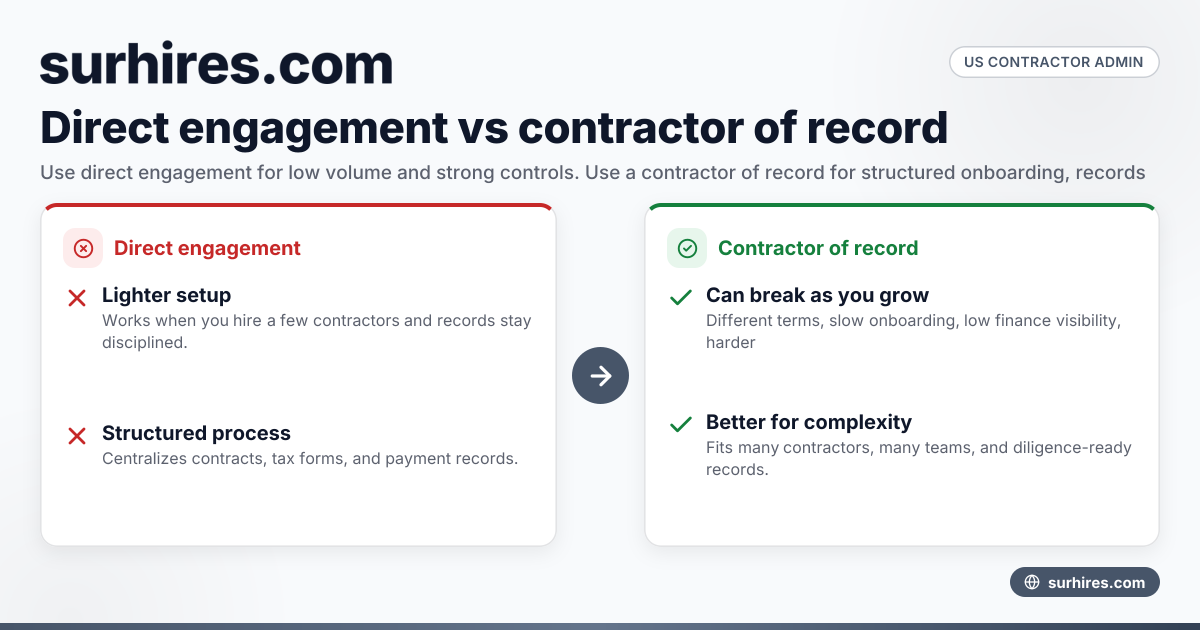
Contractor of record vs direct contractor engagement
Some US businesses ask whether they even need this kind of service. That depends on your contractor volume, internal controls, and risk tolerance.
Direct contractor engagement
This is the simple route. Your business finds the contractor, sends an agreement, collects a W-9 if applicable, and pays the person directly.
This can work well when:
- You only hire a few contractors each year
- One finance lead manages all contractor payments
- Legal has a standard agreement template
- Your teams are disciplined about recordkeeping
But direct engagement often breaks down when the business grows. Different departments start using different terms. Onboarding slows down. Finance loses visibility. Contractors send invoices in several formats. Year-end tax reporting becomes harder.
Contractor of record model
This model works better when:
- You engage many contractors
- Multiple teams hire independently
- You need consistent agreements and workflows
- You want central records for payments and compliance
- You are preparing for diligence by customers or investors
In short, direct engagement is lighter. A contractor of record is more structured.
Is a contractor of record the same as an employer of record?
No. A contractor of record manages independent contractor administration. An employer of record employs workers on your behalf in an employment model.
That means the two services support different worker types.
Contractor of record
Use this when the person is properly classified as an independent contractor. The relationship is project-based or service-based. The person is not part of your employee headcount.
Employer of record
Use this when the person should be an employee and you need formal employment infrastructure. That can matter if the worker is long-term, tightly supervised, or integrated into day-to-day operations like an employee.
Businesses sometimes start with contractors and later realize the role should be employment. If that happens, How to Convert a Contractor to an Employee in the United States can help you think through the transition.
What should you look for in a contractor of record provider?
Look for clear workflows, strong documentation, and practical support for US contractor administration. The best option is not just about speed. It is about creating a process your hiring, finance, and legal teams can trust.
1. Clear onboarding steps
You should understand exactly how contractors are onboarded. Ask what documents are collected, when signatures happen, and how payment setup works.
2. Contract support
A good process should support consistent agreements and clear record retention. Ask how amendments, renewals, and offboarding are handled.
3. Payment visibility
Finance teams need to know when a contractor is approved, what rates apply, and what payment information is on file. Strong visibility reduces rework.
If payments are a major concern, How to Pay Independent Contractors in the United States is a useful next read.
4. Tax document readiness
At a minimum, your process should support clean tax documentation and reliable contractor records. This is especially important for annual 1099 workflows.
5. Good experience for contractors
If onboarding is confusing, your best contractors may delay or walk away. A smooth contractor experience helps your company look organized and credible.
6. Alignment with your internal systems
Ask how the process fits your current stack. Many US businesses need a workflow that works cleanly with QuickBooks, Stripe, approval chains, and internal procurement controls.
When is a contractor of record a smart choice?
A contractor of record is a smart choice when your business has outgrown ad hoc contractor management. If contractor engagement now touches multiple departments, states, or payment workflows, more structure can save time and reduce risk.
Here are common trigger points.
You are scaling contractor hiring quickly
Startups and growth-stage companies often move from two contractors to twenty in a short period. That shift exposes weak processes fast.
Your finance team is doing too much manual work
If your team is chasing invoices, tax forms, and bank details through email, a better system is worth considering.
Your agreements are inconsistent
Different templates create different risk. A more standardized process brings more control.
Enterprise buyers are asking harder questions
If your customers ask about security, vendor management, access controls, or documentation, your contractor process becomes part of the picture. Even if you are not in a regulated industry, buyers may still expect a mature operating model.
You want cleaner onboarding for specialized talent
This can include short-term consultants, creative professionals, technical experts, and an ai contractor brought in for a defined automation or data project. When that type of engagement moves quickly, process quality matters.
For a broader view of contractor setup, How to Onboard Remote Contractors in the United States covers the practical pieces many teams miss.
What questions should you ask before choosing one?
What documents are collected, how payments are handled, and what remains your responsibility are the most important questions. You should also ask how the provider supports recordkeeping and whether the process fits your current finance and legal workflows.
Then go deeper.
Ask about scope
Some providers focus heavily on onboarding. Others include more payment support. Others mainly solve for documentation. You need to know what is included.
Ask about classification boundaries
A serious provider should be clear that contractor classification still matters. Be cautious if the sales process suggests the service solves every classification issue by itself.
Ask about contractor experience
Request a walkthrough of the actual contractor journey. A polished buyer demo does not always reflect the contractor side.
Ask about records and reporting
Your team should know where agreements, payment records, and tax documents are stored and how they can be accessed later.
Ask about offboarding
Contractor management does not end at onboarding. Ask how the process handles engagement end dates, contract closure, and final payments.
Common mistakes businesses make
The biggest mistake is assuming a contractor of record replaces internal decision-making. It helps you run the process. It does not decide the right worker model for you.
Other common mistakes include:
Choosing based on speed alone
Fast onboarding is useful, but bad documentation creates bigger problems later.
Ignoring finance input
If finance is not involved early, the process may create approval bottlenecks or reporting gaps.
Using vague scopes of work
A clear scope protects both sides. It also makes invoice review easier.
Treating long-term core roles as contractor roles by default
Just because a contractor can do the work does not mean the role should stay a contractor role forever.
Forgetting communication standards
Contractor outreach still needs to follow sound business practices. If your teams use email or phone for recruiting or engagement outreach, keep messaging lawful and organized. In the United States, that may include rules such as CAN-SPAM for email and TCPA considerations for certain phone and text outreach.
A strong contractor process is part legal hygiene, part operations, and part finance discipline.
If you want more practical hiring and workforce guidance, you can explore the surhires.com blog.
Published 8 October 2026
See Surhires on a live requisitionMore from the blog
How to Onboard Remote Contractors in the United States
Remote contractor onboarding in the United States means giving a contractor everything they need to start work quickly, legally, and securely without.
8 October 2026 · 12 min read
How to Hire 1099 Contractors in the United States
Hiring 1099 contractors in the United States means engaging self-employed workers for defined services without putting them on payroll as employees.
8 October 2026 · 12 min read
How to Convert a Contractor to an Employee in the United States
Converting a contractor to an employee in the United States means ending the independent contractor arrangement and putting that worker on payroll as.
8 October 2026 · 12 min read