Guides
Employer of Record in the United States: What It Is and When Businesses Need One
An employer of record in the United States is a company that hires workers on paper for another business. The employer of record handles payroll, tax.
By The surhires.com team · · 12 min read
An employer of record in the United States is a company that hires workers on paper for another business. The employer of record handles payroll, tax withholding, benefits administration, and employment paperwork, while your business manages the worker’s day-to-day tasks.
Businesses usually need an employer of record when they want to hire in a new state without setting up their own legal payroll and HR infrastructure. It can also help when speed, compliance, and risk control matter more than building an in-house employment operation right away.
Key takeaways
- An employer of record in the United States becomes the legal employer for payroll, tax, and HR administration.
- Your business still directs the worker’s role, goals, schedule, and daily performance.
- An EOR can help when hiring across state lines, testing a new market, or onboarding quickly.
- It does not remove all risk, so you still need clear job scopes, manager training, and strong documentation.
- The right setup depends on whether you need a W-2 employee, a 1099 contractor, or direct hiring.
- Businesses should review payroll taxes, state registration, benefits, workers’ compensation, and data security before choosing an EOR.
What is an employer of record in the United States?
An employer of record, often called an EOR, is a third-party company that legally employs a worker on your behalf in the United States. The EOR runs payroll, withholds federal and state taxes, manages required employment documents, and often supports benefits and workers’ compensation coverage.
Your business does not lose operational control of the role. You still assign work, set priorities, review performance, and decide whether the role is a fit. The difference is that the EOR sits between your business and the worker for formal employment administration.
For many companies, this matters most when hiring in a state where they do not yet have payroll accounts, HR processes, or legal support in place. A software company in Chicago might want to hire a sales manager in Texas. A manufacturer in Detroit might need a supply chain analyst in Georgia. An EOR can make that possible without forcing the company to build a full employment setup in each location first.
In practical terms, the employer of record united states model is about speed and compliance. It lets a business hire talent in the United States while reducing the amount of internal payroll and HR work needed to start.
When do businesses need an employer of record?
A business usually needs an EOR when it wants to hire a U.S. employee but is not ready to become the direct employer in that worker’s state. That can happen during expansion, pilot hiring, urgent backfills, or remote team growth.
There are several common situations where this becomes useful.
1. You want to hire in a new state fast
Every state has its own employment and payroll requirements. You may need tax registrations, unemployment insurance setup, labor notices, and workers’ compensation arrangements. If you need someone working soon, an EOR can bridge that gap.
For example, a Houston-based services company may want to hire an operations lead in Illinois within two weeks. Building direct payroll and HR support for that hire may take time. An EOR can often move faster.
2. You are testing a market before setting up fully
Not every new state becomes a long-term expansion success. If you are opening sales coverage in California, Florida, or New York but do not know whether you will keep a permanent team there, using an EOR can reduce upfront complexity.
This approach gives your business time to measure revenue potential before building its own entity structure, payroll process, and internal compliance workflows.
3. You need stronger compliance support
Small and mid-sized businesses often have lean HR teams. If you are hiring in several states at once, keeping up with wage laws, onboarding forms, leave rules, and payroll administration becomes harder. An EOR can help standardize those functions.
That matters if your finance stack is built around QuickBooks and Stripe but your internal HR process is still simple spreadsheets and email approvals. An EOR can reduce administrative pressure.
4. You are not sure the role should be a contractor
Some businesses start by thinking a worker should be on a 1099. Then the real working relationship looks more like employment. If you control the worker’s schedule, provide ongoing direction, and integrate them into core operations, a W-2 structure may be safer. For a deeper look, see 1099 vs W-2 for Remote Workers in the United States.
How does an employer of record work?
An employer of record legally hires the worker, runs payroll, withholds taxes, and manages employment administration. Your company controls the worker’s duties, goals, and daily output, but the EOR handles the back-office employer tasks.
Under the surface, the process is usually straightforward.
1. Your company chooses the role and candidate
You identify the job, compensation range, reporting line, and start date. You may recruit the worker yourself or with outside help.
2. The EOR becomes the legal employer
The worker signs employment documents with the EOR. That makes the EOR the employer for payroll, tax, and statutory HR purposes.
3. Your business directs the day-to-day work
You set responsibilities, track performance, approve time where needed, and manage outcomes. This is the practical working relationship the employee experiences each day.
4. The EOR handles payroll and employment administration
The EOR withholds applicable federal, state, and local taxes, issues payroll, and supports items like onboarding forms, benefits administration, and offboarding paperwork. It may also assist with workers’ compensation and employment records.
5. You pay the EOR
Your business pays the EOR based on the worker’s compensation and the service arrangement. The EOR then pays the employee through payroll.
This model can also fit companies exploring more automated HR workflows. Some buyers now look for an ai employer experience, meaning faster onboarding, clearer documents, and more centralized hiring operations. That can sound attractive, but the core issue is still compliance and service quality, not just automation.
What does an employer of record actually handle?
An EOR usually handles payroll, tax withholding, employment forms, and benefits administration. It may also support onboarding, workers’ compensation, labor notices, and terminations, but the exact scope depends on the service agreement.
Below are the core areas most U.S. businesses should review.
Payroll and tax administration
The EOR generally processes wages, withholds taxes, and handles payroll reporting tied to the employment relationship. This is one of the biggest reasons companies use an EOR in the first place.
Onboarding documents
Employment paperwork can include Form W-4, Form I-9, state withholding forms, direct deposit setup, and policy acknowledgments. A strong EOR process helps keep these steps consistent.
Benefits administration
Depending on the arrangement, the EOR may support health benefits, retirement plan access, and leave administration. Ask what is included and what remains your responsibility.
Workers’ compensation and employment notices
Many states require workers’ compensation coverage and certain notices for employees. An EOR often helps manage these obligations.
Separation support
Offboarding can involve final pay timing, benefits changes, system access coordination, and employment records. These rules can vary by state, so a clear process matters.
What does an employer of record not do?
An EOR does not run your business. It does not define your org chart, manage your managers, or guarantee that every employment decision you make is risk-free.
This is a common misunderstanding. Even with an EOR, your company still influences many employment outcomes. If your manager gives poor direction, applies inconsistent discipline, or creates a bad documentation trail, risk can still rise.
Here are the limits to keep in mind.
It does not replace management
Your leaders still need to set goals, coach employees, and document performance concerns. An EOR can support process, but it cannot fix weak people management.
It does not eliminate co-employment concerns
The EOR is the legal employer for many administrative purposes, but your business still controls daily work. That means your actions still matter. You need sound internal practices.
It does not guarantee state-by-state strategy
If you plan to hire ten people in one state, an EOR may be a short-term answer, not a permanent one. At some point, direct employment may make more sense.
It does not solve worker classification by itself
If the role should truly be contractor-based, an EOR may be the wrong structure. If the role should be an employee position, trying to force contractor status creates risk. If you are comparing direct hiring, review How to Hire Remote Employees in the United States.
Do you need an EOR or should you hire directly?
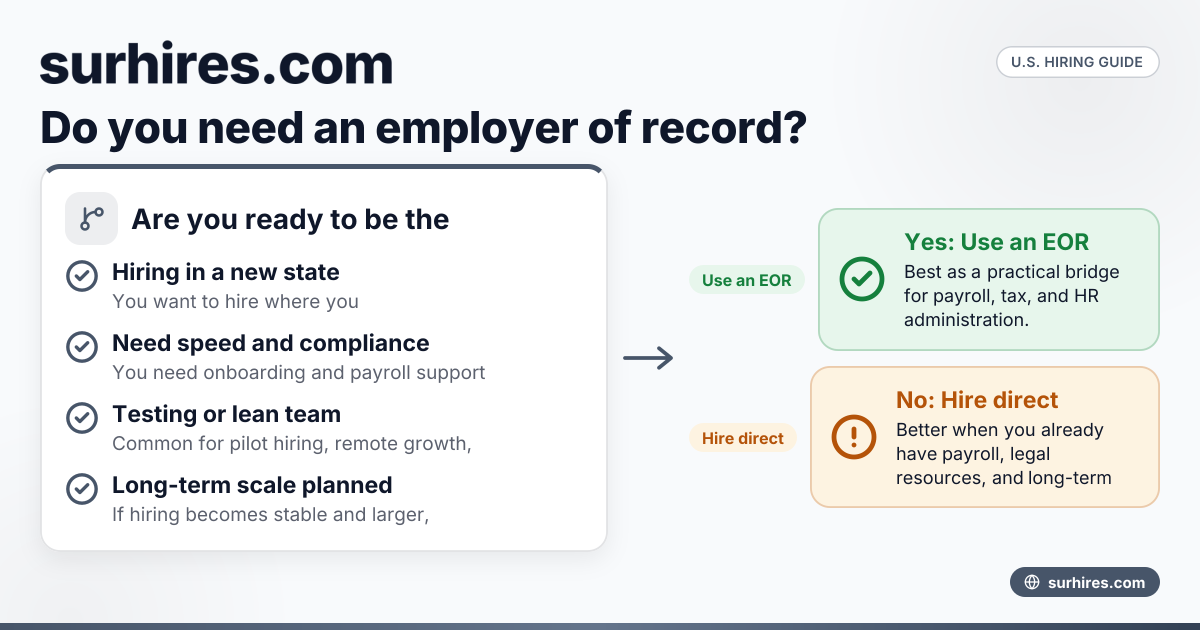
If you plan to hire quickly in a new state and want help with payroll and compliance, an EOR can make sense. If you expect long-term hiring at scale in that state, direct employment may be better once you have the internal setup.
The decision usually comes down to timing, headcount, internal resources, and risk tolerance.
Choose an EOR when:
- You need one or two hires in a new state fast
- Your HR team is small
- You are testing a market
- You want less administrative setup at the start
- You need a practical bridge before building direct payroll operations
Choose direct employment when:
- You plan a stable long-term team in that state
- You want full control over benefits and HR systems
- You already have payroll and legal resources
- You can manage registrations, tax accounts, and compliance internally
For some businesses, the real first question is not EOR versus direct hire. It is contractor versus employee. Misclassification issues can cost more than a slow hiring process. If that is your starting point, you can compare options in the surhires.com blog.
How should you evaluate an employer of record provider?
Start with compliance coverage, service clarity, and operational fit. Then review how the provider handles onboarding, payroll accuracy, state hiring support, security expectations, and issue resolution.
A careful review helps you avoid surprises after the offer letter is signed.
1. Confirm U.S. state coverage
Ask where the provider can legally employ workers and whether it supports the states where you plan to hire. Do not assume nationwide support means every use case is equally smooth.
2. Review payroll and tax workflows
Understand payroll timing, tax withholding processes, reporting access, and how corrections are handled. If your finance team closes books in QuickBooks each month, ask how payroll data is delivered.
3. Ask about benefits and leave administration
Find out what benefit options are available and how leave requests are managed. If benefits matter for hiring competitiveness, this should be reviewed early.
4. Check data security and buyer expectations
Many U.S. companies now expect strong security controls from service providers. If you sell to larger businesses, SOC 2 expectations may come up in procurement and vendor reviews.
5. Understand support during employee issues
Ask how the provider helps with warnings, leave questions, investigations, and terminations. Good support matters most when the situation is not simple.
6. Clarify the line between your duties and theirs
This is critical. You need a clear map of who owns onboarding steps, policy communication, manager guidance, equipment, reimbursements, and offboarding actions.
What risks should businesses watch for?
The biggest risks are assuming the EOR handles everything, choosing the wrong worker model, and failing to align internal managers with the process. An EOR can reduce administrative burden, but it does not replace sound employment decisions.
Watch for these issues.
Weak internal documentation
If performance problems arise, your managers need written goals, feedback records, and clear timelines. An EOR cannot invent a clean record after the fact.
Poor classification decisions
Do not use an EOR to avoid deciding whether a role should be an employee or contractor. Make that decision first based on the actual work relationship.
State-specific complexity
Some states are simply more complex from an employment standpoint. If you are hiring in multiple states at once, make sure your provider can support the details.
Overreliance on software language
Some platforms market themselves with terms like ai employer, but software labels do not change legal responsibilities. Focus on process quality, support, and documented compliance steps.
Is an employer of record right for your business?
An employer of record is right for many businesses that need to hire in the United States without building full payroll and HR infrastructure in every state. It is often a practical option for remote hiring, expansion testing, and lean internal teams.
Still, it is not always the final answer. If your U.S. hiring plan becomes larger and more permanent, direct employment may eventually be more efficient. The best decision is the one that matches your current headcount, timeline, and compliance capacity.
If your team is deciding how to hire and classify workers properly, surhires.com can help you explore practical hiring paths and compliance topics for U.S. businesses.
Frequently asked questions
Is an employer of record legal in the United States?
Yes. An employer of record is a legal service model in the United States. The key is using it correctly and understanding that the EOR handles formal employment administration while your business still manages day-to-day work.
Does an employer of record protect me from all employment risk?
No. An EOR can reduce administrative and compliance burden, but it does not remove all risk. Your managers, documentation, workplace practices, and classification decisions still matter.
Is an employer of record the same as staffing?
Not exactly. Staffing firms often recruit and place workers from their own labor pool. An EOR usually employs a worker you selected and manages the employment administration for that person.
Can I use an EOR for remote employees in different states?
Yes, that is one of the most common reasons businesses use an EOR. It can help when you want to hire remote employees across state lines without building direct payroll and HR infrastructure in each state first.
Should I use an EOR for contractors?
Usually, an EOR is designed for employee relationships, not true independent contractor arrangements. If the worker is properly a contractor, you may need a different setup instead of an EOR.
Published 7 October 2026
See Surhires on a live requisitionMore from the blog
What Is a Contractor of Record in the United States?
A contractor of record in the United States is a service provider that helps a business engage and manage independent contractors through a compliant.
8 October 2026 · 12 min read
How to Onboard Remote Contractors in the United States
Remote contractor onboarding in the United States means giving a contractor everything they need to start work quickly, legally, and securely without.
8 October 2026 · 12 min read
How to Hire 1099 Contractors in the United States
Hiring 1099 contractors in the United States means engaging self-employed workers for defined services without putting them on payroll as employees.
8 October 2026 · 12 min read