How-to
How to Hire Remote Employees in the United States
Hiring remote employees in the United States means more than posting a job and mailing a laptop. You need a clear hiring process, the right worker.
By The surhires.com team · · 12 min read
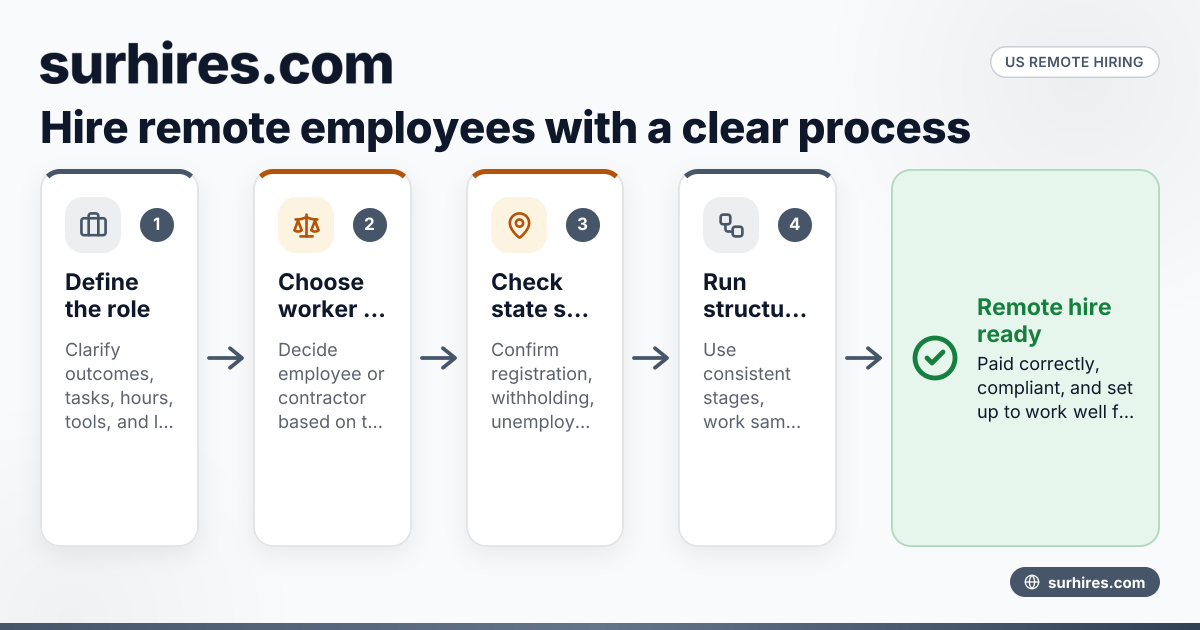
Hiring remote employees in the United States means more than posting a job and mailing a laptop. You need a clear hiring process, the right worker classification, compliant payroll and tax setup, solid onboarding, and practical policies for managing work across states. If you do those pieces well, remote hiring can widen your talent pool and help you fill roles faster.
Key takeaways
- To learn how to hire remote employees in the United States, start with job design, worker classification, and state-by-state compliance.
- Remote hiring affects payroll taxes, state registrations, labor law notices, and I-9 verification.
- A strong remote process includes structured interviews, written documentation, equipment policies, and secure onboarding.
- The best remote hires are made with clear expectations on communication, hours, output, and performance measures.
- Multi-state hiring can trigger new obligations for withholding, unemployment insurance, and employer registration.
- Good systems matter. Many US businesses rely on email, phone, payroll software, QuickBooks, and documented workflows.
What does it mean to hire remote employees in the United States?
Hiring remote employees in the United States means employing people who work outside your office, often from home, while following federal, state, and local employment rules that apply where the worker lives and works.
Remote work changes where employment obligations arise. In many cases, the employee’s work location matters more than your headquarters. If your company is based in Chicago and you hire someone working from Houston, you may need to handle payroll withholding, unemployment insurance, and labor notices tied to Texas and federal law.
This is why remote hiring needs a process. It is not only a recruiting decision. It is also a tax, payroll, legal, security, and operations decision. Small mistakes can create payroll corrections, delayed onboarding, or compliance gaps that get expensive later.
For most businesses, the goal is simple. Hire the right person, classify them correctly, get them paid correctly, and give them the tools to do good work from day one.
Why do businesses hire remote employees?
Businesses hire remote employees to access a larger talent pool, reduce time-to-fill for hard roles, and support flexible operations. Remote hiring can also help growing teams add talent in new markets without opening an office.
That matters when local hiring is tight. A manufacturer in Detroit may struggle to find a specialized planner nearby. A software company in Austin may need customer support coverage across time zones. A professional services firm in Chicago may want bookkeepers, recruiters, or coordinators outside commuting distance.
Remote hiring also supports business continuity. If weather, travel, or local disruptions affect one office, a distributed team can keep work moving. For sales, customer success, finance, and operations roles, remote work is now a normal hiring option.
Still, remote hiring works best when the role fits the model. Jobs with heavy on-site equipment use, in-person service, or regulated physical workflows may need hybrid or on-site staff instead.
How do you hire remote employees in the United States?
Define the role, classify the worker correctly, confirm where you can employ them, set up payroll and compliance in that state, run a structured hiring process, complete I-9 and onboarding steps, and document expectations for pay, hours, equipment, security, and performance.
1. Define the role clearly
Start with the work, not the title. Write down the outcomes the role owns. List the tasks, systems, communication needs, and reporting lines. Then decide whether the job can truly be remote.
A good remote job description should cover:
- Core responsibilities
- Required skills and experience
- Work hours or time zone overlap
- Whether travel is required
- Manager and team structure
- Compensation range, where appropriate
- Equipment or internet expectations
- Any location limits, if you only hire in certain states
Be specific. “Strong communication skills” is vague. “Able to handle customer calls, document follow-up in the CRM, and respond to internal email within one business day” is clearer.
2. Decide whether you need an employee or a contractor
This is one of the most important steps. If you control how, when, and where the work is done, provide tools, and integrate the person into your normal operations, you may be looking at an employee relationship rather than an independent contractor arrangement.
Misclassification can create tax and wage issues. In the United States, businesses often need to think about IRS guidance, wage and hour rules, and state-specific standards. Do not call someone a contractor just because remote work makes it easier.
As a practical rule, use employees for ongoing roles that are central to your business. Use contractors carefully for project-based work with real independence.
If you hire an employee, expect payroll withholding, Form W-4 setup, Form I-9 completion, and year-end Form W-2 reporting. If you hire a contractor, businesses commonly collect Form W-9 and may issue Form 1099-NEC when required.
3. Confirm where you can hire
Many businesses ask this too late. A candidate’s state matters. You may need to register as an employer in that state before the first payroll runs. You may also need state withholding and unemployment accounts.
This is where ai how questions often start. Leaders ask ai how remote hiring works across states, but the real answer is operational. You need a state-by-state checklist tied to payroll, notices, and employment rules.
At minimum, review:
- State income tax withholding requirements, where applicable
- State unemployment insurance registration
- New hire reporting
- Wage payment rules
- Required labor notices
- Leave law requirements
- Any pay transparency or wage notice rules that apply
If your company only supports employment in certain states, say that in the job posting. That saves time for everyone.
What paperwork do you need to hire a remote employee?
You typically need an offer letter, Form W-4, Form I-9, state tax forms where required, payroll setup documents, policy acknowledgments, and benefit enrollment forms if the role is eligible.
4. Build a structured recruiting process
Remote hiring needs more structure than casual local hiring. You see less in person, so your process has to produce evidence. Use the same interview stages for every candidate in the same role.
A practical process often looks like this:
- Resume and application review
- Short phone screen
- Skills assessment or work sample
- Hiring manager interview
- Team interview
- Reference checks
- Offer and background check, if used
Use work samples where possible. For a coordinator, ask for a written follow-up draft. For a sales role, ask for a mock discovery call. For an analyst, use a small spreadsheet exercise. Work samples often predict success better than broad interview opinions.
Write down scorecards before interviews begin. Decide what “good” looks like in advance. Rate candidates on the same criteria. That lowers bias and helps teams compare candidates fairly.
5. Handle pay, payroll, and taxes correctly
Pay is more complex when employees work remotely across states. Your payroll system must reflect where the employee works, not just where the company is based. This affects withholding, unemployment insurance, and state reporting.
Many US businesses use payroll software connected to QuickBooks for accounting. That can help, but software does not replace setup decisions. Someone on your team still needs to verify the employee’s work state, local payroll implications if any, and whether your company is registered properly before payday.
You should also define:
- Pay frequency
- Exempt or nonexempt status
- Overtime eligibility
- Timekeeping requirements
- Reimbursement policy for approved expenses
- Bonus or commission plan terms, if applicable
Be careful with nonexempt remote employees. If they are hourly, you need a clear timekeeping process. They should know when to log time, how breaks are handled, and whether overtime requires advance approval.
6. Complete remote I-9 and onboarding steps
Form I-9 is required for employees in the United States. The process has timing rules, and remote hiring adds logistics. Because I-9 rules can change, use the current USCIS instructions and your legal or HR guidance for remote document review and retention.
Onboarding should not stop at forms. A good remote onboarding plan includes:
- Signed offer letter
- Payroll setup
- Equipment shipment
- Account creation
- Security training
- Manager introduction
- First-week schedule
- Role goals for 30, 60, and 90 days
Send a written onboarding checklist. New hires should know exactly what happens before day one and during the first month. Uncertainty creates friction and delays productivity.
What tools and policies should you set up first?
Start with payroll, secure email and login access, a device policy, timekeeping if needed, communication rules, a written handbook, and a simple performance management process.
Create a remote work policy
A remote work policy should answer practical questions, not just legal ones. Keep it readable and specific.
Include items such as:
- Working hours and availability
- Core meeting windows
- Timekeeping rules
- Equipment ownership and return
- Reimbursement approval
- Data security expectations
- Use of personal devices, if allowed
- Confidentiality and customer data handling
- Performance expectations
- Communication channels for urgent issues
If your team handles customer information, payment data, or sensitive business records, tighten your access controls. Buyers often ask about security maturity, and some expect documented controls or SOC 2 readiness from vendors.
Standardize your communication stack
Remote teams need fewer tools, used better. Email and phone still matter for many businesses. Add chat, video meetings, document storage, and project tracking only if they support clear work.
Do not overload new hires with ten systems on day one. Give them a small set of core tools, written naming rules, and a simple escalation path. If a customer issue happens, the employee should know who to call, not search five apps.
Set equipment and security rules
Remote employees often use company laptops, headsets, and monitors. Decide what you provide and who supports it. Track devices by serial number. Document return procedures for offboarding.
Security basics should include:
- Unique user accounts
- Multi-factor authentication
- Password manager use
- Approved storage locations
- Rules against forwarding company data to personal email
- Clear incident reporting steps
If your business takes payments through Stripe or manages accounting in QuickBooks, limit access by role. New hires should get the least access needed to do the job.
How do you evaluate remote candidates well?
Use structured interviews, role-based work samples, and clear scorecards. Focus on communication, judgment, reliability, and the ability to work independently without constant supervision.
Remote candidates do not need to be outgoing. They do need to be clear. Written communication matters more in remote work. So does follow-through. A candidate who sends concise updates and asks good clarifying questions may outperform a polished interviewer who needs constant direction.
Look for evidence of these traits:
- Strong written communication
- Basic tech comfort
- Good time management
- Comfort with documentation
- Ability to work without constant meetings
- Sound judgment when priorities conflict
Ask practical questions. For example:
- How do you organize your day when priorities change?
- How do you handle unclear instructions?
- How do you document work so others can pick it up?
- Tell me about a time you had to solve a problem without immediate manager help.
These questions surface how the person actually works. That matters more than broad statements about being “self-motivated.”
Common mistakes when hiring remote employees
Many remote hiring problems are preventable. They usually come from rushing, assuming payroll can handle anything, or treating remote work like an afterthought.
Here are common mistakes to avoid:
Hiring in a state before checking compliance
This can lead to payroll delays and cleanup work. Always confirm registration, withholding, and unemployment setup first.
Misclassifying workers
Calling a full-time remote worker a contractor can create tax and wage problems. Review the role carefully before making the offer.
Writing vague job descriptions
If the role lacks clear outputs, managers will struggle to interview well and onboard well.
Skipping work samples
Resumes and interviews are not enough for many roles. Work samples show how the person will perform.
Weak onboarding
A remote employee who starts without tools, logins, or a schedule loses momentum immediately.
No written expectations
Remote success depends on clarity. Document working hours, deliverables, response times, and approval rules.
A practical checklist for hiring remote employees in the United States
Use this as a simple operating checklist:
- Define the role and remote requirements.
- Decide employee versus contractor status.
- Confirm which states you can hire in.
- Set up employer registration and payroll needs in that state.
- Write a clear job description.
- Post the role and screen candidates consistently.
- Use structured interviews and a work sample.
- Check references.
- Prepare the offer letter and compensation details.
- Complete tax, payroll, and I-9 steps.
- Ship equipment and create accounts.
- Train the hire on security, communication, and role expectations.
- Set 30-, 60-, and 90-day goals.
- Review performance early and often.
This checklist works for many roles, from operations coordinators to finance staff to remote sales support teams.
When should you get outside help?
You should get outside help when you hire in new states, are unsure about worker classification, need to scale recruiting quickly, or lack internal HR bandwidth.
A growing business often reaches a point where ad hoc hiring stops working. Maybe you are opening hiring in three states. Maybe a key role has stayed vacant for months. Maybe managers are spending too much time screening candidates. That is when outside support can help.
The right support depends on the problem. You may need payroll and tax setup help, employment counsel, or recruiting support. The best option is usually the one that removes risk and saves internal time without adding process for its own sake.
If your team wants a more organized way to build remote hiring capacity, surhires.com may be worth a look. Learn more about surhires.com if you want a practical approach to improving hiring operations.
Frequently asked questions
Can I hire a remote employee in any state?
Not always. A worker’s state can create employer registration, payroll tax, unemployment insurance, and labor law obligations. Many companies limit hiring to approved states until they build the right setup.
Do remote employees need to complete Form I-9?
Yes. Employees in the United States must complete Form I-9, and employers must follow current USCIS rules for document review and retention. Remote hires still need a compliant process.
Is a remote worker automatically an independent contractor?
No. Remote work location does not decide classification. The real question is how much control you have over the work relationship and whether the role looks like an employee position.
Do I need a special remote work policy?
In most cases, yes. A written remote work policy helps set expectations for hours, communication, timekeeping, equipment, reimbursement, and security. It also makes manager decisions more consistent.
Published 7 October 2026
See Surhires on a live requisitionMore from the blog
What Is a Contractor of Record in the United States?
A contractor of record in the United States is a service provider that helps a business engage and manage independent contractors through a compliant.
8 October 2026 · 12 min read
How to Onboard Remote Contractors in the United States
Remote contractor onboarding in the United States means giving a contractor everything they need to start work quickly, legally, and securely without.
8 October 2026 · 12 min read
How to Hire 1099 Contractors in the United States
Hiring 1099 contractors in the United States means engaging self-employed workers for defined services without putting them on payroll as employees.
8 October 2026 · 12 min read