How-to
How to Hire 1099 Contractors in the United States
Hiring 1099 contractors in the United States means engaging self-employed workers for defined services without putting them on payroll as employees.
By The surhires.com team · · 12 min read
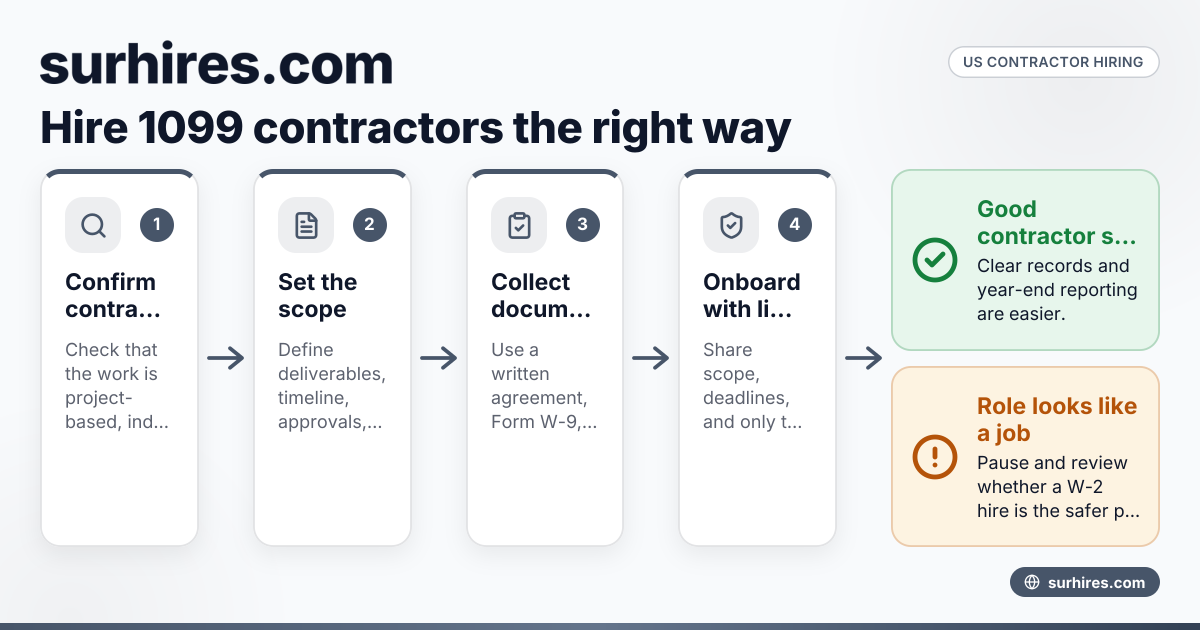
Hiring 1099 contractors in the United States means engaging self-employed workers for defined services without putting them on payroll as employees. The key is not the form itself. The key is correct worker classification, a clear contract, solid onboarding, and a payment process that supports tax reporting.
Key takeaways
- To learn how to hire 1099 contractors, start with classification, not paperwork.
- A 1099 contractor should control how the work is done, not just when it is delivered.
- Use a written agreement that covers scope, pay, deadlines, ownership, and confidentiality.
- Collect tax and payment details before work starts, including Form W-9 information.
- Keep records for invoices, contracts, and payments so year-end 1099 reporting is easier.
- If the role looks like a job, not a project, review whether a W-2 hire is the safer path.
What does it mean to hire a 1099 contractor in the United States?
Hiring a 1099 contractor means your business pays an independent contractor for services. That person is not your employee. They usually run their own business, set their own methods, and handle their own taxes.
The phrase “1099 contractor” is common business shorthand. It refers to a worker who may receive Form 1099-NEC for nonemployee compensation, if reporting thresholds and filing rules apply. But the tax form comes later. First, you need to make sure the person is actually an independent contractor under US rules.
This matters because misclassification can create payroll tax issues, wage and hour risk, and benefit disputes. It can also create friction during due diligence if your company is raising capital or being acquired. Buyers often look for clean contracts, organized tax records, and a reasonable classification process. If your customers expect mature vendor controls, they may also ask about your compliance practices and security standards, especially if a contractor will access internal systems.
For many US businesses, contractors make sense when the need is project-based. A Chicago software company might hire a freelance designer for a website refresh. A Houston distributor might use an outside bookkeeper during year-end cleanup in QuickBooks. A Detroit manufacturer might bring in a controls engineer for a short ERP integration project. In each case, the work is specialized and time-bound.
How do you hire 1099 contractors?
Start by confirming the worker is truly independent, then use a written contract, collect Form W-9 details, set payment terms, and keep records. If you control the worker like an employee, stop and reassess before you hire.
Step 1: Decide whether the role should be a contractor role at all
The first step in how to hire 1099 contractors is defining the work. Ask what business problem you are solving. Then ask whether the work is project-based, specialized, and limited in duration.
Independent contractors usually work toward a result. Employees usually fill an ongoing role inside the business. If your business needs someone full time, indefinitely, under daily supervision, that often points away from contractor status.
Look at practical factors such as:
- Who decides how the work gets done
- Who provides the tools and equipment
- Whether the worker can serve other clients
- Whether the relationship is open-ended
- Whether you train the worker like staff
- Whether the person is integrated into your core operations
Do not assume a contract alone makes someone a contractor. Labels help, but facts matter more than labels.
If your situation is unclear, compare the role against employee treatment before moving forward. This guide on 1099 vs W-2 for Remote Workers in the United States can help frame the difference.
Step 2: Write a contractor-ready scope of work
A strong scope of work prevents confusion. It also supports the idea that you are buying a service, not managing an employee.
Your scope should define:
- The service being delivered
- The deliverables
- The timeline
- The approval process
- Any milestones
- The payment structure
- Who owns work product
For example, “manage social media” is vague. “Create 12 LinkedIn posts, 4 graphics, and a monthly performance report by the last business day of each month” is much stronger.
This is also where many teams ask an ai how question internally, such as how to structure work without over-controlling the contractor. A simple rule helps: define outcomes, deadlines, and standards, but avoid directing the contractor’s day-to-day method unless the work truly requires it.
Step 3: Use a written independent contractor agreement
A handshake is not enough. Use a written agreement before work starts.
Your agreement should usually cover:
- Legal names of both parties
- Services and scope
- Start date and end date, if any
- Payment terms
- Invoice requirements
- Confidentiality
- Intellectual property ownership
- Independent contractor status
- Termination rights
- Dispute resolution
- Data access and security expectations
If the contractor will handle customer data, financial records, or internal tools, include security terms. Many US businesses now expect basic vendor discipline, especially if the contractor will touch Stripe, QuickBooks, CRM data, or shared cloud drives. If your customers care about SOC 2-aligned controls, make sure contractor access is limited and documented.
A contract should fit the work. A freelance copywriter and a fractional controller do not present the same risk.
What paperwork do you need to hire a 1099 contractor?
Usually, you need a signed contractor agreement, a completed Form W-9, payment details, and any required confidentiality or IP documents. You may also need state-specific forms depending on the work and location.
Collect Form W-9 before the first payment
Form W-9 gives you the contractor’s legal name, tax classification, and taxpayer identification number. Collect it early. Do not wait until January when you are trying to prepare information returns.
Make sure the name and taxpayer identification details match how the contractor wants to be reported. If the contractor works through an entity, confirm whether you are contracting with the individual or the business.
Gather payment and invoicing details
Decide how you will pay the contractor. Common methods include ACH, business check, or card-based methods where appropriate. Also set invoice rules. For example:
- When invoices are due
- Required line-item detail
- Purchase order requirements, if any
- Net payment timing
- Who approves invoices
A clean process reduces disputes and makes month-end accounting easier.
If you want a deeper look at payment workflows, How to Pay Independent Contractors in the United States is a useful next read.
Prepare confidentiality and IP documents if needed
If the contractor will create code, designs, marketing assets, or process documents, ownership must be clear. Your contract may cover this, but some businesses also use a separate intellectual property assignment or confidentiality agreement.
This matters most when the work has long-term value. A business should not discover later that it lacks rights to the website, software module, or sales content it paid for.
How to classify 1099 contractors correctly
Proper classification is the most important risk step. In the United States, agencies and courts generally look at the real relationship, not just the title in the contract.
Focus on control and independence
A contractor is more likely to be properly classified when they:
- Control how they perform the work
- Use their own tools or systems
- Market services to multiple clients
- Bear some business risk
- Work on a project or defined engagement
- Invoice for services instead of receiving wages
An employee is more likely when your business sets fixed schedules, provides extensive training, directs daily work, and treats the person like part of the regular staff structure.
If you find yourself assigning managers, requiring attendance like a staff member, or prohibiting other clients, pause. The relationship may be moving toward employment.
Watch for long-term drift
Many classification problems start with a valid contractor relationship that slowly changes. A three-month project turns into eighteen months of ongoing work. The contractor gets a company email, attends daily team meetings, and starts managing internal processes.
Review contractor relationships at regular intervals. That is especially important for finance, operations, engineering, and customer-facing roles.
If the role has become part of the business, it may be time to convert. This article on How to Convert a Contractor to an Employee in the United States can help with that transition.
How should you onboard a 1099 contractor?
Keep onboarding light and role-based. Give the contractor what they need to deliver the work, but avoid treating them like an employee with broad access, company policies, and daily supervision.
Give access only to what the project requires
Onboarding should match the scope. If a contractor only needs a design brief and shared folder access, do not grant full system permissions.
Use a simple checklist:
- Confirm signed contract
- Collect Form W-9
- Set payment method
- Share scope and deadlines
- Grant minimum necessary access
- Explain approval and invoicing process
- Set offboarding date or review point
This protects your business and keeps the relationship clean.
Avoid employee-style management
Do not build a contractor onboarding process that mirrors employee onboarding. Contractors usually do not need staff handbooks, broad HR training, or recurring performance reviews.
They do need clarity. They need deadlines. They need one business owner or project lead who approves work. Keep the structure simple.
This is where small businesses often ask another practical ai how question: how much direction is too much? A good test is whether you are managing the result or managing the person. With contractors, manage the result.
How do you pay 1099 contractors and handle taxes?
Pay against invoices or milestone terms in the contract, keep a clear record of each payment, and track what may need year-end reporting. Do not withhold payroll taxes from a properly classified contractor.
Set payment terms before work begins
Your contract should answer basic money questions upfront:
- Flat fee or hourly
- Retainer or project-based
- Reimbursable expenses or not
- Deposit required or not
- Invoice frequency
- Payment due date
For example, a Houston marketing consultant might bill $2,500 per month for a fixed set of deliverables. A Detroit manufacturing design specialist might bill hourly for a six-week redesign project. Either model can work if the scope is clear.
Paying on time matters. It helps you retain reliable contractors and reduces friction around delivery.
Keep accounting records organized
Use your normal accounting process. Many US businesses log contractor bills in QuickBooks, match payments through the bank feed, and reconcile month-end expenses by vendor. Keep copies of:
- Contracts
- W-9 forms
- Invoices
- Payment confirmations
- Change orders
- Email approvals for expanded work
Good records help with taxes, audits, disputes, and diligence.
Prepare for year-end information reporting
If your business makes reportable payments for services to a nonemployee, you may need to file Form 1099-NEC based on current IRS rules and thresholds. Because filing requirements can vary by payment type and circumstances, review current IRS instructions each year or ask your accountant.
The biggest mistake is scrambling for tax information after the year closes. Collect and verify contractor details before the first payment.
Common mistakes businesses make when hiring 1099 contractors
Even careful teams make errors. Most problems come from speed, not bad intent.
Mistake 1: Treating a contractor like staff
This is the biggest one. If you set a daily schedule, require internal attendance patterns, and supervise the work like employment, your risk increases.
Mistake 2: Starting work before paperwork
A contractor should not begin with “we will sort it out later.” If there is a dispute over pay, ownership, or scope, missing documents will hurt you.
Mistake 3: Using vague scopes
Vague scopes create invoice disputes, missed expectations, and messy renewals. Be specific about what success looks like.
Mistake 4: Granting too much system access
Temporary workers often receive permanent access by mistake. Limit permissions and set a removal date when the engagement ends.
Mistake 5: Forgetting review points
A contractor relationship should not run untouched for years. Add review dates at 30, 90, or 180 days depending on the project.
A practical hiring process for US businesses
If you want a repeatable internal process, use this simple framework.
1. Define the need
Write down the business problem, project outcome, budget range, and target timeline.
2. Confirm contractor fit
Review whether the work is independent, project-based, and not suited for a standard employee role.
3. Select the contractor
Review experience, work samples, references where appropriate, and availability. For higher-risk roles, confirm entity status and business insurance if relevant.
4. Finalize documents
Sign the contractor agreement, collect Form W-9, confirm payment details, and lock the scope.
5. Start with controlled access
Share only the files and tools needed for the work. Name one internal owner for approvals.
6. Pay against milestones or invoices
Follow the contract. Record each payment clearly in your accounting system.
7. Review the relationship regularly
Ask whether the engagement still fits contractor status. If not, reevaluate before extending.
When should you not hire a 1099 contractor?
You should not hire a 1099 contractor when the role is really a job. If the person will work under close supervision, perform ongoing core duties, or function like a regular team member, a W-2 structure may be more appropriate.
This comes up often in sales, customer support, operations, and long-term admin roles. It can also happen in software teams when a “temporary contractor” becomes a permanent engineer in all but name.
If you need someone employed but want help with setup and compliance, an Employer of Record in the United States: What It Is and When Businesses Need One may be worth reviewing.
Final checklist for hiring 1099 contractors in the United States
Before the contractor starts, confirm that you can answer yes to these questions:
- Is the role suitable for contractor classification?
- Do we have a clear scope of work?
- Is there a signed contractor agreement?
- Did we collect Form W-9?
- Are payment terms documented?
- Is system access limited to need?
- Do we have a plan for invoices and recordkeeping?
- Is there a review date for the relationship?
If the answer to several of these is no, fix the process before work begins.
If you want more practical hiring guidance, explore the surhires.com blog for plain-English resources on contractor engagement, classification, and US hiring operations.
Frequently asked questions
Can I hire a 1099 contractor for ongoing work?
Yes, but ongoing work raises classification risk if the relationship starts to look like employment. Review the level of control, duration, exclusivity, and integration into your business before extending the engagement.
Do I need a contract to hire a 1099 contractor?
A written contract is strongly recommended. It helps define the scope, payment terms, ownership, confidentiality, and independent contractor relationship before any dispute arises.
Published 8 October 2026
See Surhires on a live requisitionMore from the blog
What Is a Contractor of Record in the United States?
A contractor of record in the United States is a service provider that helps a business engage and manage independent contractors through a compliant.
8 October 2026 · 12 min read
How to Onboard Remote Contractors in the United States
Remote contractor onboarding in the United States means giving a contractor everything they need to start work quickly, legally, and securely without.
8 October 2026 · 12 min read
How to Convert a Contractor to an Employee in the United States
Converting a contractor to an employee in the United States means ending the independent contractor arrangement and putting that worker on payroll as.
8 October 2026 · 12 min read