How-to
How to Convert a Contractor to an Employee in the United States
Converting a contractor to an employee in the United States means ending the independent contractor arrangement and putting that worker on payroll as.
By The surhires.com team · · 12 min read
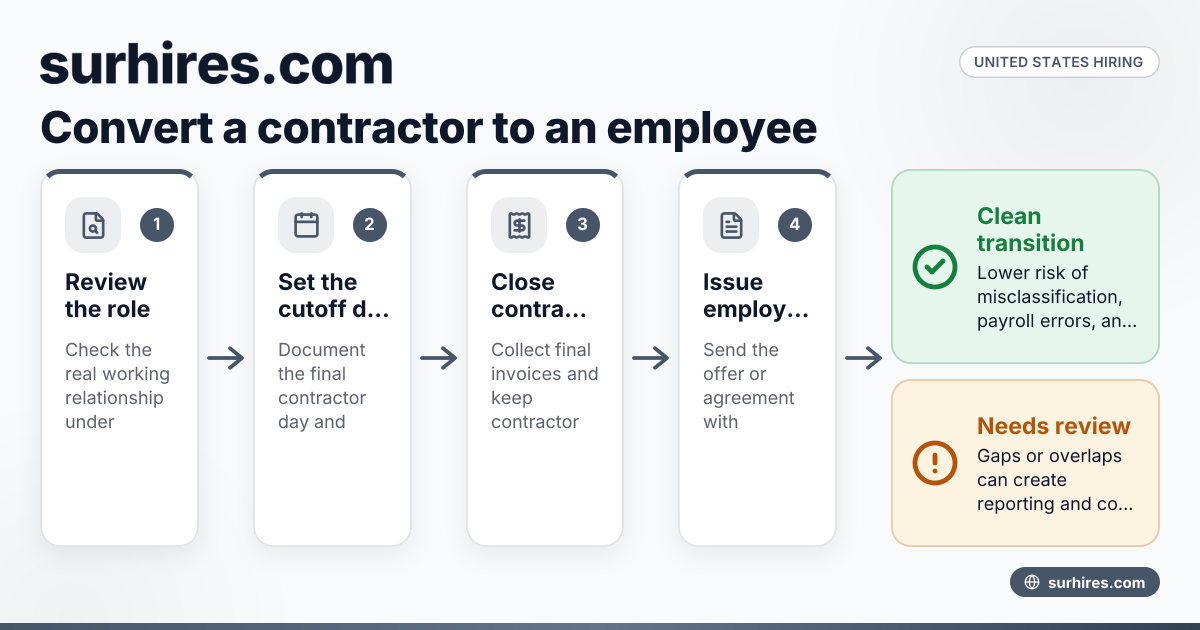
Converting a contractor to an employee in the United States means ending the independent contractor arrangement and putting that worker on payroll as a W-2 employee. The change affects classification, taxes, benefits, onboarding, and day-to-day management, so it should be planned carefully and documented clearly.
Key takeaways
- To convert contractor to employee United States, start by confirming the role should now be treated as employment under federal and state rules.
- The switch usually requires a new agreement, payroll setup, tax withholding, Form I-9 completion, and a formal start date as an employee.
- You should end contractor payments cleanly, collect any final invoices, and issue the right year-end tax forms based on how the worker was paid.
- Employee status changes how you manage the person’s schedule, tools, supervision, and benefits eligibility.
- A structured transition lowers the risk of misclassification claims, payroll errors, and confusion for the worker and your internal team.
Why businesses convert contractors to employees
Businesses often make this change when a role becomes more permanent, more controlled, or more central to operations. A worker who started on a project basis may now be working fixed hours, using company systems every day, and reporting closely to a manager. At that point, employee status may be the better fit.
This also happens when buyers, investors, or internal compliance teams review workforce practices. A company may realize the current setup creates classification risk. In the United States, worker classification depends on the facts of the relationship, not just the label in a contract.
Some businesses also convert workers for practical reasons. They want stronger retention. They want to offer benefits. They need the person embedded in a team. Or they want cleaner processes for payroll, equipment, security access, and performance management.
If your company has been asking whether a role should stay independent, a good starting point is to review 1099 vs W-2 for Remote Workers in the United States.
When should you convert a contractor to an employee?
If the worker now depends on your business like a regular staff member, it may be time to convert. Common signs include set schedules, ongoing work with no clear project end, close supervision, required internal meetings, or restrictions on outside work.
The IRS and other agencies look at the real relationship. Key themes often include behavioral control, financial control, and the overall nature of the relationship. For example, if your company decides how the work is done, provides most tools, and expects continuing service, the role may look more like employment.
This issue is common in fast-growing companies. A startup in Chicago may hire a marketing contractor for a short campaign, then keep that person on for a year with weekly reporting and a full workload. A manufacturer in Detroit may begin with a freelance operations analyst, then require on-site coordination inside its ERP workflows. A services business in Houston may bring in a sales contractor, then direct every step of outreach and call scheduling. In each case, the facts may point toward employee status.
What is the risk of waiting too long?
The longer you delay, the more exposure you may create for payroll tax issues, wage and hour claims, and benefit disputes. A late change can also make year-end reporting messier if the worker was effectively treated like an employee for months.
Misclassification risk is not only about taxes. It can also affect overtime, expense reimbursement, unemployment insurance, workers' compensation, and state labor rules. If the role should be employment, acting early is usually safer than trying to fix it after a complaint or audit.
How do you convert a contractor to an employee?
Pick a clear transition date, stop contractor payments after that date, issue an employee offer or employment agreement, and onboard the worker through payroll and HR. The worker should complete the same employment forms as any new hire, including tax withholding and Form I-9.
Start by documenting the change. State the final day of contractor services and the first day of employment. This prevents overlap and helps your finance team know which payments belong in accounts payable and which belong in payroll.
Then complete the full employee onboarding process. Even if the person has worked with you for months, do not skip basic new-hire steps. Employee status is a different legal and operational relationship.
Step 1: Review the current contractor arrangement
Gather the existing contract, payment history, scope of work, and any amendments. Check how the person has actually been managed. This helps you spot risks and prepare for the transition.
Look at practical details such as:
- Who sets the work hours
- Who provides tools and software
- Whether the person can work for other clients
- Whether the relationship is project-based or ongoing
- Whether managers direct the process, not just the outcome
This review matters because some companies do not just want to ai convert contractor records in a system. They need to fix the real working relationship, not only rename it.
Step 2: Choose the official conversion date
Set one date for the end of contractor status and another for the start of employee status. In many cases, these dates are back-to-back. Keep the timing simple if possible.
Make sure internal teams know the date. Finance, payroll, IT, HR, legal, and the hiring manager should all use the same effective date. If your business uses QuickBooks for contractor payments and a payroll platform for employees, this alignment matters.
Step 3: Close out contractor payments
Ask the worker to submit any final invoice for contractor services through the end date. Pay that invoice through your normal accounts payable process. Keep those records separate from payroll.
If the worker was being paid as an independent contractor, you may still need to issue a Form 1099-NEC for eligible payments made during the year. Employee wages after the conversion would instead be reported on Form W-2. Your accounting team should make sure payments are not mixed.
For more on the contractor payment side, see How to Pay Independent Contractors in the United States.
Step 4: Issue an employee offer letter or employment agreement
Provide a written document that explains the new role. Include the job title, manager, pay rate or salary, exempt or nonexempt status if applicable, work location, start date, and any benefit eligibility terms.
This document should not read like a contractor scope of work. It should reflect an employment relationship. In simple terms, the company is hiring the person into a role, not buying a service outcome.
Make sure compensation is clear. If the worker used to bill $5,000 per month as a contractor, do not assume the employee equivalent is exactly the same in take-home pay. Payroll withholding, employer taxes, and benefits costs can change the full picture.
Step 5: Complete employee onboarding
The worker should go through your normal employee setup. That often includes:
- Form W-4 for federal income tax withholding
- Form I-9 and supporting identity and work authorization documents
- State new-hire reporting, where required
- Payroll enrollment
- Benefits enrollment, if eligible
- Policy acknowledgments
- Security and equipment setup
Do not skip Form I-9 just because the person already worked with you as a contractor. Employment onboarding has its own requirements. If the person is remote, make sure your process still follows the current rules for I-9 completion and document review.
Step 6: Move the worker into payroll and HR systems
Once the person becomes an employee, payments should run through payroll, not contractor billing. Update HR and finance systems so taxes are withheld and employer payroll obligations are handled correctly.
This is also the point to align access levels. Employees often receive broader system access, company devices, or internal communication tools. If your customers expect basic security discipline or SOC 2-style controls from vendors, role-based access and documented onboarding matter.
Step 7: Update management practices
A clean conversion is not only paperwork. Managers must treat the person like an employee after the start date. That means using employee policies, timekeeping rules where needed, supervision structures, and standard review processes.
This sounds obvious, but it is where many teams fail. They update the label and keep the old habits. Or they do the reverse. They previously managed the contractor like an employee and only later fix the paperwork. Either way, alignment matters.
What paperwork is needed?
You typically need a contractor closeout, a written employee offer or agreement, Form W-4, Form I-9, payroll setup, and benefits enrollment if applicable. You may also need state forms, policy acknowledgments, and updated internal records for tax, security, and HR purposes.
Under that short list, your exact packet depends on your state, industry, and internal policies. But most U.S. businesses should think through the same core categories.
Tax and payroll documents
At minimum, the worker needs to be set up as an employee for payroll withholding and year-end reporting. That usually means collecting Form W-4 and any state withholding forms your payroll process requires.
Your payroll team should also confirm local tax treatment where relevant. Rules vary by location, so the employee’s work state and work city can matter. If your company has remote staff, make sure payroll setup matches where the person actually works.
Eligibility and identity documents
Employees must complete Form I-9. Keep this process separate from contractor vetting. The form and supporting document review are part of employment compliance, not independent contractor onboarding.
Internal policy acknowledgments
You may also need updated documents for:
- Employee handbook acknowledgment
- Confidentiality and IP terms
- Acceptable use and security policies
- Timekeeping and overtime policies, if applicable
- Expense reimbursement policy
- Benefits notices
If the worker had signed a contractor agreement, review whether any parts should be replaced, superseded, or expressly ended.
Pay, taxes, and benefits after conversion
Employee pay is handled through payroll with tax withholding. The business now has employer-side payroll obligations and may need to offer access to benefits based on plan rules and eligibility terms.
This change affects budgeting. A contractor paid $60 per hour is not directly comparable to an employee at the same hourly rate. As an employer, you may now be responsible for payroll taxes, insurance-related costs, paid time off programs, equipment, training time, and benefit contributions if offered.
Recalculate compensation carefully
Do not rush this part. The worker may focus on net pay. Your finance team may focus on total cost. Both matter. Build a simple model that compares the current contractor spend with projected employee cost.
For example, if a contractor invoices $8,000 per month, your employee offer should be based on the role, market, and total compensation structure, not only that invoice amount. Explain the difference clearly so the worker understands salary or hourly wages, payroll withholding, and benefits.
Handle year-end reporting correctly
A person who starts the year as a contractor and later becomes an employee can receive both a Form 1099-NEC and a Form W-2 for the same calendar year, if both statuses applied at different times. That is normal as long as the records are accurate and the dates are clear.
How do you communicate the change to the worker?
Explain the reason for the change, the effective date, the new compensation structure, and what will happen with taxes, payroll, and benefits. Keep the message simple, practical, and written down.
After the short explanation, give the worker a checklist. Many concerns are basic: When is my last contractor invoice due? When do I get paid as an employee? What forms do I need to complete? Do I keep the same manager and duties?
A simple communication plan
Use this order:
- Verbal conversation with the worker
- Written offer or summary email
- Onboarding instructions and deadlines
- Payroll and benefits setup
- Manager follow-up in the first week
Make sure teams are aligned before that first conversation. Nothing creates confusion faster than HR saying one start date and finance using another.
Explain what changes operationally
Tell the worker what will be different on day one as an employee. Examples include timekeeping, benefits eligibility, equipment policy, expense reimbursement, and reporting expectations.
If the role involves sales or outreach, update training around employee rules and company practices. U.S. businesses often use email and phone as primary channels, so employee teams should understand your internal standards for compliant outreach, including CAN-SPAM and TCPA where relevant to the role.
Common mistakes when you convert contractor to employee United States
One common mistake is treating the change as only a payroll event. It is broader than that. The relationship, documents, systems, and management approach all need to change together.
Another mistake is leaving a gap or overlap in records. If the contractor invoice period extends past the employee start date, or payroll begins before contractor status ends, year-end reporting can get messy.
Mistake 1: No clear cutoff date
Without a single effective date, teams guess. That causes duplicate payments, reporting errors, and avoidable confusion.
Mistake 2: Skipping full onboarding
A long-time contractor may feel like an existing team member, but employee onboarding still matters. Missing I-9, W-4, or policy acknowledgments can create compliance problems later.
Mistake 3: Keeping contractor-style pay practices
Employees should not keep sending monthly invoices after conversion. Once the role is employment, compensation should run through payroll.
Mistake 4: Ignoring manager behavior
If a business wants to ai convert contractor data in HR software but managers still handle the worker inconsistently, the process is incomplete. Systems matter, but daily supervision and policy use matter more.
Mistake 5: Not reviewing alternatives
In some cases, the business does not want a contractor anymore but is not ready to hire directly in-house. If you need help understanding U.S. hiring models, How to Hire Remote Employees in the United States and Employer of Record in the United States: What It Is and When Businesses Need One can help frame the options.
A practical checklist for U.S. businesses
Use this checklist when you convert contractor to employee United States:
Published 8 October 2026
See Surhires on a live requisitionMore from the blog
What Is a Contractor of Record in the United States?
A contractor of record in the United States is a service provider that helps a business engage and manage independent contractors through a compliant.
8 October 2026 · 12 min read
How to Onboard Remote Contractors in the United States
Remote contractor onboarding in the United States means giving a contractor everything they need to start work quickly, legally, and securely without.
8 October 2026 · 12 min read
How to Hire 1099 Contractors in the United States
Hiring 1099 contractors in the United States means engaging self-employed workers for defined services without putting them on payroll as employees.
8 October 2026 · 12 min read