Comparisons
1099 vs W-2 for Remote Workers in the United States
A remote worker in the United States can usually be hired either as a W-2 employee or engaged as a 1099 independent contractor, but the difference is.
By The surhires.com team · · 12 min read
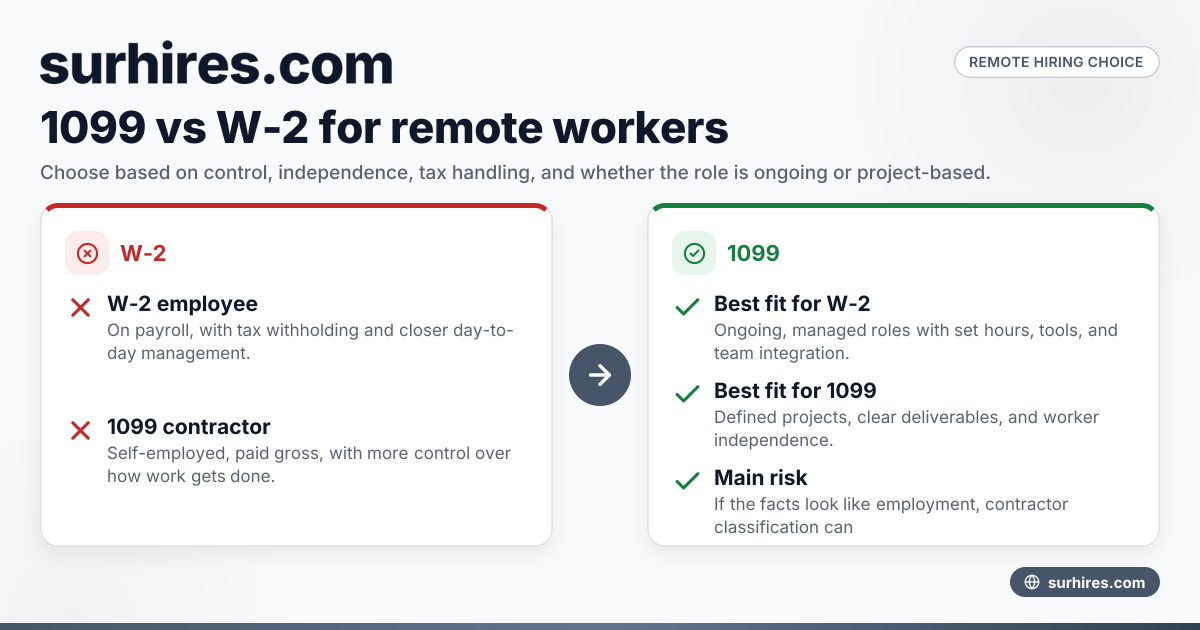
A remote worker in the United States can usually be hired either as a W-2 employee or engaged as a 1099 independent contractor, but the difference is not just paperwork. It affects taxes, control, benefits, compliance risk, payroll, and how you scale your team across states.
Key takeaways
- W-2 workers are employees, and 1099 workers are independent contractors under different legal and tax rules.
- The right classification depends on how the work is controlled, not on what the worker prefers to be called.
- Misclassifying remote workers can create back taxes, penalties, wage claims, and benefits disputes.
- W-2 hiring fits ongoing, managed roles better, while 1099 arrangements often fit project-based work with more worker independence.
- Remote work adds state-by-state payroll, registration, and tax considerations for W-2 employees.
- A clear hiring process, written agreements, and documented classification decisions reduce risk.
What is the difference between 1099 and W-2 for remote workers?
A W-2 remote worker is an employee on your payroll. A 1099 remote worker is an independent contractor who runs their own business and provides services to your company.
That is the short version. In practice, the difference matters because employees are covered by payroll tax withholding, wage and hour rules, and often company policies. Contractors usually handle their own taxes, use their own processes, and operate with more independence.
For a business owner in Chicago, Houston, or Detroit, this choice affects how you budget, onboard, and manage work. It also affects which forms you file, which systems you need, and how much direction you can give the worker day to day.
The main search phrase, 1099 vs W-2 remote workers United States, is really about one core issue: are you hiring someone to work in your business like an employee, or are you buying services from an independent business?
Why does classification matter so much?
Because the label on the agreement does not decide the result. The facts do.
If you call someone a contractor but manage them like an employee, your business can face problems with tax withholding, overtime, unemployment insurance, workers' compensation, and employee benefits. The IRS and state agencies look at the working relationship, not just the contract title.
This is where many companies get tripped up with remote work. A worker may live in another state, use Slack and email like the rest of the team, join daily meetings, and follow your schedule. That can look a lot like employment, even if you pay them through accounts payable and issue a Form 1099-NEC.
For many buyers evaluating hiring options, the real question is not just ai 1099 vs classification advice. It is whether your operating model actually supports a contractor relationship under United States rules.
W-2 means employee status
A W-2 worker is on payroll. The employer generally withholds federal income tax and the employee share of Social Security and Medicare taxes, and pays the employer share of payroll taxes. The employer may also have state payroll obligations, unemployment insurance obligations, and new-hire reporting requirements, depending on the state.
Employees may also be covered by wage and hour laws. That includes minimum wage and overtime rules where applicable. If you provide equipment, training, supervision, paid time off, or benefits, those facts can support employee status.
1099 means independent contractor status
A 1099 worker is generally self-employed. The business usually pays the contractor gross amounts with no payroll withholding, and may issue Form 1099-NEC if reporting thresholds are met. The contractor typically handles estimated taxes and business expenses.
Independent contractors usually control how they do the work. They may set their own schedule, use their own tools, work for multiple clients, and take on project-based assignments with defined deliverables.
That does not mean every remote freelancer is automatically a contractor. The relationship still needs to fit the facts.
How do you decide between 1099 and W-2?
Start with the real working relationship. If you control the details of how the person works, need them long term, and make them part of your day-to-day team, W-2 is often the safer path. If they run an independent business and deliver work with little supervision, 1099 may fit better.
A practical way to think about it is to review control, financial independence, and the nature of the relationship.
1. Look at behavioral control
Ask how much direction your business gives the worker.
If you train them on exactly how to do the job, require fixed hours, monitor ongoing performance like a manager, or require attendance at routine internal meetings, those facts may point toward employee status. This is common for remote customer support, remote operations staff, and full-time coordinators.
If the worker decides how to complete the project, uses their own methods, and is judged mainly on final output, that leans more toward contractor status. This is more common with a designer building a one-time brand package or a developer completing a defined integration.
2. Look at financial control
Ask who bears business risk and who controls the economics.
Independent contractors often invoice for services, buy their own software, set their own pricing, and can make a profit or loss. They may work through an LLC, though an LLC alone does not decide classification. They may also market their services to multiple clients.
Employees are usually paid on a regular payroll cycle. The company often provides systems, email accounts, and equipment. The worker does not usually negotiate each assignment as a separate project.
3. Look at the relationship itself
Ask whether the role is temporary and project-based or ongoing and embedded in the business.
A long-term remote worker who appears on your org chart, has a company email, and performs core business functions may look more like an employee. A contractor with a defined scope, statement of work, and end date looks more independent.
Benefits also matter. Offering paid time off, health benefits, or other employee-style perks can support W-2 treatment.
Which option is better for a remote business?
There is no universal winner. W-2 is often better for core roles you manage closely. 1099 is often better for specialized project work where the person truly operates independently.
The best option is the one that matches the facts and your growth model.
When W-2 is usually the better fit
W-2 often makes more sense when:
- The role is ongoing and central to operations
- You need set hours or shift coverage
- The person reports to a manager
- You provide tools, systems, and detailed procedures
- You want stronger retention and team integration
For example, if a Houston software company hires a remote account manager to work 8 a.m. to 5 p.m., use the company CRM, join weekly pipeline meetings, and follow internal scripts, that role often fits W-2 better.
When 1099 is usually the better fit
1099 often makes more sense when:
- The work is project-based
- The worker serves multiple clients
- The worker controls how and when the work gets done
- The engagement has a clear scope and end date
- The business is buying a service, not filling a staffed role
For example, if a Detroit manufacturer hires a remote ERP consultant for a 12-week implementation project with milestone billing, that may fit a contractor model more naturally.
What are the tax and compliance differences?
W-2 workers are handled through payroll with tax withholding. 1099 workers are usually paid through accounts payable, and the worker handles their own taxes. But payroll is only part of the compliance picture.
For W-2 employees, your business may need state registrations, payroll tax setup, unemployment accounts, and compliant onboarding for the state where the worker lives and works. You may also need to think about wage notices, final pay timing, and leave rules depending on the state.
For 1099 contractors, you avoid payroll withholding, but you do not avoid classification risk. If the relationship looks like employment, the tax savings can disappear quickly once agencies review it.
W-2 tax and admin considerations
With W-2 workers, employers commonly need to:
- Register for payroll taxes where required.
- Withhold and remit payroll taxes.
- File payroll reports and year-end forms.
- Track wages and hours where needed.
- Maintain compliant employee records.
This usually means tighter coordination with payroll systems and finance tools such as QuickBooks and payroll providers.
1099 tax and admin considerations
With 1099 contractors, businesses commonly need to:
- Collect a Form W-9.
- Maintain a written contractor agreement.
- Track payments accurately.
- Issue Form 1099-NEC when required.
- Keep records that support contractor status.
Contractors may bill through Stripe or by invoice. That can feel simpler at first. But simple payment flow is not the same as compliant classification.
What risks come with misclassifying remote workers?
Misclassification can trigger back taxes, penalties, interest, unpaid overtime claims, unemployment claims, and disputes over benefits eligibility. Remote work does not reduce those risks. In some cases, it can hide them until the team is already scaled.
A common mistake is treating a remote worker as a contractor because the person prefers it, or because it seems faster than setting up payroll in another state. Preference and convenience do not decide classification.
Another common mistake is using a contractor agreement for what is really a full-time role. If the person works only for you, follows your schedule, and needs approval for daily decisions, your risk goes up.
Operational signs that your 1099 may really be a W-2 role
Watch for these warning signs:
- You require fixed daily working hours
- You assign a direct manager for day-to-day oversight
- You prohibit work for other clients
- You provide mandatory tools and systems for all work
- You include the person in routine employee performance reviews
- You hire them into a permanent role with no project end point
None of these facts alone decides the issue. Together, they can create a strong employee pattern.
Can a remote worker choose to be 1099 instead of W-2?
Not usually. The worker’s preference matters far less than the facts of the relationship.
Some workers ask for 1099 treatment because they want more take-home cash up front or want scheduling flexibility. Some businesses agree because it seems administratively easier. But if the role is actually an employee role, that agreement will not protect the company.
The safest approach is to design the role first, then classify it. If you need an employee, hire an employee. If you need a contractor, structure the engagement like a true contractor relationship from the start.
A simple decision test
Ask these questions:
- Is this person filling an ongoing role in our business?
- Will a manager direct their daily work?
- Do we require set hours or detailed procedures?
- Will they work mainly or only for us?
- Are we buying labor instead of a defined service outcome?
If you answer yes to most of these, W-2 is often the stronger fit.
How should you set up each type of remote hire?
Good setup reduces confusion and risk. It also makes finance and operations smoother.
For W-2 remote employees
Use a structured process:
- Confirm the work state and payroll requirements.
- Prepare a compliant offer letter and onboarding documents.
- Set up payroll, tax withholding, and state accounts as needed.
- Define schedule, manager, and job duties clearly.
- Document policies for timekeeping, security, and equipment.
Security matters here too. If remote employees will access sensitive systems, many business buyers and larger customers expect reasonable controls. In some industries, SOC 2 expectations can affect how you onboard remote staff and manage access.
For 1099 remote contractors
Use a service-buying process:
- Define the scope of work and deliverables.
- Use a contractor agreement with payment terms and ownership terms.
- Collect tax information before first payment.
- Avoid employee-style supervision and daily control.
- Review the engagement if it becomes long term or expands.
This is especially important if the contractor handles outbound email or phone outreach. Your business still needs compliant practices under laws such as CAN-SPAM and the TCPA where they apply. Contractor status does not remove your responsibility for how work is done on your behalf.
A practical framework for business buyers
If you are evaluating staffing options, think beyond cost.
A W-2 hire may cost more administratively up front. But it can be the cleaner option when the role is central, ongoing, and highly managed. A 1099 arrangement may offer flexibility for short-term expertise. But it only works well when the contractor is truly independent.
The smartest comparison is not just labor cost. Compare:
- Compliance risk
- Setup time
- Ongoing management needs
- Team integration
- Retention goals
- Buyer and security expectations
- State-by-state complexity
If your business is expanding remote hiring, it helps to create a standard classification review before every new role. That review should involve operations, finance, and legal or HR support where appropriate.
You can also explore more hiring guidance in the surhires.com blog, including How to Hire Remote Employees in the United States.
Frequently asked questions
Is it cheaper to hire remote workers as 1099 contractors?
It can look cheaper because you usually do not run payroll withholding or employee benefits the same way. But if the role should have been W-2, misclassification costs can outweigh any short-term savings.
Can a full-time remote worker be a 1099 contractor?
Sometimes, but full-time alone does not decide it. The bigger issue is control, independence, and whether the person operates as an independent business or as part of your managed team.
Do remote W-2 employees create state compliance obligations?
Yes, they often can. When an employee works from another state, your business may need payroll tax registrations and other state employment setup depending on that state’s rules.
Should remote contractors use their own equipment?
Often yes, because using their own tools can support an independent contractor relationship. Still, equipment alone does not decide classification if the rest of the relationship looks like employment.
What if a contractor relationship grows over time?
Reassess it. Many compliant contractor engagements start as project work but slowly become managed, ongoing roles. That is the point where a W-2 conversion may be the safer choice.
If you want a clearer path for building remote teams in the United States, learn more about surhires.com and how it helps businesses think through practical hiring decisions.
Published 7 October 2026
See Surhires on a live requisitionMore from the blog
What Is a Contractor of Record in the United States?
A contractor of record in the United States is a service provider that helps a business engage and manage independent contractors through a compliant.
8 October 2026 · 12 min read
How to Onboard Remote Contractors in the United States
Remote contractor onboarding in the United States means giving a contractor everything they need to start work quickly, legally, and securely without.
8 October 2026 · 12 min read
How to Hire 1099 Contractors in the United States
Hiring 1099 contractors in the United States means engaging self-employed workers for defined services without putting them on payroll as employees.
8 October 2026 · 12 min read