How-to
How to Onboard Remote Contractors in the United States
Remote contractor onboarding in the United States means giving a contractor everything they need to start work quickly, legally, and securely without.
By The surhires.com team · · 12 min read
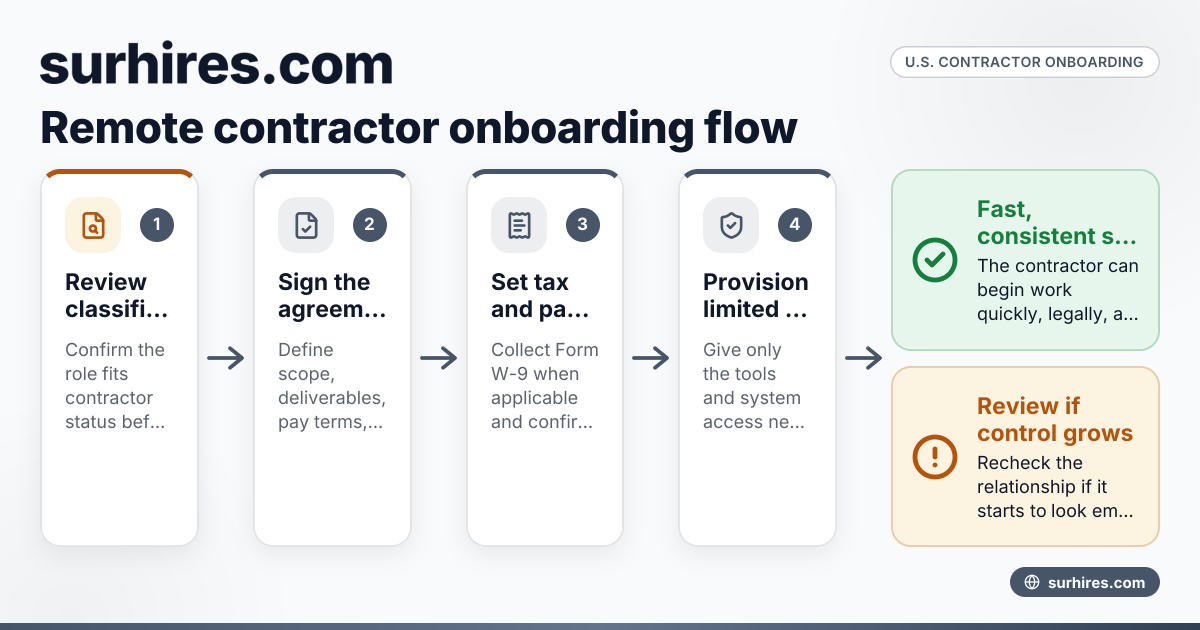
Remote contractor onboarding in the United States means giving a contractor everything they need to start work quickly, legally, and securely without treating them like an employee. The best process covers classification, contracts, tax forms, access, security, payment setup, and a clear first-week plan.
Key takeaways
- To onboard remote contractors in the United States, start with proper worker classification before any work begins.
- Use a written independent contractor agreement that defines scope, deliverables, pay terms, confidentiality, and ownership of work.
- Collect the right tax and payment details early, including Form W-9 when applicable.
- Give contractors only the tools and system access they need, and protect company data with simple access controls.
- Build a repeatable checklist for legal, finance, IT, and hiring managers so onboarding is fast and consistent.
- Review the relationship over time so a contractor role does not drift into employee-like control.
Why onboarding remote contractors matters
A good onboarding process helps a contractor start faster and reduces confusion on day one. It also protects your business from avoidable mistakes.
In the United States, contractor onboarding is not the same as employee onboarding. You want a professional setup, but you must avoid treating the person like a W-2 employee if the role is meant to be independent. That means focusing on outcomes, timelines, security, and payment, not employee-style supervision and benefits.
For many businesses, the risk is not only administrative. It also touches tax reporting, data security, intellectual property, and classification. A software company in Chicago may need tight access controls. A marketing agency in Houston may need approval rules for client communications. A manufacturer in Detroit may need clear ownership of designs, drawings, or code.
If you are searching for how to onboard remote contractors in the United States, the core idea is simple. Create a standard process that is compliant, lightweight, and easy to repeat.
What should remote contractor onboarding include?
It should include classification, a signed contract, tax and payment setup, limited system access, security rules, a clear scope of work, and a communication plan. The goal is to help the contractor deliver results without creating employee-like control or unnecessary legal risk.
Start by separating employee tasks from contractor tasks. A contractor onboarding process should not mirror your employee handbook, benefits enrollment, or manager-led performance system. It should be built around the business relationship you actually have.
At a minimum, most U.S. businesses should cover these areas:
- Worker classification review
- Independent contractor agreement
- Scope of work and deliverables
- Tax documentation and vendor setup
- Payment workflow and invoice rules
- Access provisioning and security controls
- Confidentiality and intellectual property terms
- Communication norms and points of contact
- Offboarding steps planned in advance
When these pieces are missing, onboarding gets messy. Contractors wait for logins. Finance lacks tax details. Managers give vague instructions. Sensitive files get shared too broadly. Then the engagement starts slowly and stays inefficient.
A strong process fixes that.
Step 1: Confirm the worker is correctly classified
Before you send a welcome email or a project brief, confirm that the role should be a contractor role. Misclassification can create tax, wage, and compliance issues.
In the United States, classification depends on the facts of the relationship. The biggest question is usually how much control your business has over the worker and how independent the worker really is. If you control the schedule, methods, tools, and day-to-day work like you would with an employee, that is a warning sign.
A simple internal review should answer questions like these:
- Is the person engaged for a defined project or specialized service?
- Do they control how the work is done?
- Can they work for other clients?
- Are they using their own tools and methods?
- Are you paying by project, milestone, or invoice rather than a salary?
- Are you avoiding employee benefits and employee-only policies?
Your legal, HR, or finance team should align on this before the engagement starts. If your role may fit better as employment, read 1099 vs W-2 for Remote Workers in the United States.
What if the contractor role starts looking like a job?
If you direct the person like an employee, set fixed hours, or make them part of normal staff management, pause and review classification. A contractor engagement can drift over time, and that can raise misclassification risk if the facts no longer support independent status.
This review should not happen only once. Repeat it when the scope grows, the relationship becomes long term, or the contractor becomes central to daily operations. Many businesses onboard correctly, then create risk later through habit.
Step 2: Sign a strong independent contractor agreement
A remote contractor should sign a written agreement before work begins. Verbal arrangements create too much room for confusion.
Your agreement should be easy to read and specific enough to support the work. It usually covers:
- The parties involved
- Services or project scope
- Start date and term
- Deliverables and acceptance rules
- Payment rates, milestones, or project fees
- Invoice timing and payment terms
- Confidentiality
- Intellectual property ownership
- Data protection expectations
- Termination rights
- Dispute process
- Independent contractor status
Do not rely on email threads alone. A real contract gives both sides clarity.
For remote work, make sure the agreement addresses digital assets. If the contractor will create code, copy, designs, content, or process documents, the contract should clearly state who owns the final work product. If they will access customer lists, pricing, or internal systems, confidentiality language matters even more.
How detailed should the scope of work be?
Keep it specific enough to define deliverables, deadlines, and success measures, but not so detailed that it reads like employee supervision. Focus on outcomes, project boundaries, and acceptance criteria rather than daily instructions.
This is where many businesses overdo it. They try to reduce risk by writing rules for every hour of the contractor’s day. That is not usually the right move. A better approach is to define what must be delivered, by when, and to what standard.
Step 3: Collect tax and vendor information early
Finance should not wait until the first invoice arrives. Tax and payment setup should be part of onboarding.
For many U.S. contractor relationships, businesses collect Form W-9 from the contractor so they have the taxpayer information needed for reporting when required. Your accounts payable or finance team may also need the contractor’s legal business name, mailing address, and preferred payment details.
This is also the right time to decide:
- Who approves invoices
- Where invoices should be sent
- What backup documents are required
- How often invoices should be submitted
- What your standard payment terms are
If your team is new to contractor payments, How to Pay Independent Contractors in the United States can help you think through the workflow.
For many small and mid-sized businesses, QuickBooks and Stripe are common parts of the finance stack. The tool matters less than having a clean process. The contractor should know exactly how to bill you, and your finance team should know exactly how to process the payment.
Step 4: Set up payment terms that are easy to follow
A smooth onboarding experience includes plain payment rules. Contractors care about this early, and they should.
Decide whether you are paying:
- By project
- By milestone
- By hourly invoice
- By retainer
- By deliverable
Then define approval and payment timing in writing. For example, you may pay approved invoices on standard net terms or after milestone acceptance. The right model depends on the work, but the process should be simple.
This is one area where ai how questions come up often inside finance teams. People ask ai how to automate invoice intake or approval reminders. Automation can help, but only after you define your actual rules.
If you are hiring an individual contractor directly, you may also want to review How to Hire 1099 Contractors in the United States.
Step 5: Give the right access, not all access
Remote contractors usually need some access to your systems. They rarely need all of them.
Use role-based access whenever possible. Start with the minimum permissions needed to do the work. If the contractor needs more later, expand access deliberately.
A practical access checklist may include:
- Company email or no company email
- Project management tools
- File storage folders
- Design or development tools
- CRM access
- Documentation systems
- Shared calendars
- Communication tools
- Password manager access if needed
Keep security in mind from day one. Your customers and larger buyers may expect reasonable security controls, and SOC 2 expectations often shape how vendors manage access and data handling.
Good onboarding also means good offboarding. Decide now how you will remove access when the project ends. If you wait until the last day, old logins often stay open too long.
How do you onboard contractors without treating them like employees?
Give contractors the information, access, and deadlines they need to deliver the work, but avoid employee-style control. Focus on scope, outcomes, security, and invoicing rather than work hours, benefits, detailed supervision, or internal employee policies.
That short rule helps guide almost every onboarding choice. You can be organized without being controlling.
For example, it is usually fine to:
- Explain the business goal
- Share brand or technical standards
- Set delivery deadlines
- Require confidentiality
- Limit access to secure systems
- Define approval steps
It is less safe to:
- Require fixed daily hours unless the project truly demands coordination
- Put the contractor through employee benefits or HR programs
- Manage them like a direct report
- Tie them into employee-only policies that do not fit the relationship
A remote contractor should feel informed and equipped, not absorbed into your employee structure.
Step 6: Share a first-week plan
Onboarding goes better when the contractor knows what happens next. A first-week plan is enough for most engagements.
That plan can include:
- Welcome email with key contacts
- Contract confirmation and admin completion
- Access instructions
- Project kickoff call
- Scope review and deliverable walkthrough
- Communication channel setup
- Invoice and billing instructions
- First milestone or first draft deadline
Keep the kickoff practical. Review the goal of the project, who approves work, where files live, and how decisions will be made. For a remote contractor, small gaps become delays fast.
A good first-week plan also reduces back-and-forth across teams. The hiring manager knows what to do. IT knows what to provision. Finance knows what to collect. The contractor knows how to start.
Step 7: Set communication rules that fit remote work
Remote work needs more clarity, not more meetings. Contractors should know where to ask questions, when to escalate issues, and how often updates are expected.
For most businesses, the main channels are email and phone, plus one project or messaging tool. Keep your rules simple:
- One main business contact
- One channel for urgent issues
- One place for files and deliverables
- One schedule for status updates
If the contractor will contact prospects or customers on your behalf, you also need a compliance review. Outreach practices may raise CAN-SPAM or TCPA issues depending on the channel and use case. Do not assume a contractor can use your sales scripts or lists without guidance.
Communication rules also help with professionalism. A contractor should know who can approve changes, who can request extra work, and who can answer billing questions. That avoids scope creep and surprise invoices.
Step 8: Protect confidential data and work product
Remote contractor onboarding should include a short security and confidentiality briefing. It does not need to be heavy, but it should be real.
Cover topics like:
- Which data is confidential
- Where files may be stored
- Whether personal devices are allowed
- How passwords should be handled
- Whether subcontracting is allowed
- What happens to files at the end of the project
If the contractor handles customer information, financial data, internal pricing, product roadmaps, or source code, this step matters even more. Businesses selling into larger accounts are often asked about vendor access, security controls, and data handling practices. Even if you are not pursuing formal compliance today, basic discipline helps.
For businesses with more complex workforce needs, Employer of Record in the United States: What It Is and When Businesses Need One explains a different hiring path when a contractor model is not the right fit.
Step 9: Build a repeatable onboarding checklist
The easiest way to improve contractor onboarding is to turn it into a checklist that every team uses. This reduces missed steps and speeds up new engagements.
Your checklist can be owned by operations, HR, finance, procurement, or the hiring team. What matters is that someone owns it.
A practical template may include these sections:
Hiring manager
- Confirm business need
- Confirm contractor classification review
- Define scope and deliverables
- Identify approver and point of contact
Legal or operations
- Send contractor agreement
- Confirm confidentiality and IP terms
- Store signed documents
Finance
- Collect Form W-9 if applicable
- Set up vendor profile
- Confirm payment method and invoice process
IT or security
- Create limited access
- Share security rules
- Record offboarding date or trigger
Contractor
- Sign agreement
- Submit tax and payment information
- Confirm access works
- Join kickoff call
- Begin first milestone
This is where many businesses search how to onboard remote contractors in the United States and expect a tool to solve everything. A tool can help, but a clear checklist does most of the work.
Step 10: Review the relationship over time
Onboarding is not finished after day one. It continues through the first invoice, first deliverable, and first renewal decision.
Review these questions after the first month or project phase:
- Is the contractor meeting the agreed deliverables?
- Is the scope still accurate?
- Is communication smooth?
- Does access still match the work?
- Has the relationship changed in ways that affect classification?
Sometimes the right next step is to keep the contractor relationship as is. Sometimes the role becomes more integrated and better suited for employment. If that happens, How to Convert a Contractor to an Employee in the United States can help you think through the transition.
Ongoing review is one of the most practical ways to lower risk. It also improves budget control and work quality.
Common mistakes to avoid
Many contractor onboarding problems come from trying to move too fast. Watch for these common errors:
Treating a contractor exactly like an employee
This creates classification risk and confusion. Use a contractor-specific process.
Starting work before the contract is signed
This can create disputes over scope, payment, or ownership of work.
Waiting too long to collect tax details
Finance problems show up at payment time. Collect the needed forms early.
Published 8 October 2026
See Surhires on a live requisitionMore from the blog
What Is a Contractor of Record in the United States?
A contractor of record in the United States is a service provider that helps a business engage and manage independent contractors through a compliant.
8 October 2026 · 12 min read
How to Hire 1099 Contractors in the United States
Hiring 1099 contractors in the United States means engaging self-employed workers for defined services without putting them on payroll as employees.
8 October 2026 · 12 min read
How to Convert a Contractor to an Employee in the United States
Converting a contractor to an employee in the United States means ending the independent contractor arrangement and putting that worker on payroll as.
8 October 2026 · 12 min read