Guides
Contractor Agreement Checklist in the United States
A contractor agreement checklist in the United States is a practical way to make sure your business covers the terms that matter before work starts. A
By The surhires.com team · · 12 min read
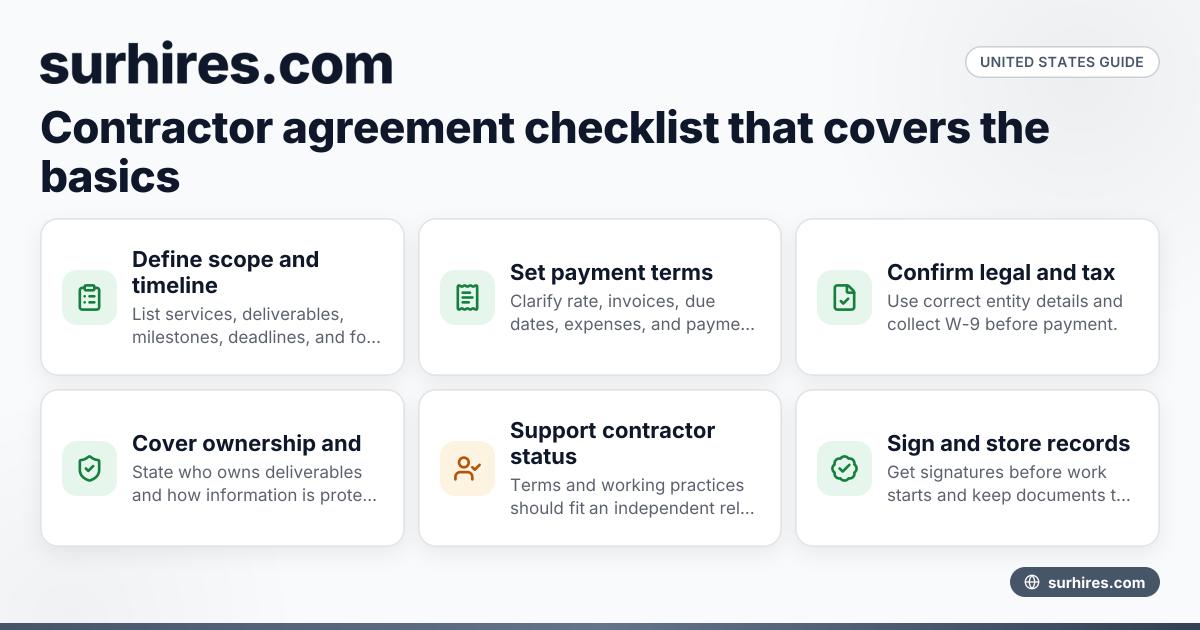
A contractor agreement checklist in the United States is a practical way to make sure your business covers the terms that matter before work starts. A strong agreement helps define scope, payment, ownership, confidentiality, tax status, and the working relationship so you reduce disputes and lower misclassification risk.
Key takeaways
- A contractor agreement should define the work, timeline, payment terms, and who owns the deliverables.
- In the United States, the agreement should support an independent contractor relationship, not accidentally create an employee-like arrangement.
- Your checklist should cover legal basics like confidentiality, termination, dispute handling, and tax documentation.
- State law can affect enforceability, so your agreement should name governing law and be reviewed for your situation.
- A reusable checklist speeds up hiring and onboarding while keeping records more consistent.
- The best contractor agreement checklist United States teams use is simple, repeatable, and tied to how work actually gets done.
What is a contractor agreement checklist in the United States?
A contractor agreement checklist in the United States is a step-by-step list of items to confirm before signing an independent contractor agreement. It helps business owners, finance teams, and hiring managers avoid missing important terms. It also creates a more consistent process when you hire freelancers or specialized contractors.
For many businesses, the risk is not just a vague agreement. The bigger risk is inconsistency. One team may send a short statement of work by email. Another may use an old contract template. A third may rely on a verbal understanding. That creates confusion when payment timing, ownership of work, or performance issues come up later.
A checklist solves that problem. It gives your team one standard review process. That matters whether you are hiring a software developer in Chicago, a marketing contractor in Houston, or a manufacturing consultant supporting an ERP rollout in Detroit.
A checklist is also useful because contractor agreements do more than describe services. They support compliance. The wording should fit a real independent business relationship. If your agreement says one thing but your process treats the person like an employee, you can create tax and labor risk. If you need background on that issue, read How to Avoid Worker Misclassification When Hiring Remote Talent in the United States.
Why does a contractor agreement checklist matter?
It prevents common mistakes before they become expensive problems. A checklist helps your team confirm the deal, the documents, and the working model before anyone starts work.
Without a checklist, businesses often miss basic items such as:
- The legal name of the contractor
- A clear scope of work
- Payment due dates
- Expense approval rules
- IP ownership language
- Confidentiality obligations
- Termination rights
- W-9 collection for tax reporting
- A signed agreement before services begin
These issues can affect daily operations quickly. Finance may not know whether to pay against milestones or invoices. Operations may not know whether the contractor can subcontract work. Sales may assume your business owns the deliverables when the contract is silent. Procurement may not have enough documentation for vendor files.
A checklist also helps when different departments are involved. Legal cares about enforceability. Finance cares about invoice terms and 1099 reporting support. Security may care about access controls and customer data handling. The hiring manager cares about delivery deadlines. A shared checklist keeps those concerns aligned.
What should every contractor agreement include?
Every contractor agreement should clearly identify the parties, the services, payment terms, term and termination, confidentiality, and ownership of work. It should also support independent contractor status and match your actual working practices.
Below is the practical checklist most United States businesses should review.
1. Correct legal names and contact details
Start with the basics. Confirm the full legal name of your business and the contractor. If the contractor operates through an LLC or corporation, use the legal entity name in the agreement. Include a valid business address and contact details for notices.
This sounds simple, but it matters. Payment errors, tax reporting issues, and signature disputes often begin with bad entity information.
2. A clear description of services
Describe the work in plain language. Avoid broad phrases like “marketing support” or “technology services” if they do not explain what the contractor will actually deliver.
A better scope includes:
- The services to be performed
- Specific deliverables
- Milestones
- Deadlines
- Required formats
- Acceptance criteria if needed
If the work is complex, attach a statement of work. The main agreement can set general terms, and the statement of work can define the project details. That makes future projects easier to add without rewriting the full contract.
3. Payment terms
Set payment terms clearly. Include the rate structure, invoice process, due dates, and any approved expenses. State whether the contractor is paid hourly, per project, per milestone, or on a retainer.
Also clarify:
- Invoice frequency
- Required invoice detail
- Late fee language if you use it
- Reimbursement rules
- Whether pre-approval is required for expenses
- Payment method, such as ACH through your normal accounts payable process
This is especially important if your business uses QuickBooks or Stripe for payment workflows. Your agreement should match how invoices are approved internally. For more on payment mechanics, see How to Pay Independent Contractors in the United States.
4. Term and termination
State when the agreement starts and whether it ends on a specific date, continues until the work is complete, or remains ongoing until terminated. Include how either party can end the relationship.
Common items include:
- Termination with notice
- Termination for breach
- Payment for completed work
- Return or deletion of company property and data
- Survival of confidentiality and IP clauses
Clear termination language gives both sides a clean exit path. That can reduce disputes if priorities change or the contractor is not a fit.
5. Independent contractor status
This section is essential. The agreement should state that the contractor is an independent contractor and not an employee. It should also make clear that the contractor is responsible for their own taxes, benefits, and business expenses unless the agreement says otherwise.
But the written clause is only part of the picture. Your operations must match it. If you control the contractor like an employee, require fixed schedules without business need, or integrate them into employee-only policies, the agreement alone will not protect you.
If you need a deeper hiring framework, review How to Hire 1099 Contractors in the United States.
6. Tax documentation and reporting support
Your checklist should include collection of a completed Form W-9 before the first payment where appropriate. That helps your finance team set up the contractor correctly and prepare for year-end reporting if required.
The agreement itself does not replace tax paperwork. Your checklist should connect legal review with vendor onboarding. That includes entity name matching, taxpayer information, and payment setup.
7. Confidentiality and data handling
Most contractors will have access to some business information. Include a confidentiality clause that defines confidential information, states how it can be used, and explains what happens when the relationship ends.
If the contractor will access sensitive systems or customer data, add more detail. Many business buyers now expect reasonable security practices, and some customers may ask about controls during procurement. If your business sells into larger accounts, this can connect to broader SOC 2 expectations and vendor review processes.
8. Intellectual property ownership
This is one of the most important parts of the checklist. If the contractor creates software code, designs, content, product documentation, or other deliverables, your agreement should state who owns that work.
Do not assume payment alone transfers ownership. The contract should clearly address assignment of rights or ownership of deliverables. It should also state whether the contractor can reuse pre-existing materials, tools, or templates.
If the contractor uses their own background materials, your agreement may need a license provision so your business can still use the final work.
9. Non-solicitation or other restrictive terms, if appropriate
Some businesses include non-solicitation language to prevent a contractor from poaching employees or customers for a period of time. Use caution here. Rules vary by state, and overbroad restrictive language may be hard to enforce.
Your checklist should not assume every contractor needs every restriction. Use only what fits the role and business need.
10. Governing law and dispute process
Your agreement should say which state’s law governs the contract. It should also explain how disputes will be handled, such as through court litigation, arbitration, or mediation if your business chooses those methods.
This section matters more than many teams realize. A dispute process affects cost, speed, and leverage if there is a payment or ownership disagreement later.
11. Insurance, licenses, or compliance requirements
Some contractor roles need extra clauses. For example, a field services contractor may need insurance requirements. A licensed professional may need to confirm they maintain required credentials. A contractor doing outreach may need to follow CAN-SPAM or TCPA rules depending on the work.
This is where your checklist should be role-based, not just generic.
12. Signature and recordkeeping
Make sure the agreement is signed before work starts. Save the final signed copy in a place that legal, finance, and the hiring team can access. Keep any statements of work, W-9 records, and related onboarding documents with it.
A good agreement is much less useful if no one can find it later.
What is the best process for using a contractor agreement checklist?
Use one intake process before work begins. Confirm the business need, classification, contract terms, tax documents, and approvals before the contractor gets access or starts billing.
Here is a practical workflow many businesses can use.
Step 1: Confirm the role is suitable for a contractor
Start by reviewing the nature of the work. Is this project-based, specialized, and outcome-focused? Or is it ongoing work under close company control that looks more like employment?
This is the first decision, not the last. If the role should be an employee role, a contractor agreement checklist will not fix that.
Step 2: Gather intake details from the hiring manager
Have the hiring manager submit:
- Contractor legal name or entity
- Scope of work
- Budget
- Timeline
- Internal owner
- System or data access needed
- Deliverables and milestones
This keeps legal and finance from chasing details later.
Step 3: Match the right agreement template
Use a standard template approved for your business. Then add a statement of work or special terms only if needed. Avoid editing from random old versions stored in email.
This is also where some teams ask whether an ai contractor agreement tool can draft the first version. It can help organize inputs, but your team still needs human review for classification, state law issues, and business-specific risk.
Step 4: Review tax and onboarding documents
Collect the W-9 and set up the contractor in your finance system. Confirm invoice instructions and payment method. Make sure the legal entity on the agreement matches the payee setup.
Step 5: Check security and data access
If the contractor will use company systems, define access scope. Give only the minimum required access. Document who approves it and when it should be removed.
Step 6: Get signatures before work starts
Do not let work begin on a promise that paperwork will come later. Delayed signatures create weak records and harder disputes.
Step 7: Store the agreement and monitor the relationship
Save the signed agreement and linked documents in a consistent system. Review long-running contractor relationships periodically. If the work changes over time, the original classification and contract terms may need review.
Can you use AI to create a contractor agreement?
Yes, AI can help draft a starting point, summarize clauses, and build a checklist. It should not replace legal review, business judgment, or a real classification assessment.
AI can speed up the first draft. It can also help a team standardize intake questions and flag missing terms. That is useful for busy operations teams. But AI often lacks the full context of your business relationship, your state law concerns, and your security obligations.
For example, AI may produce broad language that sounds complete but does not match how your company actually works. It may also miss a conflict between your agreement and your onboarding process. If your contract says the contractor controls how work is done, but your internal process requires employee-style supervision, that mismatch still creates risk.
The safest approach is to treat AI as a drafting assistant, not a decision-maker. Use it to create structure. Then have the right people review the result:
- Legal or outside counsel for enforceability
- Finance for payment and tax setup
- Security for access and data terms
- The hiring manager for scope accuracy
How do you spot red flags in a contractor agreement?
Look for vague scope, missing payment terms, weak IP language, no termination clause, and any terms that conflict with true contractor status.
Here are the most common warning signs.
Vague work descriptions
If the contractor’s services are unclear, disputes become more likely. The contractor may believe they finished the job while your team expects more work.
Employee-like control in the contract
Watch for clauses that require fixed daily schedules, ongoing direct supervision, or broad internal policy compliance unrelated to the project. Those terms can undercut your independent contractor position.
No ownership language
If your business is paying for a website redesign, code module, or marketing content, the agreement should address ownership clearly. Silence creates risk.
Missing invoice and payment process
If there is no clear invoicing process, delays and frustration follow. This becomes a bigger problem when your AP team uses scheduled weekly or biweekly payment runs.
No confidentiality or data language
Even smaller businesses handle sensitive pricing, customer lists, internal forecasts, and login credentials. Basic confidentiality terms are usually worth having.
No signed copy on file
This is one of the most common practical failures. A checklist should end only when a signed copy is stored and accessible.
How should small and mid-sized businesses apply this checklist?
Start with one standard template, one intake form, and one approval path. Keep the process light, but do not skip the basics.
For a small business, the goal is not to build a giant procurement system. The goal is to avoid avoidable mistakes. You can usually get strong results with:
- A standard contractor agreement
- A short statement of work template
- A W-9 collection step
- A finance setup checklist
- A simple document storage rule
Published 9 October 2026
See Surhires on a live requisitionMore from the blog
How to Avoid Worker Misclassification When Hiring Remote Talent in the United States
Worker misclassification happens when a business treats a worker as an independent contractor when the law says that worker should be an employee.
9 October 2026 · 12 min read
What Is a Contractor of Record in the United States?
A contractor of record in the United States is a service provider that helps a business engage and manage independent contractors through a compliant.
8 October 2026 · 12 min read
How to Onboard Remote Contractors in the United States
Remote contractor onboarding in the United States means giving a contractor everything they need to start work quickly, legally, and securely without.
8 October 2026 · 12 min read