Guides
How to Avoid Worker Misclassification When Hiring Remote Talent in the United States
Worker misclassification happens when a business treats a worker as an independent contractor when the law says that worker should be an employee.
By The surhires.com team · · 12 min read
Worker misclassification happens when a business treats a worker as an independent contractor when the law says that worker should be an employee. When you hire remote talent in the United States, the risk rises because work happens across states, managers rely on digital tools, and day-to-day control can creep in without anyone noticing.
Key takeaways
- Worker misclassification can trigger back taxes, wage claims, penalties, and benefits disputes.
- Remote work does not change the legal test by itself, but it often changes how control is exercised and documented.
- The safest approach is to review the real working relationship, not just the contract title.
- State rules matter, especially for wage and hour compliance, unemployment insurance, and workers’ compensation.
- A written process for classification, onboarding, payments, and manager training reduces mistakes.
- If a role looks like ongoing, directed work, consider hiring as an employee or using the right support model.
Why worker misclassification matters for remote hiring
Many businesses think misclassification is mostly a paperwork issue. It is not. It affects taxes, payroll, overtime, benefits, insurance, and legal exposure.
If you classify a remote worker as a contractor but treat that person like an employee, you may face claims for unpaid overtime, minimum wage, expense reimbursement, tax withholding, unemployment coverage, or benefits eligibility. In some cases, the issue appears during a routine finance review. In others, it starts when the worker files for unemployment or raises a wage complaint.
Remote hiring makes this more complicated because managers often supervise people through Slack, email, project boards, time tracking tools, and scheduled check-ins. Those systems can create the same kind of control that exists in a physical office. If the worker must be online at set hours, use your process exactly, ask permission for time off, and work only for you, the relationship may look more like employment.
This is why the search phrase worker misclassification remote employees United States matters in practice. Businesses are not just asking what the rules say. They are asking how remote operations change the facts.
What counts as worker misclassification in the United States?
Worker misclassification means labeling someone the wrong way for legal and tax purposes. The most common mistake is calling someone an independent contractor when the facts show an employee relationship.
There is no single rule that covers every issue in every context. Different agencies and laws may use different tests. In general, the key question is how much control the business has, how independent the worker really is, and whether the worker runs an actual business of their own.
Common signs a remote worker may be an employee
These signs do not guarantee employee status, but they should trigger a review:
- The worker follows a fixed schedule set by your company.
- The worker is supervised like a staff member.
- The worker uses your systems as their primary work environment.
- The worker performs core ongoing business functions.
- The worker is paid regularly like payroll instead of by project or milestone.
- The worker cannot hire helpers or subcontract the work.
- The worker works mainly or only for your business.
- The worker has little risk of profit or loss.
A written agreement matters, but the actual relationship matters more. A contract that says “independent contractor” will not fix a role that operates like employment.
Why remote work blurs the line
In office settings, managers often see control more clearly. In remote settings, control shows up through workflows and software. A manager may require daily standups, active status, approval for breaks, mandatory tool use, and strict process compliance. Those instructions may be normal for employees. They can be risky for contractors.
Remote work also leads businesses to hire in states where they have never employed anyone before. That creates new obligations. State labor agencies may look at classification, final pay rules, unemployment insurance, and wage claims differently from what your team expects.
How do you tell if a remote worker should be an employee?
Look at the real relationship: control, independence, pay structure, and whether the person runs their own business. If your company directs how, when, and where the work gets done on an ongoing basis, the role may fit employee status even if the worker is remote.
That short answer is the starting point. The hard part is applying it consistently across departments.
Focus on the facts, not the label
A good classification review asks practical questions:
- Who controls the work?
Do you direct only the deliverable, or do you direct the process, schedule, and methods?
- Is the work project-based or ongoing?
A six-week website redesign looks different from an open-ended full-time marketing role.
- Does the worker operate an independent business?
Do they market services to others, carry business insurance, use their own tools, and invoice for work?
- How is the worker paid?
Flat project fees or milestone payments usually support contractor treatment more than a salary-like weekly amount.
- Can the worker work for others?
Exclusivity can point toward employee status, especially if combined with ongoing supervision.
- Is the role central to your business?
The closer the work is to your core operations, the more caution you should use.
Remote management habits that create risk
Managers often create misclassification risk without meaning to. Watch for these patterns:
- Requiring fixed daily schedules for contractors
- Tracking hours the same way you track employees
- Giving contractors company titles or org chart positions
- Including contractors in employee performance reviews
- Requiring company-wide policies that go beyond security or confidentiality
- Approving vacation requests instead of coordinating deadlines
- Providing permanent company equipment for indefinite, integrated work
Some businesses now use software to flag classification issues. That can help, but ai worker misclassification checks are only as good as the information your team enters. If managers describe the role inaccurately, the system will not save you.
Which laws and agencies should businesses think about?
Several federal and state rules can apply, depending on the issue. Tax treatment, wage claims, unemployment insurance, and benefits questions may not use the exact same standard.
Because this is a United States issue, businesses should think in layers rather than in one single test.
Federal tax and reporting issues
The IRS looks at whether the business has the right to direct and control the worker. If a worker is really an employee, the business may owe employment taxes and withholding obligations that were missed.
Independent contractors are commonly paid outside payroll and may receive Form 1099-NEC when required. That reporting step does not prove the classification was correct. It only shows how the business reported the payments.
If your current process is built around contractor payments, it helps to review How to Pay Independent Contractors in the United States alongside your classification steps.
Wage and hour exposure
Under federal wage and hour rules, employees may be entitled to minimum wage and overtime unless an exemption applies. Contractors are not covered in the same way. If a worker was misclassified, the company may face claims for unpaid overtime and related damages.
Remote work adds another layer because timekeeping may be informal. If the worker was treated like a contractor but worked long hours under company direction, the absence of good records can make the situation worse.
State law exposure
States may have their own tests and enforcement priorities. They may also review unemployment insurance, wage payment timing, reimbursement obligations, and workers’ compensation coverage.
That matters if you hire a remote worker in Illinois, Texas, Michigan, or any other state where your business has not hired before. A Chicago software company and a Houston distributor can face different practical compliance issues even when they use the same contractor agreement.
What are the biggest remote hiring mistakes that lead to misclassification?
The biggest mistakes are treating contractors like staff, using one template for every role, and letting hiring managers make classification decisions alone. Remote work hides these problems until a dispute, audit, or termination brings them to light.
Here are the mistakes that show up most often.
1. Hiring for a full-time job but calling it freelance
If the role is permanent, manager-led, and central to the business, contractor status is hard to defend. A remote customer success lead, internal recruiter, or operations manager often looks more like an employee than a true contractor.
2. Using one contract for every state and role
A single agreement may miss state-specific issues and role-specific realities. Classification should match the actual work and working relationship, not just your template library.
3. Letting managers supervise contractors like employees
This is a major remote risk. Managers may set schedules, require daily attendance, dictate tools, and measure responsiveness. That level of control can undermine contractor status quickly.
4. Paying by the week without project structure
Regular weekly payments are not automatically wrong, but they can look more like wages when paired with ongoing duties and supervision. Clear statements of work, milestones, and deliverables are often safer.
5. Skipping onboarding controls
Poor onboarding causes classification drift. If contractors are added to employee handbooks, all-staff meetings, and standard HR workflows, the relationship may begin to look like employment from day one.
For practical setup guidance, see How to Onboard Remote Contractors in the United States.
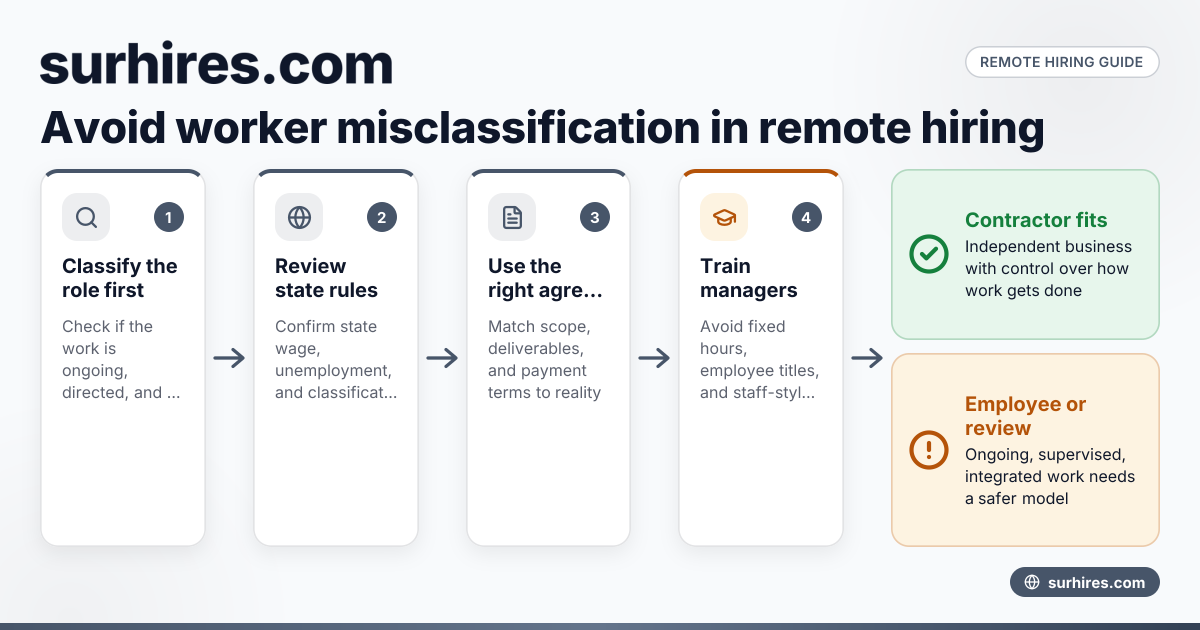
A practical process to avoid worker misclassification
The best way to reduce risk is to build a repeatable review before the worker starts. Most problems begin when speed wins over process.
1. Classify the role before sourcing candidates
Start with the job itself, not the candidate preference. Ask:
- Is this ongoing work or a defined project?
- Will the person be directed daily by a manager?
- Is the role core to revenue or operations?
- Will the person work set hours?
- Will the person be integrated into teams and systems?
If the answer points toward employment, decide that early.
2. Review state-specific implications
Identify where the worker will perform services. Then confirm what state-level wage, unemployment, and worker classification issues may apply. Remote work is not location-free for compliance purposes.
3. Use the right agreement and scope
A contractor agreement should reflect a real independent business relationship. Include a clear scope of work, deliverables, payment terms, confidentiality terms, and ownership provisions where appropriate. Do not use contractor wording for a role you plan to manage like staff.
4. Train managers on what not to do
Manager behavior often decides the outcome more than legal paperwork. Train teams not to:
- Set fixed daily hours for contractors unless truly necessary and legally reviewed
- Require employee-style attendance
- Give employee titles
- Route contractors through employee performance systems
- Restrict outside work without a strong reason
5. Keep contractor workflows separate
Use separate onboarding, approvals, payment, and records processes. Finance, legal, and HR should be able to tell the difference between employees and contractors immediately.
6. Reassess long-term relationships
A contractor who starts with a narrow project may drift into an employee-like role over time. Review relationships at regular intervals, especially after six months, renewals, or scope changes.
If the role has outgrown contractor status, plan a lawful transition. This guide on How to Convert a Contractor to an Employee in the United States can help.
What should your hiring team document?
Document the business reason for the classification, the scope of work, payment structure, state of work, and manager guidance. Good records do not guarantee the classification is right, but they help show that your business used a thoughtful process instead of guessing.
Then go a step further and make the documentation usable.
Build a simple classification file
For each remote contractor or borderline role, keep:
- A classification checklist
- The signed agreement
- The statement of work
- The payment method and invoice process
- The worker’s business details
- Notes on the state where the work is performed
- Any reclassification or renewal review notes
This file should be easy to find during finance reviews, legal reviews, or diligence. Buyers and larger customers may also care about your compliance maturity, especially if they expect strong internal controls or SOC 2-aligned operations.
Align finance and legal operations
Classification problems often show up when systems disagree. For example:
- HR treats the worker like staff
- Finance pays through accounts payable
- IT grants broad employee access
- Managers expect real-time availability
Your process should line up across QuickBooks, contract files, payment records, and manager instructions. If you use Stripe for contractor payouts or invoice collection workflows, make sure those records match the relationship described in your contract and scope.
When should you choose an employee, a contractor, or another model?
Choose employee status when the role is ongoing, supervised, and integrated into your business. Choose contractor status when the person runs an independent business and controls how the work gets done. If you need help structuring the relationship, a specialized model may reduce risk.
Employee status is often the safer option when
- You need full-time availability
- You set work hours
- You provide detailed process control
- The role is central and permanent
- The worker reports to your managers like staff
Contractor status may fit when
- The work is project-based
- Deliverables are clearly defined
- The worker controls the method
- The worker serves multiple clients
- The engagement has a real end point
Support models can help
If your team lacks internal capacity to manage classification well, it may help to understand options like a contractor-focused service model or an employment solution for employee roles. Start with What Is a Contractor of Record in the United States? and, for employee hiring structures, Employer of Record in the United States: What It Is and When Businesses Need One.
How can surhires.com help businesses hiring remote talent?
surhires.com can help businesses think through contractor hiring workflows, remote onboarding, and compliance-sensitive classification decisions in the United States. It is most useful when you want a clearer process before remote hiring expands across more states and managers.
You do not need a huge compliance team to reduce risk. You need a repeatable system, clear ownership, and the discipline to review facts before the worker starts. That means involving legal, HR, finance, and the hiring manager early. It also means fixing roles that have drifted over time.
If you are building that process now, start with one department. Review all remote non-payroll workers. Separate true project contractors from employee-like roles. Update onboarding. Tighten statements of work. Retrain managers. Then apply the same playbook company-wide.
For more practical guidance, explore the surhires.com blog.
If you want a simpler way to structure remote hiring decisions in the United States, learn more about surhires.com and how it can support compliant contractor and workforce processes.
Published 9 October 2026
See Surhires on a live requisitionMore from the blog
What Is a Contractor of Record in the United States?
A contractor of record in the United States is a service provider that helps a business engage and manage independent contractors through a compliant.
8 October 2026 · 12 min read
How to Onboard Remote Contractors in the United States
Remote contractor onboarding in the United States means giving a contractor everything they need to start work quickly, legally, and securely without.
8 October 2026 · 12 min read
How to Hire 1099 Contractors in the United States
Hiring 1099 contractors in the United States means engaging self-employed workers for defined services without putting them on payroll as employees.
8 October 2026 · 12 min read