Guides
Independent Contractor Compliance Guide in the United States
Independent contractor compliance in the United States means setting up the right classification, contract, tax paperwork, payment process, and.
By The surhires.com team · · 12 min read
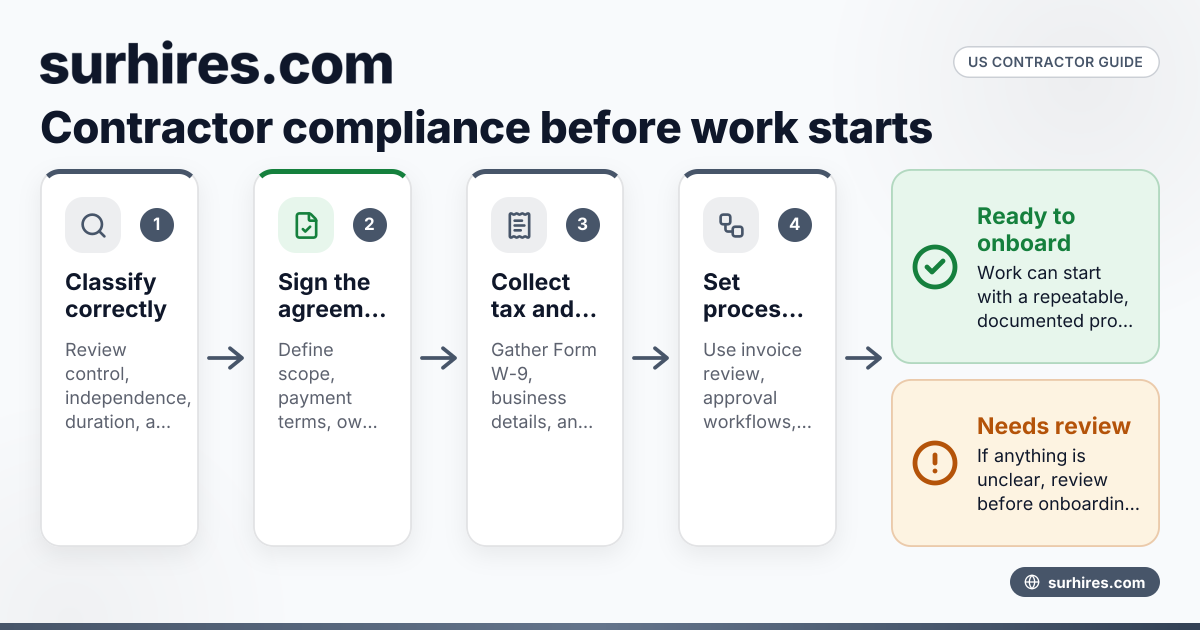
Independent contractor compliance in the United States means setting up the right classification, contract, tax paperwork, payment process, and recordkeeping before work starts. A good compliance process lowers the risk of worker misclassification, tax mistakes, payment disputes, and buyer due diligence issues later.
Key takeaways
- Independent contractor compliance in the United States starts with correct worker classification, not paperwork alone.
- A written agreement should define scope, payment terms, ownership, confidentiality, and the contractor’s independent status.
- Tax and onboarding steps often include collecting Form W-9, validating business details, and preparing for 1099 reporting when required.
- Compliance also includes process controls such as invoice review, approval workflows, document storage, and state-specific checks.
- Fast growth, remote work, and use of an ai independent contractor workflow do not remove legal or tax obligations.
- A repeatable system is easier to manage than one-off decisions made by separate teams.
What is independent contractor compliance in the United States?
Independent contractor compliance in the United States is the set of rules, documents, and internal controls a business uses when engaging self-employed workers. It covers classification, contracting, tax forms, payment setup, information security, and records.
This matters because a contractor relationship is not just a cheaper version of employment. If your company treats a contractor like an employee, the risk does not disappear because both sides agreed to the label. Regulators and agencies generally look at the facts of the working relationship.
For a business in Chicago, Houston, or Detroit, the practical risk is broad. It can affect federal and state tax treatment, wage claims, insurance questions, IP ownership, and audit readiness. It can also create operational friction when finance, legal, procurement, and hiring managers all use different standards.
A strong independent contractor compliance guide United States process helps answer a few basic questions before work begins:
- Is this person properly classified as an independent contractor?
- Is the contract complete and signed?
- Have you collected the right tax and payment details?
- Do your working practices match contractor status?
- Can your team prove that if asked later?
If any of those answers is unclear, the relationship needs review before onboarding.
Why does independent contractor compliance matter?
The biggest risk is misclassification. If a worker should have been treated as an employee, your business may face back taxes, penalties, benefit disputes, and labor claims. The exact outcome depends on the facts and the agencies involved, but the cleanup is usually much more expensive than setting up the relationship correctly at the start.
There is also a business risk beyond legal exposure. Many buyers, enterprise customers, and investors now expect organized compliance. During procurement or due diligence, they may ask how you classify contractors, how you collect tax forms, and whether you follow a repeatable process. If your company is pursuing larger contracts, especially those with security reviews and SOC 2 expectations, contractor controls can become part of the discussion.
Operationally, a weak process creates payment delays and disputes. Missing W-9s, unclear statements of work, or inconsistent approval rules can slow AP close and create friction with QuickBooks or Stripe-based workflows. In manufacturing or field services, the problem can spread into ERP records, purchase orders, and vendor master data.
Who counts as an independent contractor?
An independent contractor is generally a self-employed person or business that provides services to your company without becoming your employee. In practice, the label alone is not enough. The real test is how much control your company has over the worker and how the relationship operates day to day.
Common contractor examples include:
- Freelance designers and writers
- IT consultants
- Software developers working on a project basis
- Marketing specialists
- Fractional finance or operations professionals
- Certain field service providers working through their own business
But titles can be misleading. A “consultant” who works full time under your manager’s direct supervision, uses your schedule, and performs core ongoing duties may not be a true contractor.
That is why your compliance process should focus on facts such as:
- Who controls the work methods
- Whether the worker can serve other clients
- Whether the relationship is project-based or indefinite
- How payment is structured
- Whether the worker uses their own tools and business entity
- Whether the services are central to your normal operations
For a deeper look at this issue, see How to Avoid Worker Misclassification When Hiring Remote Talent in the United States.
How do you classify an independent contractor correctly?
Start with the actual working relationship, not the job title or the worker’s preference. Review control, independence, duration, and business reality before onboarding anyone as a contractor.
Correct classification is the foundation of compliance. If this step is wrong, the rest of your paperwork may not help much. A signed contract and a W-9 do not fix a relationship that operates like employment.
A practical classification review process
Use a simple internal review before any offer goes out.
- Define the work clearly
Describe the project, deliverables, timeline, and business need. Short-term, specialized, deliverable-based work is usually easier to assess than open-ended support.
- Review control over the work
Ask whether your company is directing the result or directing the daily method. Contractors should usually control how they perform the work.
- Check business independence
Look for signs the worker is operating an independent business. Examples include a business name, business insurance, multiple clients, a website, and their own tools.
- Assess duration and exclusivity
Long, exclusive, indefinite arrangements create more risk. So do situations where the worker functions like a permanent team member.
- Document the reasoning
Keep a short internal memo or intake record showing why the role was approved as contractor work.
This review should happen before the contract is sent. It should also be repeated if the scope changes. Many compliance failures start with a valid short project that slowly turns into a permanent operating role.
What documents do you need for contractor compliance?
At minimum, collect a signed agreement, Form W-9, payment details, and records that support your classification decision. Keep everything in one place and update it when scope, entity details, or payment terms change.
Those core documents create the backbone of your process. However, document collection should match the work and the risk level. A software developer with system access may need stronger confidentiality and security language than a one-time copy editor.
Core documents to collect before work starts
Most businesses in the United States should consider the following:
- Independent contractor agreement
This should define the parties, services, payment terms, term and termination, confidentiality, IP ownership, and dispute terms.
- Statement of work or scope document
This is useful when the master agreement is broad. It sets deliverables, deadlines, rates, milestones, and acceptance criteria.
- Form W-9
This supports tax reporting and helps your finance team confirm the contractor’s legal name and taxpayer information.
- Business and payment details
Collect remittance instructions and verify who you are paying. This helps reduce fraud and AP errors.
- Classification review record
Maintain an internal file showing why the worker was treated as a contractor.
- Security and access records
If the contractor will access systems or customer data, record approvals, permissions, and offboarding steps.
If you need help tightening your agreement terms, review Contractor Agreement Checklist in the United States.
The onboarding checklist for independent contractors
A repeatable onboarding checklist helps different teams follow the same standard. It also reduces the chance that a hiring manager starts work before finance and legal are ready.
Step 1: Intake and role review
Create a short request form for managers. It should ask:
- What services are needed
- Why a contractor is the right fit
- Expected start and end dates
- Deliverables and budget
- Reporting structure
- Access needed to systems or data
This step often reveals whether the role should actually be employment.
Step 2: Classification approval
Have one owner for classification review. In a small business, this may be the founder, finance lead, or operations manager. In a larger company, it may sit with HR, legal, or procurement.
The key is consistency. If every department makes its own call, your risk rises.
Step 3: Collect legal and tax documents
Before work begins, gather the agreement, W-9, and scope documents. Confirm the legal entity name matches your AP and tax records. If the contractor will receive Form 1099 reporting, your records need to be accurate from the start.
For a more detailed tax-focused workflow, see How to Create a Compliant 1099 Contractor Onboarding Process in the United States.
Step 4: Set payment controls
Define rate, milestone, invoice timing, approval authority, and payment method. Make sure your finance team knows whether the contractor is in QuickBooks as a vendor and what documentation is required before each payment.
Step 5: Limit and document system access
Contractors should receive only the access needed for the project. Record access requests, approvals, and end dates. If your customers care about vendor controls, this process supports your broader compliance story.
Step 6: Offboard at project end
Remove access, close outstanding invoices, and archive records. If the project extends or changes significantly, rerun classification and contract review instead of letting the relationship drift.
You can also review How to Onboard Remote Contractors in the United States for a broader operating checklist.
Tax and payment compliance basics
Tax compliance for independent contractors usually starts with collecting Form W-9 and paying from your vendor process, not payroll. Your business may also need to issue Form 1099 in cases where reporting is required, based on the facts and payment method.
That sounds simple, but common mistakes still happen:
- Paying before collecting the W-9
- Using the wrong legal name in AP
- Mixing employee reimbursement rules with contractor payments
- Missing year-end reporting preparation
- Keeping tax forms in scattered email threads
A cleaner process is to treat contractors as a controlled vendor category. Finance should know exactly what must be on file before the first invoice is approved. This is easier when one system of record owns documents and status.
If your team uses Stripe for customer collections and QuickBooks for bookkeeping, contractor payments should still follow a separate vendor review process. Customer billing tools do not replace contractor compliance.
Can you use AI to manage contractor compliance?
Yes, but AI should support your workflow, not make the legal decision by itself. You still need human review for classification, contract terms, tax setup, and changing work conditions.
Many teams now use automation to collect documents, flag missing fields, and route approvals. That can help, especially at volume. An ai independent contractor workflow may speed onboarding, but speed should not replace judgment.
Where AI can help
Used carefully, AI tools can assist with:
- Intake form review
- Document completeness checks
- Invoice coding suggestions
- Reminder emails for missing W-9s
- Access offboarding prompts
- Contract clause comparison
Where AI should not be the final authority
Avoid relying only on automation for:
- Worker classification decisions
- State-specific legal conclusions
- Tax reporting judgments
- Final contract approval
- IP ownership assumptions
- Security exceptions
The safest model is “automation for process, humans for accountability.” If your business engages many contractors across functions, that balance matters.
Common contractor compliance mistakes to avoid
Even strong companies make avoidable errors. Most of them come from treating contractors as a quick staffing fix instead of a distinct business relationship.
1. Starting work before documents are complete
This is one of the most common issues. Once work begins, leverage to collect paperwork drops fast.
2. Using employee-style management
Daily supervision, required work hours, and open-ended assignments can undermine contractor status.
3. Reusing weak templates
A generic agreement may miss core terms such as IP assignment, confidentiality, or invoice timing.
4. Letting projects become permanent roles
A six-week project can quietly turn into a year-long dependency. Reassess before extensions.
5. Poor recordkeeping
If documents sit in inboxes, shared drives, and AP folders, audits become much harder.
6. Ignoring security and customer expectations
If contractors touch systems or sensitive data, access controls matter. Buyers may ask about them.
How should a business build a compliant process?
Build one owner, one checklist, one approval path, and one document repository. Keep the process simple enough that managers use it every time.
That short answer works because contractor compliance is usually a coordination problem. The law matters, but day-to-day failures often come from fragmented ownership.
A practical operating model
For many small and midsize businesses, this structure works well:
- Business owner or hiring manager requests contractor engagement
- Operations, legal, or finance reviews classification and contract package
- Accounts payable confirms W-9 and payment setup
- IT or security controls access if needed
- One system of record stores signed files and status
This model also helps during procurement reviews. If a customer asks how you manage non-employee workers, you can explain the workflow clearly.
If your company hires remote talent often, Remote Hiring Compliance Checklist in the United States is a useful next read.
A simple internal policy template outline
You do not need a 40-page manual to improve compliance. A short internal policy can be enough if it is clear and enforced.
Include these sections:
- Purpose of the contractor policy
- Who can request a contractor
- Classification review steps
- Required documents before start
- Approval levels by spend or risk
- Payment and invoicing rules
- System access and data handling
- Offboarding steps
- Record retention ownership
- Escalation process for exceptions
Keep the language plain. Managers should be able to follow it without legal training.
When should you get outside legal or tax advice?
Get advice when the facts are close, the spend is high, the relationship is long-term, or the contractor is performing sensitive core work. You should also seek help when state-specific issues, IP concerns, or audit questions arise.
In many cases, the right move is not to stop using contractors. It is to create a stronger review process for edge cases. Businesses often get into trouble not because they used contractors, but because they used them casually.
A practical trigger list includes:
- Full-time or near full-time workload
- Indefinite engagement
- Managerial control over daily tasks
- Work central to your regular business
- Access to sensitive systems or customer data
- Multiple contractors doing employee-like work in the same function
Building a contractor compliance system that scales
The best independent contractor compliance guide United States approach is one your team can actually repeat. It should work when you hire one contractor and when you hire fifty.
Start simple:
- Standard intake form
- Standard classification review
- Standard contract package
- Standard tax and payment setup
- Standard access controls
- Standard offboarding
Published 9 October 2026
See Surhires on a live requisitionMore from the blog
Remote Hiring Compliance Checklist in the United States
Remote hiring compliance in the United States means making sure your company follows federal, state, and local rules before, during, and after you.
9 October 2026 · 12 min read
How to Create a Compliant 1099 Contractor Onboarding Process in the United States
A compliant 1099 contractor onboarding process in the United States helps you start work quickly without creating tax, labor, or security problems.
9 October 2026 · 12 min read
Contractor Agreement Checklist in the United States
A contractor agreement checklist in the United States is a practical way to make sure your business covers the terms that matter before work starts. A
9 October 2026 · 12 min read