Guides
Best Way to Hire International Contractors From the United States
Hiring international contractors from the United States works best when you use a clear contractor agreement, verify classification, set a simple.
By The surhires.com team · · 12 min read
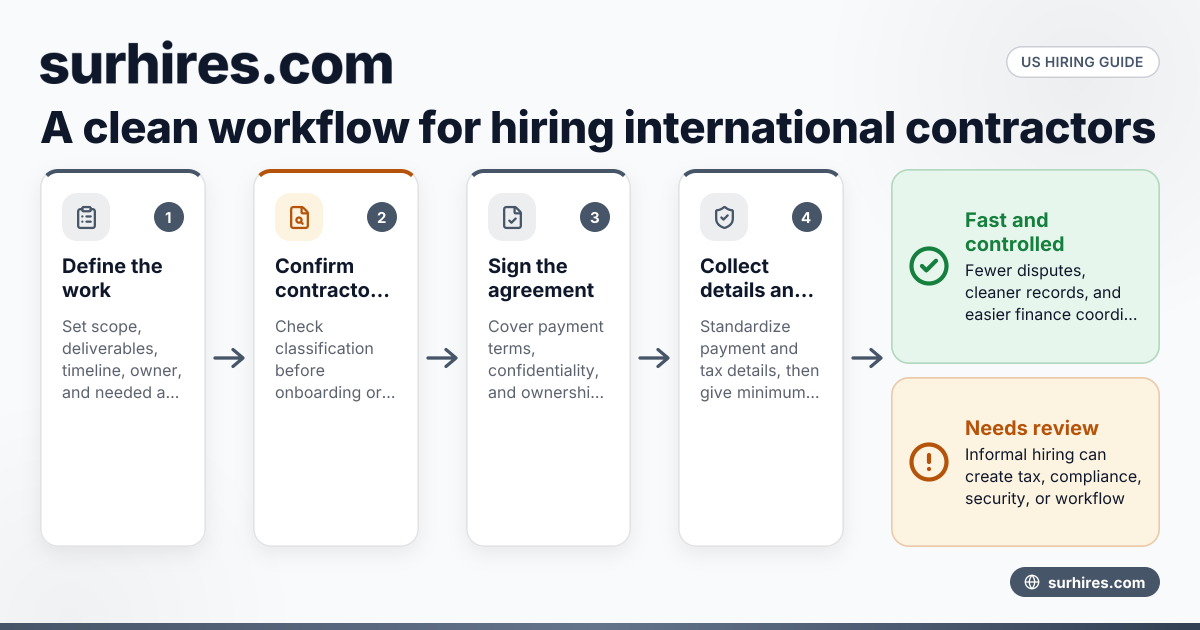
Hiring international contractors from the United States works best when you use a clear contractor agreement, verify classification, set a simple payment process, and keep strong records from day one. The goal is to move fast without creating tax, compliance, security, or workflow problems for your business.
Key takeaways
- The best way to hire international contractors from the United States is to standardize onboarding, contracts, payment approvals, and documentation.
- Start with worker classification first. A great hire can still create risk if the relationship looks like employment.
- Use written scopes, milestone-based payments, and documented ownership of deliverables.
- Build a repeatable finance process that fits common US tools like QuickBooks and Stripe.
- Protect customer and company data with limited access, clear security rules, and audit trails.
- A hiring workflow through surhires.com can help organize contractor sourcing and operations.
Why US businesses hire international contractors
US companies hire international contractors to access specialized skills, extend working hours, and control fixed payroll costs. This is common for software work, design, research, customer support, marketing operations, and back-office tasks.
A Chicago software company may need a niche developer for a six-month product build. A Houston distributor may need part-time ERP support for a systems rollout. A Detroit marketing team may need extra design capacity during a product launch. In each case, the business wants output and flexibility without adding a full-time domestic headcount.
That said, global contractor hiring is not just a sourcing decision. It is also an operations decision. The right process reduces delays, missed paperwork, payment disputes, and security gaps.
If you want to hire international contractors from the United States, think beyond finding talent. You need a full workflow that covers classification, contracts, onboarding, payments, data access, and recordkeeping.
What is the best way to hire international contractors from the United States?
The best way is to use a documented process: define the work, confirm contractor status, sign a contract, collect tax and payment details, control access, and pay against approved work. Keep each step consistent so finance, legal, and hiring managers stay aligned.
A lot of problems begin when teams skip structure in the name of speed. A manager finds a great contractor, starts work over email, and figures out paperwork later. That often leads to unclear deliverables, messy invoicing, and confusion over intellectual property.
A better approach is to treat contractor hiring like a lightweight procurement process.
Build the role around outcomes, not hours
Contractors should usually be engaged for deliverables, projects, or defined services. Write the scope around outcomes. Avoid vague terms like “help with marketing” or “support engineering as needed.”
Instead, define:
- The project or service
- Deliverables
- Acceptance criteria
- Timeline
- Review cadence
- Payment triggers
- Required tools and access
This matters for both operations and classification. The more a contractor relationship looks like a managed service with defined outputs, the easier it is to run cleanly.
Use one owner for the process
Many US businesses split responsibility across teams. Recruiting finds the person. The hiring manager sets the work. Finance pays invoices. IT grants access. Legal reviews the contract. Without one owner, things slip.
Assign one internal owner to move the file from approval to first payment. This can be someone in operations, HR, finance, or procurement depending on company size.
How do you stay compliant when you hire international contractors from the United States?
Start by confirming the worker is truly a contractor, not an employee, and use a written agreement that explains scope, payment terms, confidentiality, and ownership of work. Keep records of approvals, invoices, and communications so your process is defensible.
Compliance starts with classification. US businesses need to be careful not to manage contractors like employees. If your company controls work hours, requires constant supervision, supplies all tools, and folds the person into daily employee routines, the relationship can become risky.
Focus on classification before onboarding
Ask practical questions:
- Is the person engaged for a defined project or specialized service?
- Do they control how the work gets done?
- Can they use their own methods and tools?
- Are they paid by milestone, project, or invoice rather than salary-like payroll?
- Is the relationship documented as contractor services?
This is not just legal hygiene. It changes how you run the relationship day to day.
Use a contractor agreement that covers the essentials
Your agreement should clearly address:
- Scope of services
- Deliverables and deadlines
- Payment terms
- Invoice requirements
- Confidentiality
- Data use
- Ownership of deliverables and intellectual property
- Termination rights
- Dispute process
For US businesses, ownership language is especially important. If a contractor creates code, designs, content, or documentation, your contract should clearly state who owns the work product.
Keep tax documentation organized
Tax treatment depends on your specific facts, and many businesses review this with counsel or a qualified tax advisor. What matters operationally is having a standard packet and storing it in one place.
At minimum, your finance team should know:
- Who approved the contractor
- What entity is paying
- What services are provided
- Where invoices are stored
- What supporting documentation exists
For US businesses, 1099 workflows often come up in contractor discussions. Your exact obligations depend on your facts and the structure of the engagement, so use your accountant or tax advisor when setting policy. Do not wait until year-end to reconstruct records.
What should your hiring workflow look like?
Use a six-step workflow: define the need, vet the contractor, sign the agreement, collect payment and tax details, grant limited access, and approve invoices against deliverables. That keeps hiring fast while giving finance, IT, and managers a shared system.
Once you know the structure, build it into a repeatable workflow.
1. Define the work clearly
Start with a short intake document. It should include:
- Business purpose
- Scope
- Deliverables
- Budget owner
- Timeline
- Required systems access
- Manager responsible for acceptance
This prevents the common problem of hiring before the company knows what success looks like.
2. Vet the contractor for fit and risk
Review skills, experience, references if needed, and communication habits. For sensitive work, ask practical security questions. For example:
- Will they access customer data?
- Will they touch production systems?
- Will they use company devices or their own devices?
- Do they need access to Stripe, QuickBooks, or your CRM?
The goal is not to create a giant security review for every project. It is to match controls to risk.
3. Sign the agreement before work starts
Do not begin work on goodwill and emails alone. The agreement should be complete before access is granted or deliverables begin.
4. Collect payment and onboarding details
Standardize what you collect. This may include:
- Legal name and business details
- Contact information
- Invoice instructions
- Approved payment method
- Tax documentation required by your finance team
A simple checklist saves hours later.
5. Grant only the access they need
Give the minimum system access required for the project. Use separate accounts where possible. Remove access when the work ends.
For teams selling into larger US companies, this discipline also supports buyer expectations around security. Many procurement teams ask about data handling and access controls, and some expect mature practices that align with SOC 2-style controls.
6. Pay against approved work
Tie payments to milestones or approved invoices. The manager confirms the work. Finance confirms the documentation. Then payment is released.
This reduces disputes and makes month-end close easier.
Common mistakes US businesses should avoid
Most problems come from treating contractor hiring as informal. That creates avoidable cost and risk.
Mistake 1: Managing contractors like employees
If a contractor is handled like a full-time team member with fixed hours and close control, the line blurs quickly. Keep the relationship focused on outputs and agreed service terms.
Mistake 2: Starting work without a contract
This causes confusion over payment, revisions, ownership, and confidentiality. Even small engagements need written terms.
Mistake 3: Letting every manager invent a new process
When each department uses its own forms and payment rules, finance ends up cleaning up exceptions. Use one standard workflow across the business.
Mistake 4: Ignoring data access
A contractor may only need a shared folder and one app login. Do not hand over broad access because it is convenient.
Mistake 5: Waiting until year-end for documentation
If invoices, approvals, and tax records are scattered across inboxes, year-end reporting becomes painful. Build the file as you go.
How should you pay international contractors from the United States?
Pay through a documented business process with invoice approval, a clear payment method, and records stored in one place. The best setup is simple for the contractor and easy for your finance team to reconcile in QuickBooks and your bank records.
Payment is where many teams lose control. The hiring manager wants speed. Finance needs clean documentation. Contractors want predictable timing. You need a process that serves all three.
Use invoice-based payments
Invoice-based payments work well because they create a clear record. Each invoice should match the scope, milestone, or time period defined in the agreement.
A good invoice review process includes:
- Contractor submits the invoice
- Hiring manager confirms the work was delivered
- Finance checks required details
- Payment is approved and recorded
- Supporting files are stored with the invoice
Keep payment terms simple
Use consistent payment terms across the business when possible. If every contractor has different timing and approval rules, finance complexity grows fast.
Match payments to deliverables
For project work, milestone payments are often better than open-ended monthly arrangements. They make acceptance clearer and reduce disputes over incomplete work.
Reconcile everything to your accounting system
If your business runs on QuickBooks, make sure contractor payments are coded consistently. If payments relate to customer work, map them to the right project or department. If customer billing runs through Stripe, keep contractor costs visible so you can evaluate margin by service line.
Security and data controls matter more than most teams expect
International contractor hiring often starts as a staffing decision, but it quickly becomes a security decision. This is especially true if contractors handle customer data, internal financial information, sales records, or product systems.
Limit access from the start
Give contractors access only to what is required. Avoid shared passwords. Use named accounts and remove access promptly when the project ends.
Set written rules for data use
Your agreement or onboarding packet should explain:
- What data can be accessed
- What devices can be used
- Where files can be stored
- Whether subcontracting is allowed
- What happens at offboarding
Prepare for customer scrutiny
Larger buyers often ask vendors how they manage third-party access. If your business sells software, services, or manufacturing support, your buyer may ask basic security questions during procurement.
A clean contractor process helps you answer those questions with confidence.
When does it make sense to use a platform?
A platform can help when your team hires repeatedly, across multiple functions, or without a centralized operations team. It is especially useful when managers need a faster path from talent search to documented onboarding.
For example, a small business may handle one contractor manually. A growing company with ten managers hiring across engineering, marketing, design, and support usually needs more structure.
This is where teams may search terms like ai hire international because they want speed without losing control. The real value is not just faster sourcing. It is combining sourcing with a usable process for documentation, approvals, and ongoing management.
Signs you need more than spreadsheets and email
You may be outgrowing manual workflows if:
- Contractor records are stored in multiple places
- Finance chases managers for invoice approvals
- Contracts are inconsistent
- IT does not know who has access
- Offboarding is ad hoc
- Leadership cannot see total contractor spend
At that point, a more organized workflow can save time and reduce risk.
A practical checklist for US businesses
If you want a simple operating model, use this checklist.
Before hiring
- Define the project and deliverables
- Confirm budget owner and manager
- Review contractor classification risk
- Decide what systems access is needed
Before work starts
- Sign the contractor agreement
- Collect required payment and tax details
- Set invoice instructions
- Create a file for all documents
- Grant limited system access
During the engagement
- Review deliverables against the scope
- Approve invoices on a set schedule
- Store invoices and approvals together
- Update access if the scope changes
At the end of the project
- Confirm final delivery
- Pay the final approved invoice
- Remove system access
- Archive the contract, invoices, and approvals
This kind of discipline is what separates a clean contractor program from a messy one.
Final thoughts
The best way to hire international contractors from the United States is to make the process boring in the best sense. Clear scope, clean classification, written contracts, simple invoice approvals, and tight access controls will protect your business while helping managers move faster.
If you want a more organized way to source and manage contractor hiring workflows, learn more about how surhires.com supports businesses building repeatable hiring operations.
Frequently asked questions
Can I hire international contractors without setting up payroll?
In many cases, businesses engage contractors through invoice-based arrangements rather than payroll. The key issue is proper classification and documentation. Review your setup with legal or tax advisors before making it standard.
What is the biggest compliance risk?
Misclassification is often the biggest operational risk. If the relationship functions like employment, your business may face tax and legal issues. Good contracts help, but day-to-day management matters too.
Should I pay hourly or by milestone?
Milestones often work better for project-based contractor work because they tie payment to clear deliverables. Hourly billing can work for ongoing services, but it needs tighter review and approval controls.
Do I need a separate security process for contractors?
You need at least a basic one. Contractors should get only the access they need, and that access should be removed when the work ends. Sensitive work may require stronger controls and documentation.
Can a small business do this without a large operations team?
Yes. A small US business can run a strong contractor process with a standard agreement, a checklist, one approval owner, and organized records. The key is consistency, not complexity.
Published 7 October 2026
See Surhires on a live requisitionMore from the blog
What Is a Contractor of Record in the United States?
A contractor of record in the United States is a service provider that helps a business engage and manage independent contractors through a compliant.
8 October 2026 · 12 min read
How to Onboard Remote Contractors in the United States
Remote contractor onboarding in the United States means giving a contractor everything they need to start work quickly, legally, and securely without.
8 October 2026 · 12 min read
How to Hire 1099 Contractors in the United States
Hiring 1099 contractors in the United States means engaging self-employed workers for defined services without putting them on payroll as employees.
8 October 2026 · 12 min read