Guides
Contractor vs Employee in India: How Businesses Should Classify Remote Talent
A contractor is usually engaged for a defined scope of work, with more control over how the work is done. An employee usually works under the.
By The surhires.com team · · 12 min read
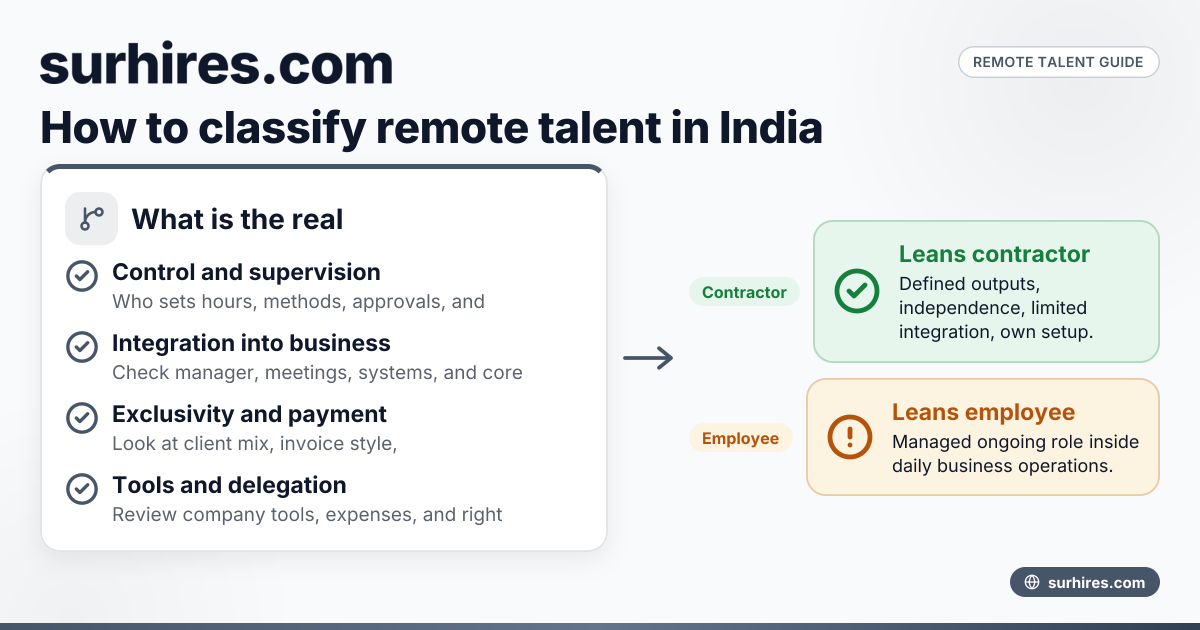
A contractor is usually engaged for a defined scope of work, with more control over how the work is done. An employee usually works under the company’s direction, follows set working methods, and becomes part of day-to-day operations. For Indian businesses hiring remote talent, getting this classification right matters for compliance, payments, data handling, and operational risk.
Key takeaways
- In India, classification depends more on the real working relationship than the label in the contract.
- Control, supervision, exclusivity, working hours, tools, and integration into the business are practical signals.
- Remote work does not automatically make someone a contractor or an employee.
- Wrong classification can create disputes over dues, taxes, benefits, confidentiality, and data access.
- A written agreement helps, but actual practice must match the agreement.
- Businesses should review roles regularly, especially when contractors start working like full-time team members.
What does contractor vs employee India really mean?
In simple terms, the question is this: are you buying a service, or are you hiring a person into your business?
A contractor usually delivers an outcome. An employee usually performs ongoing work under your supervision. That sounds simple, but many Indian businesses blur the line when they hire remote talent over WhatsApp, email, referrals, IndiaMART, or JustDial.
A common example is a Pune manufacturer hiring a remote designer for catalogue updates. If the designer works on a project basis, uses their own process, sends invoices, and serves multiple clients, that often looks closer to a contractor arrangement.
Now consider a remote sales coordinator working every day for the same business, using the company’s CRM, attending daily review calls, following a manager’s instructions, and handling leads from WhatsApp. Even if the agreement says “consultant”, the relationship may look more like employment.
That is why contractor vs employee India is not just a contract drafting issue. It is an operating model issue.
Why does classification matter for Indian businesses?
If you classify remote talent incorrectly, the risk is not only legal. It also affects how the business runs.
You may face disputes over:
- payment terms
- leave and attendance expectations
- notice periods
- confidentiality obligations
- ownership of work product
- reimbursement of expenses
- access to systems and customer data
For example, a Bengaluru startup may engage a remote developer as a contractor. Over time, that person starts working fixed hours, joins weekly planning, uses company devices, and handles customer data daily. The business may still pay against invoices, but the real arrangement has changed.
This can create problems if the relationship ends badly. The individual may claim they were treated like an employee. The business may discover that its contract does not match reality.
For Indian businesses, there is also a practical data issue. Remote workers often access customer names, phone numbers, addresses, bank details, and employee records. Under the DPDP Act 2023, businesses should take personal data handling seriously. Classification affects contracts, access controls, and accountability, even when the person works from another city.
How do you tell if a remote worker is a contractor or an employee?
Look at the real relationship, not just the title. If the business controls work hours, methods, reporting lines, and daily activity, the role may lean towards employee status. If the person controls how work is done and delivers defined outputs independently, it may lean towards contractor status.
Here are the main factors Indian businesses should review.
1. Control over work
This is often the first test in practice.
Ask:
- Who decides how the work is done?
- Who sets the daily schedule?
- Is there constant supervision?
- Does the person need approval for routine actions?
A contractor is usually responsible for results. An employee is usually managed in the process of getting those results.
2. Integration into the business
A remote person can still be deeply embedded in your team.
Signs of employee-like integration include:
- company email ID
- fixed reporting manager
- inclusion in daily stand-ups
- internal performance reviews
- long-term role in core operations
- use of internal HR or attendance systems
A contractor may interact with your team, but they are usually not woven into the business in the same way.
3. Exclusivity
If a person works only for your business for a long period, that can raise questions.
Many genuine contractors serve several clients. Exclusivity is not always decisive, but if your “contractor” works full-time only for you and is expected to remain available throughout the day, the arrangement may start resembling employment.
4. Payment structure
How you pay also matters.
A contractor often raises invoices linked to milestones, monthly retainers, or project deliverables. An employee is usually paid a salary or structured monthly compensation for ongoing work.
This does not mean invoice-based payments are always contractor payments. If the role otherwise looks like employment, invoicing alone will not solve the issue.
5. Tools and expenses
Contractors often use their own laptop, software, and working methods. Employees often use company tools or receive reimbursements under company policies.
Again, this is a signal, not a final answer. A remote contractor may need limited system access. But if the person depends fully on company infrastructure and follows internal processes every day, review the arrangement.
6. Right to delegate
A true contractor can often decide who performs the work, subject to quality and confidentiality needs. An employee is usually hired personally and cannot substitute someone else.
If your agreement says the person is an independent contractor but also requires personal service under close supervision, the document may contradict itself.
What are the biggest misclassification mistakes businesses make?
The biggest mistake is using a contractor agreement for convenience while running the role like a full-time job. The second mistake is not reviewing long-running remote engagements. If the work has become continuous, managed, and core to operations, the original classification may no longer fit.
Below are the mistakes that come up often.
Calling everyone a consultant
Some businesses believe that using words like “consultant”, “freelancer”, or “retainer” reduces compliance effort. It does not. Labels help only when they reflect the facts.
Setting fixed office-style rules for contractors
If remote contractors must log in at exact times, seek leave approval, attend all internal meetings, and follow detailed daily instructions, the business may be treating them like employees.
Using one template for every role
A marketing strategist, a telecaller, and a backend operations executive should not all be engaged the same way. Classification should reflect the nature of the role.
Forgetting ownership and confidentiality
Many disputes begin when work ends. Who owns the design files, code, reports, lead lists, or customer records? A proper agreement should address ownership, confidentiality, and return of access.
Ignoring data handling
If remote talent accesses personal data, the contract should set clear limits on use, storage, sharing, and deletion. This matters whether the person is a contractor or employee.
What should you put in the contract?
A strong contract does not guarantee correct classification, but it reduces confusion and risk. The document should match the reality of the working relationship.
For contractors
A contractor agreement should clearly cover:
- scope of work
- deliverables and timelines
- fees and invoicing
- payment terms
- confidentiality
- intellectual property ownership
- limited access to business systems
- data protection obligations
- termination rights
- dispute resolution
Avoid employee-style language unless it is genuinely needed.
For employees
An employment arrangement should typically define:
- role and responsibilities
- compensation structure
- working hours or expectations
- leave and holiday policy
- reporting line
- probation, if applicable
- confidentiality and IP
- company policies
- exit terms and handover
If your remote team uses Tally, Razorpay, internal dashboards, or customer WhatsApp accounts, document access rights properly.
ai contractor vs: can software decide classification for you?
No. Software can help you organise contracts, collect documents, and review role details, but it cannot safely replace legal and business judgment. The final classification should match how the person actually works in your business.
Tools can support consistency. They can prompt your team to check important facts before onboarding someone. But they cannot fix a badly designed role.
For example, a hiring manager may select “contractor” in a system because the budget is ₹50,000 per month and the person works remotely from Indore. That does not answer the real question. If that person is being supervised like a team member, handling core operations, and working only for the business, the risk remains.
Use systems to support decisions, not to avoid them.
How should businesses classify remote talent in practice?
Start with the role design, not the paperwork. Decide whether the business needs an outcome-based external service or a managed internal role. Then match the agreement, payment process, access rights, and supervision model to that decision.
Here is a practical process.
1. Define the business need
Ask whether you need:
- a project or specialist outcome
- a time-bound external service
- a long-term operating role inside the business
If the need is continuous and central, employee classification may be more suitable.
2. Review the six signals together
Do not rely on one factor. Review:
- control
- integration
- exclusivity
- payment style
- tools and expenses
- delegation rights
Write down your reasoning for each role.
3. Match the contract to reality
If the role is contractor-based, do not impose employee-like management structures without a good reason. If the role is employee-based, do not disguise it as a consultancy.
4. Set payment and documentation properly
For contractors, define invoice rules, milestones, and approval workflows. For employees, align compensation and internal records clearly.
For Indian SMEs, this step matters operationally. Finance teams often process contractor invoices differently from salaries. If your accounts are managed in Tally, make sure the ledger treatment reflects the correct engagement model.
5. Limit data and system access
Give access based on need.
A contractor doing a one-month SEO audit should not have the same access as a remote employee handling customer service daily. Apply least-access principles to files, dashboards, CRM tools, and shared drives.
6. Recheck the role every few months
This is where many businesses fail.
A three-month contractor engagement can quietly become an 18-month full-time arrangement. Review active roles at regular intervals and update the classification if the facts have changed.
A practical checklist for Indian SMEs
Use this quick test before onboarding remote talent.
Stronger signs of contractor status
- defined project or deliverable
- freedom over working method
- limited supervision
- invoice-based payment linked to work
- ability to work for other clients
- use of own tools
- limited integration into internal teams
Stronger signs of employee status
- fixed daily role in business operations
- direct manager and regular reviews
- set working hours
- continuous supervision
- exclusive or near-exclusive service
- business email and internal system access
- role is core to ongoing operations
If you tick many boxes in the second list, do not rely on a contractor label.
Can one person move from contractor to employee?
Yes. A role can begin as a genuine contractor arrangement and later become more like employment. This often happens when a business grows quickly and keeps expanding the person’s responsibilities.
For example, a Mumbai ecommerce business may hire a remote performance marketer for a three-month campaign. Later, that person starts managing the entire ad budget, joins leadership calls, handles agency coordination, and works only for that business. At that stage, the relationship should be reviewed.
Do not assume the first agreement will remain suitable forever.
How do payments, invoices, and records fit in?
Classification affects process discipline.
For contractors
You should usually maintain:
- signed service agreement
- scope and deliverable records
- invoices
- payment approvals
- access and confidentiality records
- termination and handover notes
If the contractor is tied to sales or marketing work, store communication carefully. WhatsApp approvals often create confusion later. Confirm key commercial points by email or signed documents.
For employees
You should maintain:
- appointment documentation
- compensation details
- policy acknowledgements
- leave and attendance records, where relevant
- access permissions
- exit records and asset handover
This is not just an admin exercise. Clean records help resolve disputes and improve finance control.
When should you get extra help?
You should get extra help when:
- the role is long-term and business-critical
- the person handles sensitive personal data
- the role has changed over time
- the contractor works only for you
- you want to convert a contractor into an employee
- there is a payment or notice dispute
Many businesses wait until a dispute begins. It is better to review the structure before the relationship becomes difficult.
If you are building a distributed team and want more practical hiring guidance, browse the surhires.com blog. Keep in mind that not every remote hiring article online will fit India-specific business realities.
Frequently asked questions
Is remote work automatically contractor work?
No. Remote work only describes where the person works. It does not decide whether the relationship is a contractor arrangement or employment.
Can I call someone a consultant to avoid employee classification?
No. The title helps only if it matches the facts. If the person works under your control as part of your business, the label alone will not decide the issue.
Does monthly payment mean the person is an employee?
Not by itself. Some contractors are paid monthly retainers. You must look at control, integration, exclusivity, and the overall structure of the role.
Is a full-time remote contractor always risky?
Not always, but it needs careful review. If the person works only for you, follows your schedule, and is managed like an internal team member, the classification risk becomes higher.
Should startups and SMEs review old contractor agreements?
Yes. This is especially important when the business has grown and roles have expanded. A contractor engaged for a short project can gradually become part of daily operations.
Can I use guides written for other markets for India?
Be careful. Many guides are written for other markets and use terms that do not fit Indian business practice. India-specific classification decisions should be based on Indian contracts, business processes, and compliance realities.
If you are hiring remote talent in India and want a cleaner, more practical process, learn more about surhires.com.
Published 7 October 2026
See Surhires on a live requisitionMore from the blog
What Is a Contractor of Record in the United States?
A contractor of record in the United States is a service provider that helps a business engage and manage independent contractors through a compliant.
8 October 2026 · 12 min read
How to Onboard Remote Contractors in the United States
Remote contractor onboarding in the United States means giving a contractor everything they need to start work quickly, legally, and securely without.
8 October 2026 · 12 min read
How to Hire 1099 Contractors in the United States
Hiring 1099 contractors in the United States means engaging self-employed workers for defined services without putting them on payroll as employees.
8 October 2026 · 12 min read